San Saba in Roma in Città metropolitana di Roma Capitale, Latium, Rome, Italy — Central Italy (Tyrrhenian Coast)
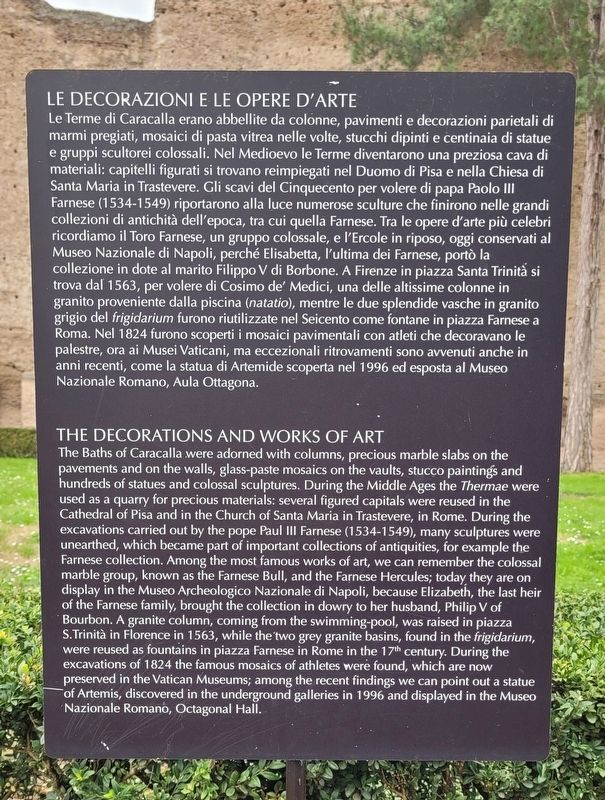
Le Decorazioni e le Opere D'arte
⎯⎯⎯
The Decorations and Works of Art
Photographed by James Hulse, February 27, 2024
1. Le Decorazioni e le Opere D'arte / The Decorations and Works of Art Marker

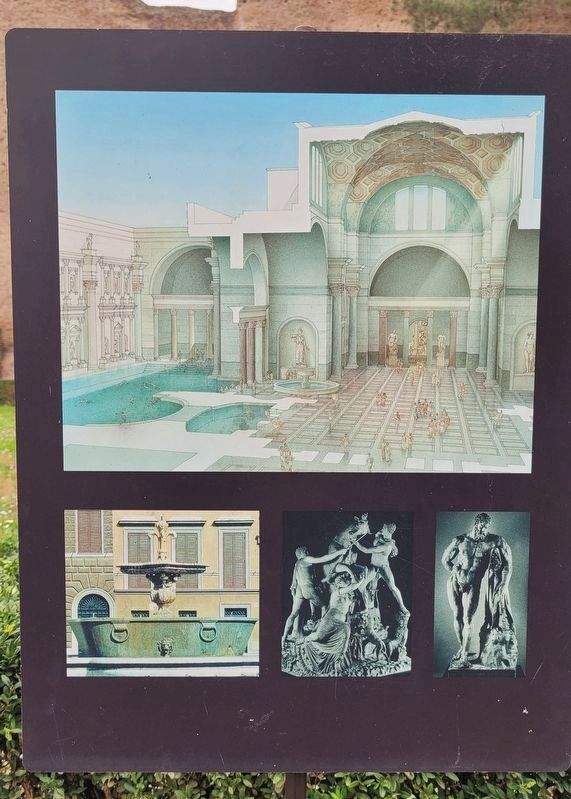
Le Terme di Caracalla erano abbellite da colonne, pavimenti e decorazioni parietali di marmi pregiati, mosaici di pasta vitrea nelle volte, stucchi dipinti e centinaia di statue e gruppi scultorei colossali. Nel Medioevo le Terme diventarono una preziosa cava di materiali: capitelli figurati si trovano reimpiegati nel Duomo di Pisa e nella Chiesa di Santa Maria in Trastevere. Gli scavi del Cinquecento per volere di papa Paolo III Farnese (1534-1549) riportarono alla luce numerose sculture che finirono nelle grandi collezioni di antichità dell'epoca, tra cui quella Farnese. Tra le opere d'arte più celebri ricordiamo il Toro Farnese, un gruppo colossale, e l'Ercole in riposo, oggi conservati al Museo Nazionale di Napoli, perché Elisabetta, l'ultima dei Farnese, portò la collezione in dote al marito Filippo V di Borbone. A Firenze in piazza Santa Trinita si trova dal 1563, per volere di Cosimo de' Medici, una delle altissime colonne in granito proveniente dalla piscina (natatio), mentre le due splendide vasche in granito grigio del frigidarium furono riutilizzate nel Seicento come fontane in piazza Farnese
this page online
The Baths of Caracalla were adorned with columns, precious marble slabs on the pavements and on the walls, glass-paste mosaics on the vaults, stucco paintings and hundreds of statues and colossal sculptures. During the Middle Ages the Thermae were used as a quarry for precious materials: several figured capitals were reused in the Cathedral of Pisa and in the Church of Santa Maria in Trastevere, in Rome. During the excavations carried out by the pope Paul III Farnese (1534-1549), many sculptures were unearthed, which became part of important collections of antiquities, for example the Farnese collection. Among the most famous works of art, we can remember the colossal marble group, known as the Farnese Bull, and the Farnese Hercules; today they are on display in the Museo Archeologico Nazionale di Napoli, because Elizabeth, the last heir of the
Photographed by James Hulse, February 27, 2024
2. Le Decorazioni e le Opere D'arte / The Decorations and Works of Art Marker
Diagrams of inside the Baths of Caracalla during its operation and photographs of Roman artwork
Topics. This historical marker is listed in this topic list: Anthropology & Archaeology. A significant historical year for this entry is 1563.
Location. 41° 52.821′ N, 12° 29.519′ E. Marker is in Roma, Lazio (Latium, Rome), in Città metropolitana di Roma Capitale. It is in San Saba. It is at the intersection of Viale delle Terme di Caracalla and Via Antonina on Viale delle Terme di Caracalla. The marker is located on the grounds to the Baths of Caracalla. Touch for map. Marker is in this post office area: Roma, Lazio 00153, Italy.
Photographed by James Hulse, February 27, 2024
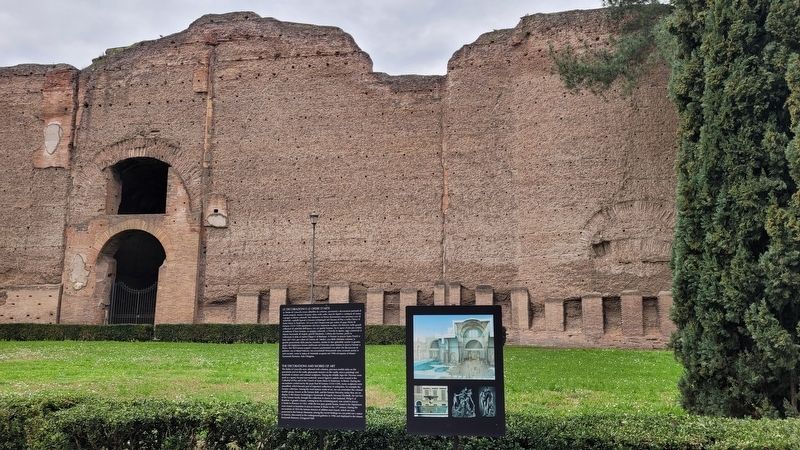
3. The view of the markers along the inner wall of the Baths of Caracalla

Regionally, it is in Europe, the European Union, the Schengen Area, a coastal Mediterranean country, and the Western World. Historically, it finds itself in what was once the Roman Empire.
Other nearby markers. At least 8 other markers are within walking distance of this marker: I Percorsi, I Sotterranei, Gli Impianti Idraulici (here, next to this marker); La Storia e il Contesto Urbano / The History of the Site and the Urban Context (a few steps from this marker); Terme di Caracalla - Rovine Attuali / Caracalla`s Baths - Actual Ruins (within shouting distance of this marker); Terme di Caracalla - Ricostruzione / Caracalla`s Baths - Reconstruction (within shouting distance of this marker); Palestra Occidentale / Western Gym (within shouting distance of this marker); Le Murature Romane / Roman Walls (about 90 meters away, measured in a direct line); Tabula Lusoria / Game Board (about 120 meters away); La Natatio E I Giochi / Swimming Pools and Games (about 120 meters away). Touch for a list and map of all markers in Roma.
More about this marker. There is a small entry fee to visit the Baths of Caracalla.
Also see . . . Baths of Caracalla.
Photographed by James Hulse, February 27, 2024
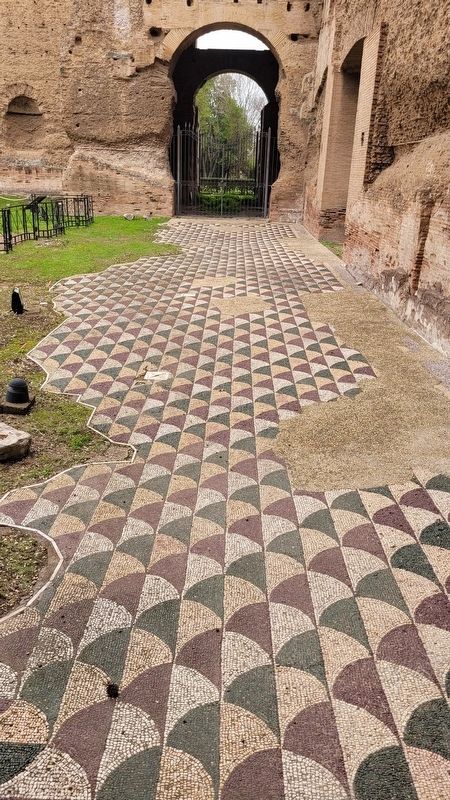
4. A view of the some of the floor tile in the Baths of Caracalla
The Baths of Caracalla (Italian: Terme di Caracalla) in Rome, Italy, were the city's second largest Roman public baths, or thermae, after the Baths of Diocletian. The baths were likely built between AD 212 (or 211) and 216/217, during the reigns of emperors Septimius Severus and Caracalla. They were in operation until the 530s and then fell into disuse and ruin.(Submitted on January 28, 2025, by James Hulse of Medina, Texas.)
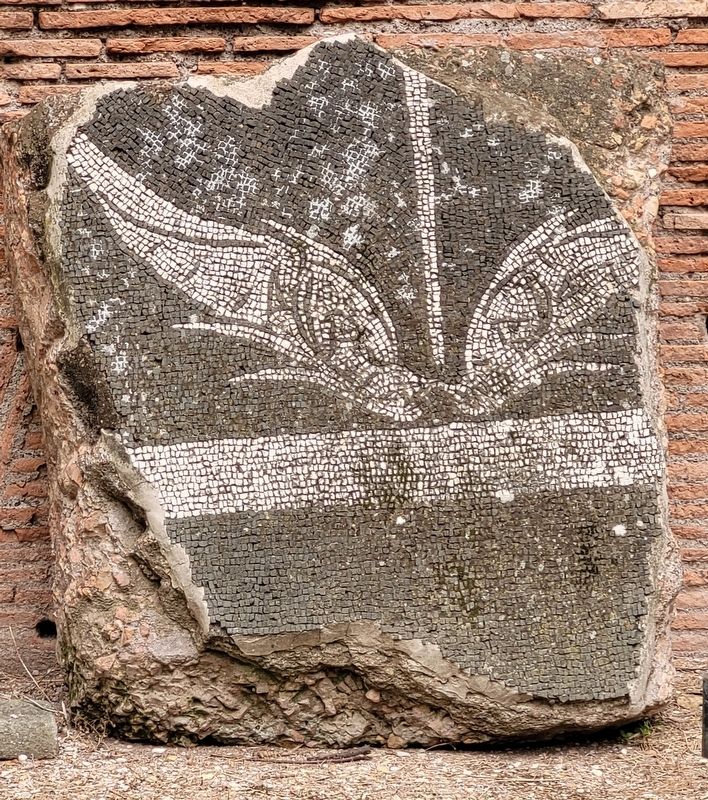
Photographed by James Hulse, February 27, 2024
5. Artwork of two fish inside the Baths of Caracalla
Credits. This page was last revised on January 29, 2025. It was originally submitted on January 28, 2025, by James Hulse of Medina, Texas. This page has been viewed 112 times since then and 16 times this year. Photos: 1, 2, 3, 4, 5. submitted on January 29, 2025, by James Hulse of Medina, Texas.
