San Saba in Roma in Città metropolitana di Roma Capitale, Latium, Rome, Italy — Central Italy (Tyrrhenian Coast)
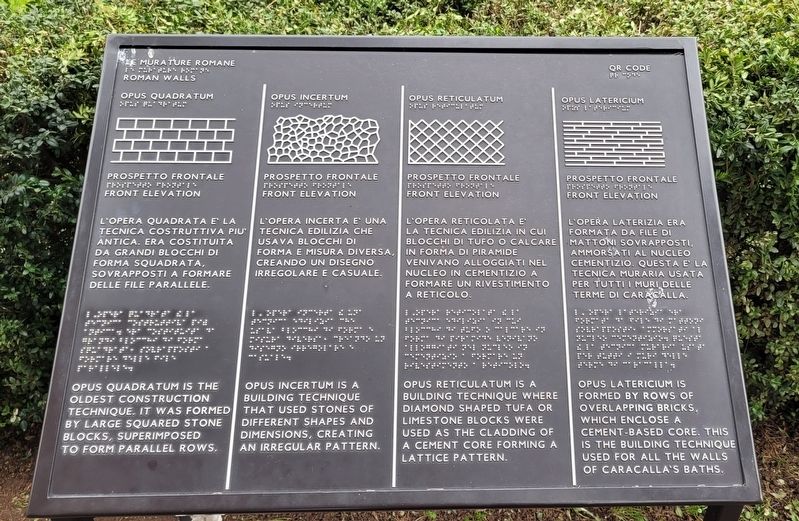
Le Murature Romane
⎯⎯⎯
Roman Walls
Photographed by James Hulse, February 27, 2024
1. Le Murature Romane / Roman Walls Marker

Opus Quadratum
Prospetto Frontale
L'opera quadrata è la tecnica costruttiva piu' antica. Era costituita da grandi blocchi di forma squadrata, sovrapposti a formare delle file parallele.
Opus Incertum
Prospetto Frontale
L'opera incerta è una tecnica edilizia che usava blocchi di forma e misura diversa, creando un disegno irregolare e casuale.
Opus Reticulatum
Prospetto Frontale
L'opera reticolata è la tecnica edilizia in cui blocchi di tufo o calcare in forma di piramide venivano alloggiati nel nucleo in cementizio a formare un rivestimento a reticolo.
Opus Latericium
Prospetto Frontale
L'opera laterizia era formata da file di mattoni sovrapposti, ammorsati al nucleo cementizio. Questa e la tecnica muraria usata per tutti i muri delle Terme di Caracalla.
Square Work
Front Elevation
Opus quadratum is the oldest construction technique. It was formed by large squared stone blocks, superimposed to form parallel rows.
Uncertain Work
Front Elevation
Opus incertum is a building technique that used stones of different shapes and dimensions, creating an irregular pattern.
Netted Work
Front
this page online
Opus reticulatum is a building technique where diamond shaped tufa or limestone blocks were used as the cladding of a cement core forming a lattice pattern.
Brickwork
Front Elevation
Opus latericium is formed by rows of overlapping bricks, which enclose a cement-based core. This is the building technique used for all the walls of Caracalla's Baths.
Topics. This historical marker is listed in this topic list: Anthropology & Archaeology.
Location. 41° 52.791′ N, 12° 29.476′ E. Marker is in Roma, Lazio (Latium, Rome), in Città metropolitana di Roma Capitale. It is in San Saba. It is at the intersection of Viale delle Terme di Caracalla and Via Antonina on Viale delle Terme di Caracalla. The marker is located on the grounds to the Baths of Caracalla. Touch for map. Marker is in this post office area: Roma, Lazio 00153, Italy. Touch for directions.

Regionally, it is in Europe, the European Union, the Schengen Area, a coastal Mediterranean country, and the Western World. Historically, it finds itself in what was once the Roman Empire.
Other nearby markers. At least
Photographed by James Hulse, February 27, 2024
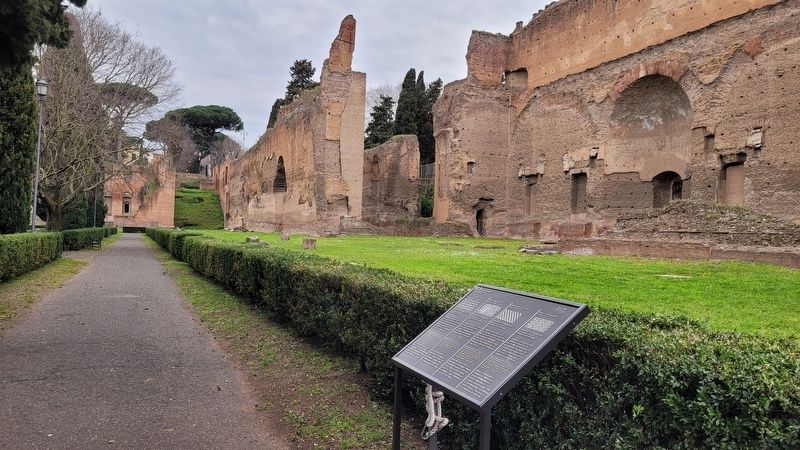
2. The view of the Roman Walls and Marker
More about this marker. There is a small entry fee to visit the Baths of Caracalla.
Also see . . . Baths of Caracalla. Wikipedia
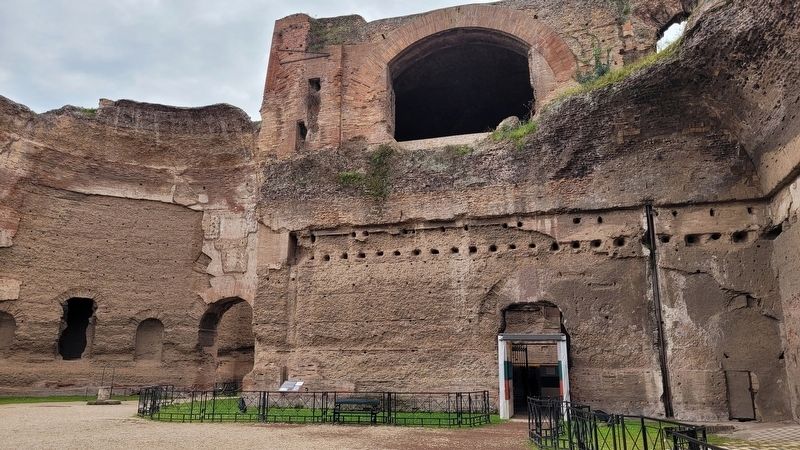
The Baths of Caracalla (Italian: Terme di Caracalla) in Rome, Italy, were the city's second largest Roman public baths, or thermae, after the Baths of Diocletian. The baths were likely built between AD 212 (or 211) and 216/217, during the reigns(Submitted on January 28, 2025, by James Hulse of Medina, Texas.)of emperors Septimius Severus and Caracalla. They were in operation until the 530s and then fell into disuse and ruin.Photographed by James Hulse, February 27, 20243. A view of the different building materials used at the Baths of Caracalla
Photographed by James Hulse, February 27, 2024
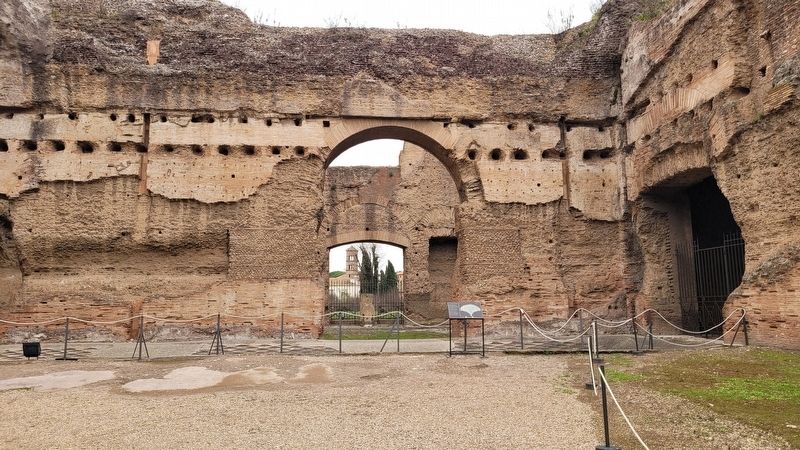
4. A view of inside the inner courtyard of the Baths of Caracalla
Credits. This page was last revised on January 29, 2025. It was originally submitted on January 28, 2025, by James Hulse of Medina, Texas. This page has been viewed 169 times since then and 60 times this year. Photos: 1, 2, 3, 4. submitted on January 29, 2025, by James Hulse of Medina, Texas.
