San Saba in Roma in Città metropolitana di Roma Capitale, Latium, Rome, Italy — Central Italy (Tyrrhenian Coast)
Tabula Lusoria
⎯⎯⎯
Game Board
Photographed by James Hulse, February 27, 2024
1. Tabula Lusoria / Game Board Marker

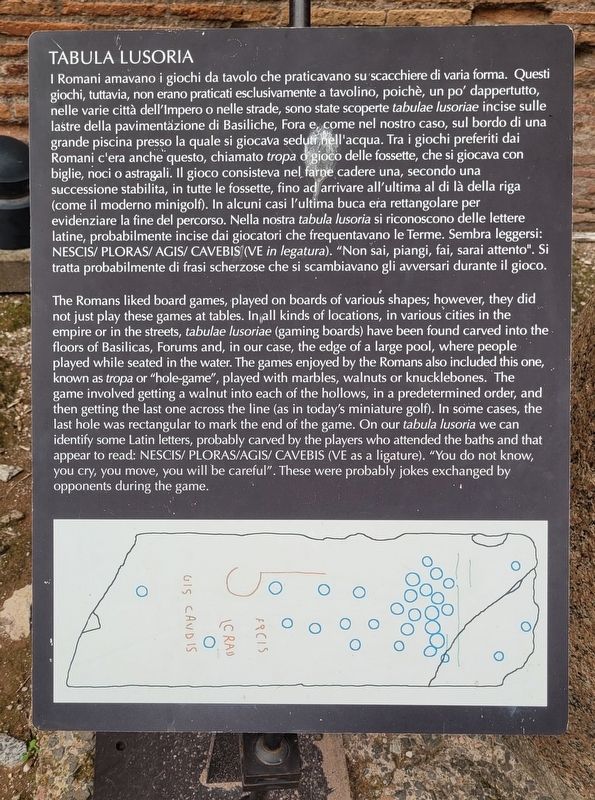
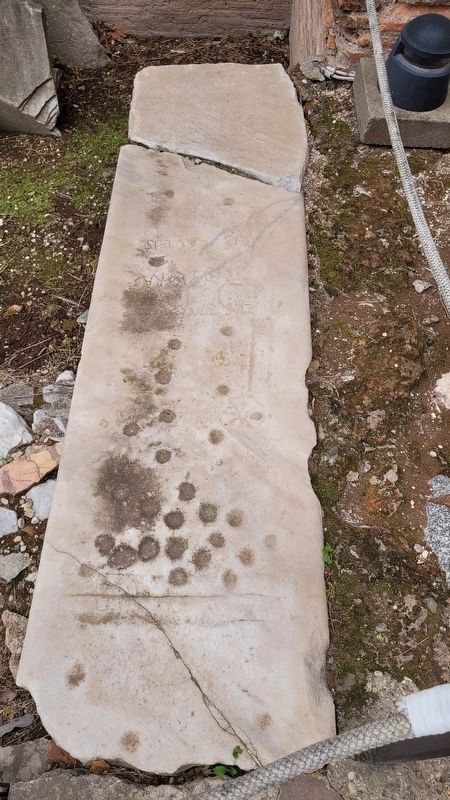
I Romani amavano i giochi da tavolo che praticavano su scacchiere di varia forma. Questi giochi, tuttavia, non erano praticati esclusivamente a tavolino, poiché, un po' dappertutto, nelle varie città dell'Impero o nelle strade, sono state scoperte tabulae lusoriae incise sulle lastre della pavimentazione di Basiliche, Fora e, come nel nostro caso, sul bordo di una grande piscina presso la quale si giocava seduti nell'acqua. Tra i giochi preferiti dai Romani c'era anche questo, chiamato tropa o gioco delle fossette, che si giocava con biglie, noci o astragali. Il gioco consisteva nel farne cadere una, secondo una successione stabilita, in tutte le fossette, fino ad arrivare all'ultima al di là della riga (come il moderno minigolf). In alcuni casi l'ultima buca era rettangolare per evidenziare la fine del percorso. Nella nostra tabula lusoria si riconoscono delle lettere latine, probabilmente incise dai giocatori che frequentavano le Terme. Sembra leggersi: Nescis/Ploras/Agis/Cavebis (VE in legatura). "Non sai, piangi, fai, sarai attento". Si tratta probabilmente di frasi scherzose che si scambiavano gli
this page online
The Romans liked board games, played on boards of various shapes; however, they did not just play these games at tables. In all kinds of locations, in various cities in the empire or in the streets, tabulae lusoriae (gaming boards) have been found carved into the floors of Basilicas, Forums and, in our case, the edge of a large pool, where people played while seated in the water. The games enjoyed by the Romans also included this one, known as tropa or "hole-game", played with marbles, walnuts or knucklebones. The game involved getting a walnut into each of the hollows, in a predetermined order, and then getting the last one across the line (as in today's miniature golf). In some cases, the last hole was rectangular to mark the end of the game. On our tabula lusoria we can identify some Latin letters, probably carved by the players who attended the baths and that appear to read: Nescis/Ploras/Agis/Cavebis (VE as a ligature). "You do not know, you cry, you move, you will be careful". These were probably jokes exchanged by opponents during the game.
Topics. This historical marker is listed
Photographed by James Hulse, February 27, 2024
2. Tabula Lusoria / Game Board and Marker
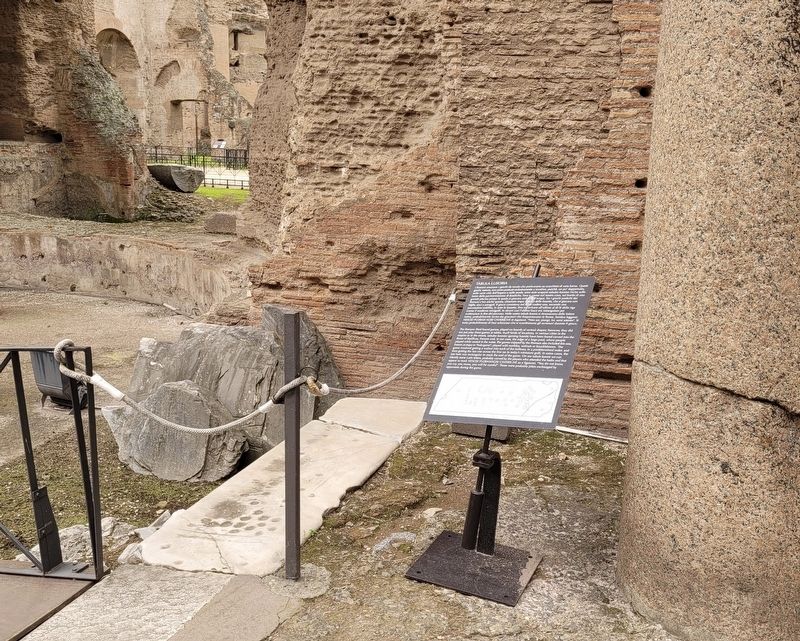
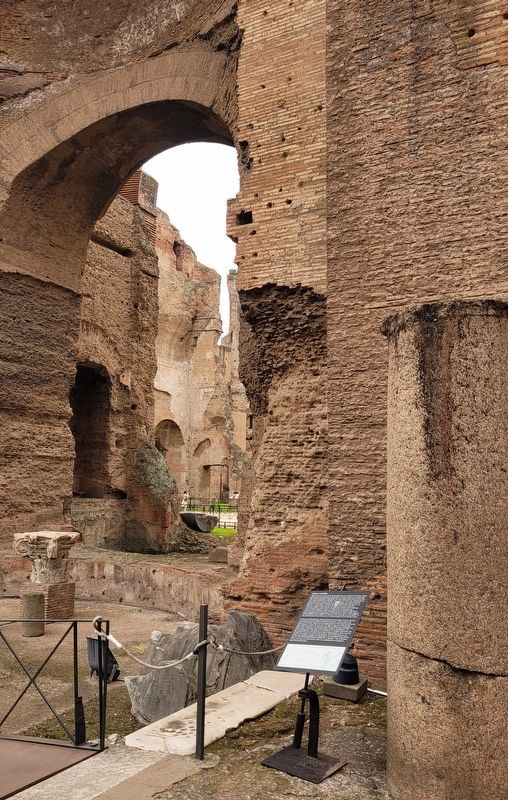
Location. 41° 52.79′ N, 12° 29.593′ E. Marker is in Roma, Lazio (Latium, Rome), in Città metropolitana di Roma Capitale. It is in San Saba. It is at the intersection of Viale delle Terme di Caracalla and Via Antonina on Viale delle Terme di Caracalla. The marker is located on the grounds to the Baths of Caracalla. Touch for map. Marker is in this post office area: Roma, Lazio 00153, Italy. Touch for directions.

Regionally, it is in Europe, the European Union, the Schengen Area, a coastal Mediterranean country, and the Western World. Historically, it finds itself in what was once the Roman Empire.
Other nearby markers. At least 8 other markers are within walking distance of this marker: La Natatio E I Giochi / Swimming Pools and Games (here, next to this marker); Natatio (a few steps from this marker); Frigidarium / Cold Room (within shouting distance of this marker); a different marker also named Frigidarium / Cold Room (within shouting distance of this marker); Palestra Occidentale / Western Gym (within shouting distance
Photographed by James Hulse, February 27, 2024
3. The Tabula Lusoria / Game Board and Marker
More about this marker. There is a small entry fee to visit the Baths of Caracalla.
Also see . . . Baths of Caracalla. Wikipedia
The Baths of Caracalla (Italian: Terme di Caracalla) in Rome, Italy, were the city's second largest Roman public baths, or thermae, after the Baths of Diocletian. The baths were likely built between AD 212 (or 211) and 216/217, during the reigns of emperors Septimius Severus and Caracalla. They were in operation until the 530s and then fell into disuse and ruin.(Submitted on January 28, 2025, by James Hulse of Medina, Texas.)
Photographed by James Hulse, February 27, 2024
4. Closeup of the Tabula Lusoria / Game Board
Credits. This page was last revised on January 29, 2025. It was originally submitted on January 28, 2025, by James Hulse of Medina, Texas. This page has been viewed 313 times since then and 79 times this year. Photos: 1, 2, 3, 4. submitted on January 29, 2025, by James Hulse of Medina, Texas.
