Reupelsdorf in Wiesentheid in Kitzingen, Bavaria, Germany — Central Europe
Mitten Durchs Dorf
⎯⎯⎯
Right Through the Village
Photographed by Andrew Ruppenstein, September 14, 2024
1. Mitten Durchs Dorf / Right Through the Village Marker

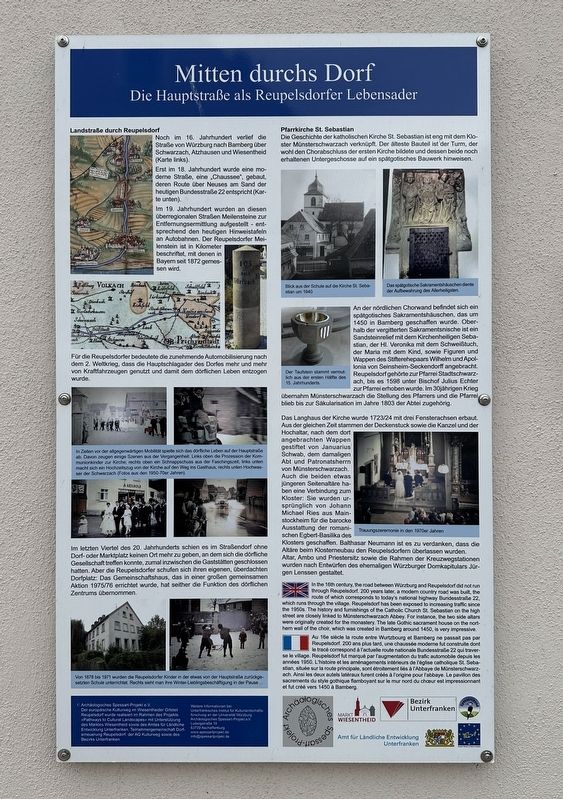
Landstraße durch Reupelsdorf
Noch im 16. Jahrhundert verlief die Straße von Würzburg nach Bamberg über Schwarzach, Atzhausen und Wiesentheid (Karte links).
Erst im 18. Jahrhundert wurde eine moderne Straße, eine „Chaussee“, gebaut, deren Route über Neuses am Sand der Bundesstraße 22 entspricht (Karte unten).
Im 19. Jahrhundert wurden an diesen überregionalen Straßen Meilensteine zur Entfernungsermittlung aufgestellt - entsprechend den heutigen Hinweistafeln an Autobahnen. Der Reupelsdorfer Meilenstein ist in Kilometer beschriftet, mit denen in Bayern seit 1872 gemessen wird.
Für die Reupelsdorfer bedeutete die zunehmende Automobilisierung nach dem 2. Weltkrieg, dass die Hauptschlagader des Dorfes mehr und mehr von Kraftfahrzeugen genutzt und damit dem dörflichen Leben entzogen wurde.
Für die Reupelsdorfer bedeutete die zunehmende Automobilisierung nach dem 2. Weltkrieg, dass die Hauptschlagader des Dorfes mehr und mehr von Kraftfahrzeugen genutzt und damit dem dörflichen Leben entzogen wurde.
Im letzten Viertel des 20. Jahrhunderts schien es im
this page online
Pfarrkirche St. Sebastian
Die Geschichte der katholischen Kirche St. Sebastian ist eng mit dem Kloster Münsterschwarzach verknüpft. Der älteste Bauteil ist der Turm, der wohl den Chorabschluss der ersten Kirche bildete und dessen beide noch erhaltenen Untergeschosse auf ein spätgotisches Bauwerk hinweisen.
An der nördlichen Chorwand befindet sich ein spätgotisches Sakramentshäuschen, das um 1450 in Bamberg geschaffen wurde. Oberhalb der vergitterten Sakramentsnische ist ein Sandsteinrelief mit dem Kirchenheiligen Sebastian, der Hl. Veronika mit dem Schweißtuch, der Maria mit dem Kind, sowie Figuren und Wappen des Stifterehepaars Wilhelm und Apollonia von Seinsheim-Seckendorff angebracht. Reupelsdorf gehörte zur Pfarrei Stadtschwarzach,
Photographed by Andrew Ruppenstein, September 14, 2024
2. Mitten Durchs Dorf / Right Through the Village Marker - wide view
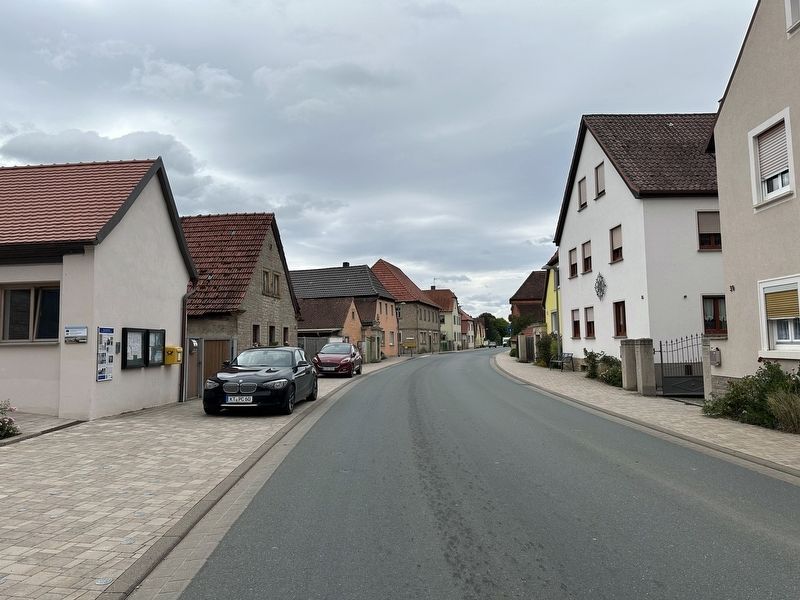
The marker is visible here on the left. Looking south on Hauptstraße.
Das Langhaus der Kirche wurde 1723/24 mit drei Fensterachsen erbaut. Aus der gleichen Zeit stammen der Deckenstuck sowie die Kanzel und der Hochaltar, nach dem dort angebrachten Wappen gestiftet von Januarius Schwab, dem damaligen Abt und Patronatsherrn von Münsterschwarzach. Auch die beiden etwas jüngeren Seitenaltäre haben eine Verbindung zum Kloster: Sie wurden ursprünglich von Johann Michael Ries aus Mainstockheim für die barocke Ausstattung der romanischen Egbert-Basilika des Trauungszeremonie in den 1970er Jahren Klosters geschaffen. Balthasar Neumann ist es zu verdanken, dass die Altäre beim Klosterneubau den Reupelsdorfern überlassen wurden. Altar, Ambo und Priestersitz sowie die Rahmen der Kreuzwegstationen wurden nach Entwürfen des ehemaligen Würzburger Domkapitulars Jürgen Lenssen gestaltet.
The Main Street as Reupelsdorf's Lifeline
A Country Road through Reupelsdorf
As recently as the 16th century, the road from Würzburg to Bamberg ran via Schwarzach, Atzhausen, and Wiesentheid (map left).
It wasn't until the 18th century that a modern road, a "Chaussee," was built, whose route via Neuses am Sand corresponds to Federal Highway 22 (map below).
In the 19th century, milestones were erected along these major roads to measure distances – similar to today's directional signs on highways. The Reupelsdorf milestone is marked in kilometers, the unit of measurement used in Bavaria since 1872.
For the residents of Reupelsdorf, the increasing motorization after World War II meant that the village's main thoroughfare was increasingly used by motor vehicles and thus removed from village life.
In the last quarter of the 20th century, it seemed that in the linear village without a village square or marketplace, there was no longer a place where the village community could meet, especially since the inns had closed. But the residents of Reupelsdorf created their own covered village square: The community center, built in a large community effort in 1975/76, has since taken over the function of the village center.
St. Sebastian Parish Church
The history of the Catholic Church of St. Sebastian is closely linked to Münsterschwarzach Abbey. The oldest part of the building is the tower, which likely formed the chancel end of the first church and whose two remaining lower stories point to a late Gothic structure.
On the north wall of the chancel is a late Gothic tabernacle, created in Bamberg around 1450. Above the grilled tabernacle niche is a sandstone relief depicting the church's patron saint, Sebastian, St. Veronica with the Veil of Veronica, the Virgin Mary with the Christ Child, as well as figures and the coat of arms of the donors, Wilhelm and Apollonia von Seinsheim-Seckendorff. Reupelsdorf belonged to the parish of Stadtschwarzach until it was elevated to a parish in 1598 under Bishop Julius Echter. During the Thirty Years' War, Münsterschwarzach Abbey assumed the role of parish priest, and the parish remained part of the abbey until secularization in 1803.
Reupelsdorf was part of the parish of Stadtschwarzach until it was elevated to a parish in its own right under Bishop Julius Echter in 1598. The nave of the church was built in 1723/24 with three window bays. The ceiling stucco, pulpit, and high altar date from the same period; the latter, according to the coat of arms displayed there, was donated by Januarius Schwab, the then abbot and patron of Münsterschwarzach Abbey. The two somewhat later side altars also have a connection to the abbey: they were originally created by Johann Michael Ries from Mainstockheim for the Baroque furnishings of the Romanesque Egbert Basilica, which was used for wedding ceremonies in the abbey during the 1970s. It is thanks to Balthasar Neumann that the altars were given to the people of Reupelsdorf when the abbey was rebuilt. The altar, ambo, priest's chair, and the frames of the Stations of the Cross were designed by Jürgen Lenssen, a former canon of Würzburg Cathedral.
Erected by Markt Wiesentheid.
Topics. This historical marker is listed in these topic lists: Religion & Religious Structures • Roads & Vehicles. A significant historical year for this entry is 1872.
Location. 49° 48.791′ N, 10° 17.441′ E. Marker is in Wiesentheid, Bayern (Bavaria), in Kitzingen. It is in Reupelsdorf. It is on Hauptstraße, on the right when traveling east. Touch for map. Marker is at or near this postal address: Hauptstraße 33, Wiesentheid BY 97353, Germany. Touch for directions.

Regionally, this marker is in German Franconia. Globally, it is in Europe, the European Union, Atlantic Europe, Central Europe, the Schengen Area, Western Europe, and the Western World. Historically, it finds itself in what was once the Holy Roman Empire and also the former West Germany.
Other nearby markers. At least 8 other markers are within 5 kilometers of this marker, measured as the crow flies: Kreuz von 1731 / Cross from 1731 (within shouting distance of this marker); Wiesentheid (approx. 4.3 kilometers away); Westtor / West Gate (approx. 4.3 kilometers away); Franz Alfons Wolpert (approx. 4.4 kilometers away); Luitpoldstrasse 12 (approx. 4.4 kilometers away); Luitpoldstrasse 5/7 (approx. 4.4 kilometers away); Stadtturm / City Tower (approx. 4.5 kilometers away); Karlsplatz 7 (approx. 4.5 kilometers away). Touch for a list and map of all markers in Wiesentheid.
Credits. This page was last revised on December 27, 2025. It was originally submitted on January 28, 2025, by Andrew Ruppenstein of Lamorinda, California. This page has been viewed 42 times since then and 15 times this year. Photos: 1, 2. submitted on January 28, 2025, by Andrew Ruppenstein of Lamorinda, California.
