Appalachian Trail
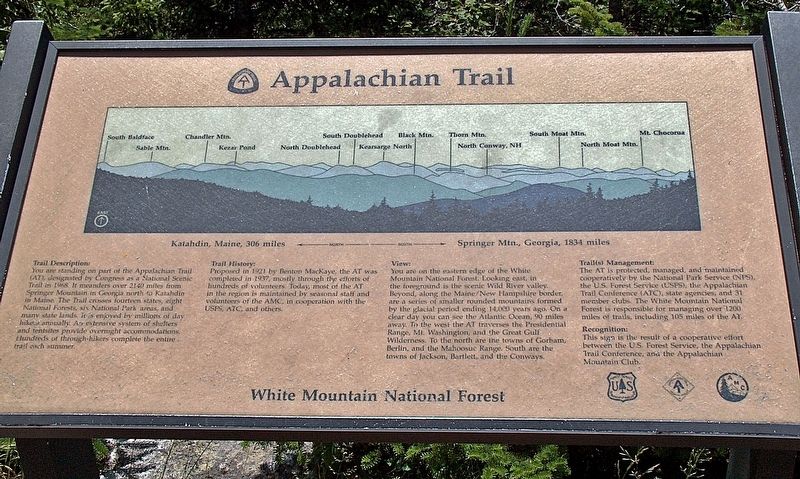
Katahdin, Maine, 306 miles (north) ↔ (south) Springer Mtn., Georgia, 1834 miles
| — | White Mountain National Forest | — |
Trail Description:
You are standing on part of the Appalachian Trail (AT), designated by Congress as a National Scenic Trail in 1968. It meanders over 2140 miles from Springer Mountain in Georgia north to Katahdin in Maine. The Trail crosses fourteen states, eight National Forests, six National Park areas, and many state lands. It is enjoyed by millions of day hikers annually. An extensive system of shelters and tentsites provide overnight accommodations. Hundreds of through-hikers complete the entire trail each summer.
Trail History:
Proposed in 1921 by Benton MacKaye, the AT was completed in 1937, mostly through the efforts of hundreds of volunteers. Today, most of the AT in the region is maintained by seasonal staff and volunteers of the AMC, in cooperation with the USFS, ATC, and others.
View:
You are on the eastern edge of the White Mountain National Forest. Looking east, in the foreground is the scenic Wild River valley. Beyond, along the Maine/New Hampshire border, are a series of smaller rounded mountains formed by the glacial period ending 14,000 years ago. On a clear day you can see the Atlantic Ocean, 90 miles away.
this page online
Trail(s) Management:
The AT is protected, managed, and maintained cooperatively by the National Park Service (NPS), the U.S. Forest Service (USFS), the Appalachian Trail Conference (ATC), state agencies, and 31 member clubs. The White Mountain National Forest is responsible for managing over 1200 miles of trails, including 105 miles of the AT.
Recognition:
This sign is the result of a cooperative effort between the U.S. Forest Service, the Appalachian Trail Conference, and the Appalachian Mountain Club.
Erected by U.S. Forest Service, the Appalachian Trail Conference, and the Appalachian Mountain Club.
Topics. This historical marker is listed in this topic list: Parks & Recreational Areas. A significant historical year for this entry is 1937.
Location. 44° 14.932′ N, 71° 13.488′ W. Marker is near Bean's Purchase, New Hampshire, in Coos County. It can be reached from White Mountain Road (New Hampshire Route


Regionally, this marker is in the White Mountains. It is also in the American Northeast and in New England. Globally, it is in North America, the Great North Woods, the Western Hemisphere, the Western World, and the Anglosphere. Historically, it finds itself in what was once one of the original Thirteen Colonies.
Other nearby markers. At least 8 other markers are within 8 miles of this marker, measured as the crow flies: First Ascent of Mount Washington (approx. 1.4 miles away); Presidential Range (approx. 2.8 miles away); 10th Mountain Division Memorial (approx. 4.1 miles away); Crawford Path (approx. 4.2 miles away); Mount Washington Summit (approx. 4.2 miles away); Mount Washington Cog Railway (approx. 6½ miles away); Stone Bridge (approx. 7.4 miles away); The Jackson Covered Bridge
Other markers no longer nearby. Northern Peaks of Presidential Range (was approx. 4.1 miles away but has been permanently removed); The Old Hero (was approx. 6.4 miles away but has been permanently removed).
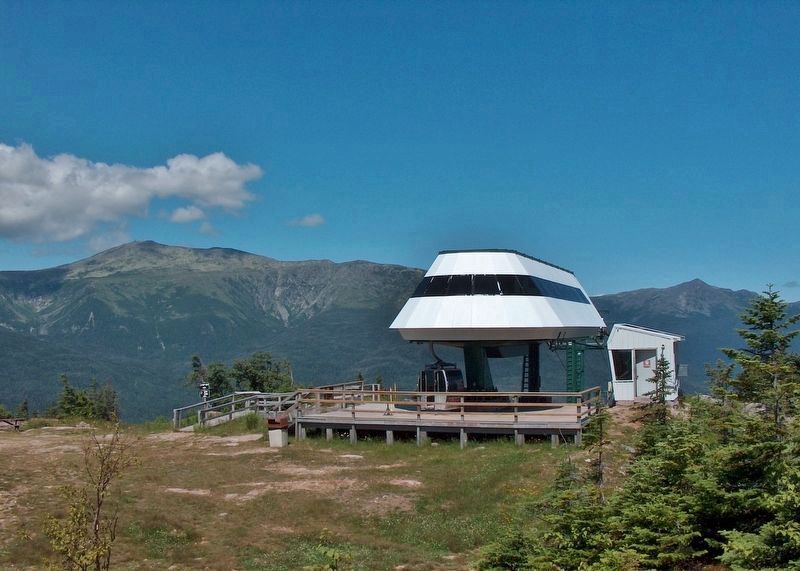
More about this marker. The easiest way to access this marker is via the Wildcat Mountain Resort ski lift, which terminates near the marker and lookout point.
Also see . . . A Brief History of the Appalachian Trail (thetrek.co).
Excerpt: In 1921 MacKaye made his ambitious vision public with his proposal: An Appalachian Trail: A Project in Regional Planning. Over the next several years MacKaye spent his time trying to gain support for his ambitious plans. In 1925 MacKaye eventually found enough like-minded individuals to organize the Appalachian Trail Conference (eventually becoming the Appalachian Trail Conservancy, ATC) and begin developing a plan of action for the heart of his proposal: a walking trail from New England to Georgia. Arthur Perkins, a retired judge from Connecticut, took control over the ATC from MacKaye near the end of the decade. It was Perkins’s efforts that attracted the attention of a Washington lawyer known as Myron Avery. Avery and a few other local supporters began mapping out a path for the trail through northern Virginia and West Virginia. Eventually, Avery succeeded Perkins as the head of the ATC and under his leadership the development efforts for the AT surged. Under Avery’s continued efforts the AT was finally connected as a continuous footpath stretching from Georgia to Maine on Aug. 14, 1937.(Submitted on January 29, 2025, by Cosmos Mariner of Cape Canaveral, Florida.)The following decade the trail was plagued with challenges. A hurricane in 1938 heavily damaged parts of the trail in the north. That same year Congress approved the extension of the Blue Ridge Parkway, which would ultimately displace nearly 120 miles of trail. Conflicts with the trail running through private lands also began to arise. Then, with the onset of World War II, progress on the trail was more or less halted for much of the decade with many volunteers’ efforts focused on the war. However, in 1948 new life was breathed into the trail by a man named Earl Shaffer. A recovering WWII veteran, Shaffer set out on the AT and became the first recorded thru-hiker in history — a feat that at the time was believed impossible. Throughout the 1950s and 1960s work on the trail continued, refining its path. Stanley Murray and Murray Stevens (who took the reins after Avery’s sudden passing), began to formulate federal legislation that would ensure the protection of the AT corridor. Their efforts paid off in 1968 when President Lyndon B. Johnson signed the National Trails System Act into law, making the Appalachian Trail the first national scenic trail under the National Park System (NPS).
Credits. This page was last revised on January 29, 2025. It was originally submitted on January 29, 2025, by Cosmos Mariner of Cape Canaveral, Florida. This page has been viewed 185 times since then and 27 times this year. Photos: 1, 2, 3. submitted on January 29, 2025, by Cosmos Mariner of Cape Canaveral, Florida.
Editor’s want-list for this marker. wide photo of the marker with context • Can you help?
