Passendale near Zonnebeke in West-Vlaanderen, Flanders, Belgium — Northwestern Europe
Tyne Cot Cemetery
The Tyne Cot Memorial
Photographed by Steve Stoessel, November 12, 2024
1. Tyne Cot Cemetery Marker
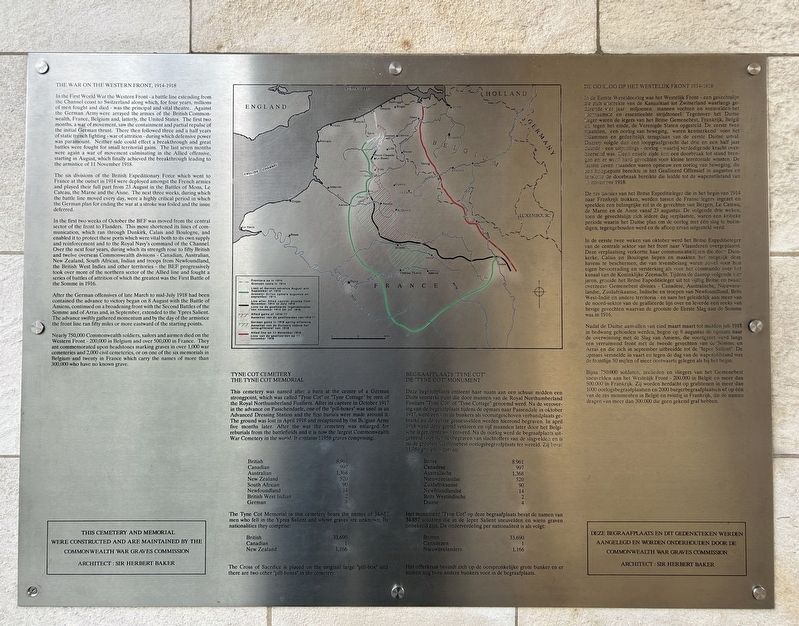
The War on the Western Front 1914-1918
In the First World War the Western Front a battle line extending from the Channel coast to Switzerland along which, for four years, millions of men fought and died - was the principal and vital theatre. Against the German Army were arrayed the armies of the British Common wealth. France, Belgium and, latterly, the United States The first two months a war of movement, saw the containment and partial repulse of the initial German thrust. There then followed three and a half years of static trench fighting - war of attrition - during which defensive power was paramount. Neither side could effect a breakthrough and great battles were fought for small territorial gains. The last seven months were again a war of movement cumulating In the Allied offensive starting in August, which finally achieved the breakthrough leading to the armistice of !! November 1918.
The six divisions of the British Expeditionary Force which went to France at the outset in l914 - were deployed amongst the French armies and played their full part from 23 August in the Battles of Mons, Le Cateau, the Marne
this page online
In the first two weeks of October the BEF was moved from the central sector of the front to Flanders. This move shortened its lines of communication, which ran through Dunkirk, Calais and Boulogne, and enabled it to protect these ports which were vital both to its own supply and reinforcement and to the Royal Navy's command of the Channel. Over the next four years, during which its strength rose to fifty British and twelve overseas Commonwealth divisions - Canadian, Australian, New Zealand, South African, Indian and troops from Newfoundland, the British West Indies and other territories - the BEF progressively took over more of the northern sector of the Allied line and fought a series of battles of attrition of which the greatest was the First Battle of the Somme in 1916.
After the German offensives of late March to mid-July 1918 had been contained, the advance to victory began on 8 August with the Battle of Amiens, continued
Photographed by Steve Stoessel, November 12, 2024
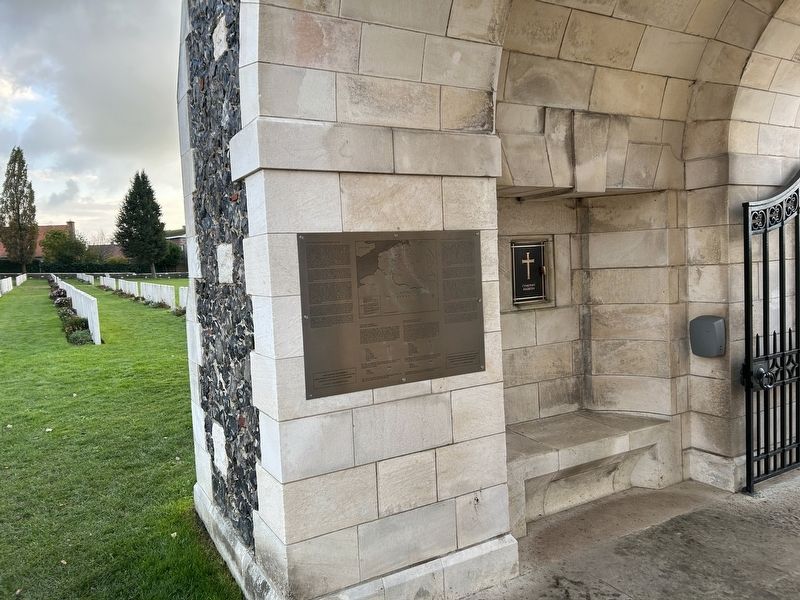
2. Tyne Cot Cemetery Marker
After the German offensives of late March to mid-July 1918 had been contained, the advance to victory began on 8 August with the Battle of Amiens, continued on a broadening front with the Second-Battles of the Somme and of Arras and, in September extended to the Ypres Salient. The advance swiftly gathered momentum and by the day of the armistice the front line ran fifty miles or more eastward of the staring points.
Nearly 750,000 Commonwealth soldiers, sailors and airmen died on the Western Front - 200,000 in Belgium and over 500.000 in France They are commemorated upon headstones marking graves in over 1.000 war cemeteries and 2,000 civil cemeteries, or on one of the six memorials in Belgium and twenty in France which carry the names of more than 300.000 who have no known grave.
The Tyne Cot Memorial
This cemetery was named after a barn at the centre of a German strongpoint, which was called "Tyne Cot" or "Tyne Cottage" by men of the Royal Northumberland Fusiliers. After its capture

Photographed by Steve Stoessel, November 12, 2024
3. Viewing the Cross of Sacrifice through the Portal at Tyne Cot
The ground was lost in April 1918 and recaptured by the Belgian Army five months later. After the war the cemetery was enlarged for reburials from the battlefields and it is now the largest Commonwealth War Cemetery in the world. It contains 11956 graves comprising 8,961 British, 997 Canadian, 1,368 Australian, 520 New Zealand, 90 South African,14 Newfoundland, 2 British West Indian and 4 German graves. The Tyne Cot Memorial in this cemetery bears the names of 34,857 men who fell in the Ypres Salient and whose graves are unknown. By nationalities they comprise 33,960 British, 1 Canadian and 1,1166 New Zealand.
The Cross of Sacrifice is placed on the original large "pill-box" and there are two other "pill-boxes" in the cemetery.
[Nederland]
De Oorlog op het Westelijk Front 1914-1918
In de Eerste Wereldoorlog was het Westelijk Front - een gevechtslijn die zich uitstrekte van de Kanaalkust tot Zwitserland waarlangs gedurende vier jaar miljoenen mannen vochten en sneuvelden-het
Photographed by Steve Stoessel, November 12, 2024
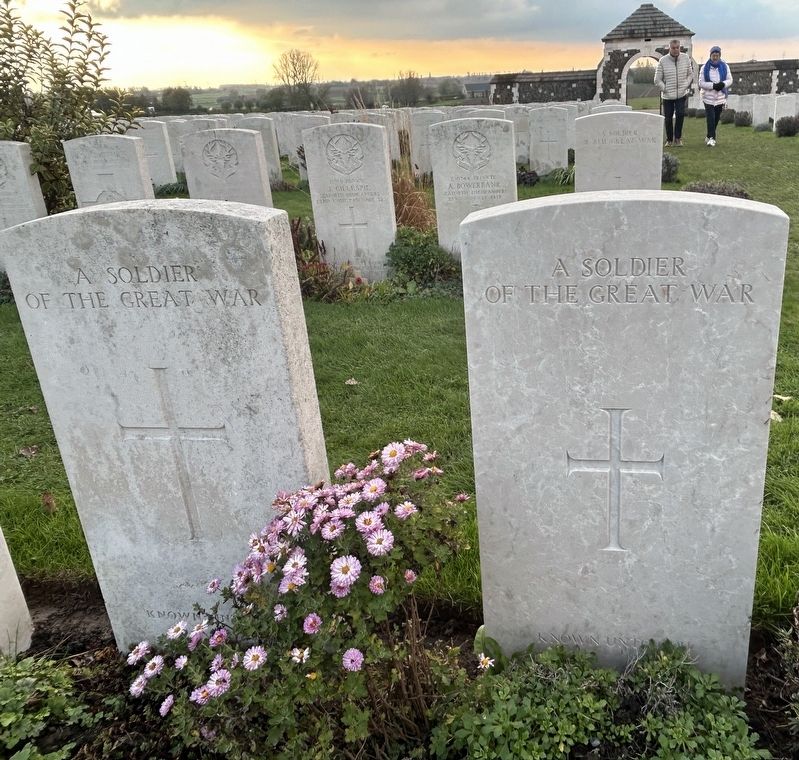
4. Tyne Cot Cemetery
De zes divisies van het Britse Expeditieleger die in het begin van 1914 naar Frankrijk trokken, werden tussen de Franse legers ingezet en speelden een belangrijke rol in de gevechten van Bergen, Le Cateau, de Marne en de Aisne vanaf 23 augustus. De volgende drie weken, toen de gevechtslijn zich iedere dag verplaatste, waren een kritieke periode waarin het Duitse plan om de oorlog met één slag te beëindigen, tegengehouden werd en de afloop ervan uitgesteld werd.
In de eerste twee weken van oktober werd het Britse Expeditieleger van de centrale sektor van het front naar Vlaanderen overgeplaatst. Deze verplaatsing verkortte haar communicatielijnen die door Duinkerke, Calais en Boulogne liepen en maakten het mogelijk deze havens te beschermen, die van levensbelang waren zowel voor hun eigen bevoorrading en versterking als voor het commando over het kanaal van de Koninklijke Zeemacht. Tijdens de daarop volgende vier jaren, groeide het Britse Expeditieleger uit tor vijftig Britse en twaalf overzeese Gemenebest divisies - Canadese, Australische, Nieuwzeelandse, Zuidafrikaanse, Indische en troepen van Newfoundland, Brits West-Indie en andere territoria - en nam het geleidelijk aan meer van de noord-sektor van de geallieerde lijn over en leverde een reeks van hevige gevechten waarvan de grootste de Eerste Slag aan de Somme was in 1916.
Nadat de Duitse aanvallen van eind maart maart tot midden juli 1918 in bedwang gehouden werden, begon op 8 augustus de opmars naar de overwinning met de Slag van Amiens, die voortgezet werd langs een verruimend front met de tweede gevechten van de Somme en Arras en die zich in september uitbreidde tot de "Ieper Salient". De opmars versnelde in vaart en tegen de dag van de wapenstilstand was de frontlijn 50 mijlen of meer oostwaarts gelegen als bij het begin.
Bijna 750.000 soldaten, zeelieden en vliegers van het Gemenebest sneuvelden aan het Westelijk Front - 200.000 in België en meer dan 500.000 in Frankrijk. Zij worden herdacht op grafstenen in meer dan 1000 oorlogsbegraafplaatsen en 2000 burgerbegraafplaatsen of op één van de zes monmenten in België en twintig in Frankrijk, die de namen dragen van meer dan 300.000 die geen gekend graf hebben.
De "Tyne Cot" Monument
Het monument "Tyne Cot" op deze begraafplaats bevat de namen van 34.857 soldaten die in de leper Salient sneuvelden en wiens graven onbekend zin. De onderverdeling per nationaliteit is als volgt 33.690 Britten. 1 Canadezen en 1.166 Nieuwzeelanders.
Het offerkruis bevindt zich op de oorspronkelijke grote bunker en er komen nog twee andere bunkers voor in de begraafplaats.
[tables converted to text.]
Topics and series. This memorial is listed in these topic lists: Cemeteries & Burial Sites • War, World I. In addition, it is included in the The Cross of Sacrifice series list.
Location. 50° 53.225′ N, 2° 59.872′ E. Memorial is near Zonnebeke, Vlaanderen (Flanders), in West-Vlaanderen. It is in Passendale. It can be reached from Tynecotstraat. Marker is in the rear of the cemetery on the portal that leads to the graves and memorial. Touch for map. Memorial is at or near this postal address: Tynecotstraat 35, Zonnebeke, Vlaanderen 8980, Belgium. Touch for directions.

Regionally, it is in Europe, the European Union, Atlantic Europe, the Benelux Low Countries, the Schengen Area, Western Europe, and the Western World. Historically, it finds itself in what was once the Roman Empire and specifically also the Holy Roman Empire.
Other nearby markers. At least 8 other markers are within walking distance of this marker: Tyne Cot Cemetery & Memorial (a few steps from this marker); a different marker also named Tyne Cot Cemetery & Memorial (a few steps from this marker); Flandern I-stellung (about 90 meters away, measured in a direct line); Tyne Cot Blockhouse (about 120 meters away); New Zealand Memorial (about 210 meters away); Sherwood Forresters (about 210 meters away); In Memory of the King’s Own Yorkshire Light Infantry (about 210 meters away); Bedfordshire Regiment (about 210 meters away). Touch for a list and map of all markers in Zonnebeke.
Credits. This page was last revised on January 30, 2025. It was originally submitted on January 30, 2025, by Steve Stoessel of Niskayuna, New York. This page has been viewed 188 times since then and 35 times this year. Photos: 1, 2, 3, 4. submitted on January 30, 2025, by Steve Stoessel of Niskayuna, New York.
