Oak Park in Cook County, Illinois — The American Midwest (Great Lakes)
Growing a Community: Principal John Hodge and the White Oak
"From a small seed a mighty trunk may grow." -Aeschylus

Photographed by Sean P. Flynn, October 20, 2023
1. Growing a Community: Principal John Hodge and the White Oak Marker
"Be respectful. Be responsible. Be safe... Everywhere. And as always, students, do your best."
—the Irving Eagle Essentials, shared daily by Mr. Hodge at the end of morning announcements
The white oak (Quercus alba)* is the state tree of Illinois and is native to (grows naturally in) this part of the country. Being a native tree, it is perfectly adapted to the climate and conditions of this region and is an important part of the ecosystem. These trees can reach nearly 100 feet tall and live up to 300 years!
Beneath its large, spreading branches, a single white oak tree is a community unto itself.
this page online
Oak trees host more than 530 species of caterpillars—more than any other tree! They are also home to many other insect species, such as beetles, and arthropods like spiders. This makes oak trees a favorite dining destination of bug-eating birds. In addition, the acorn is part of the winter diet of many birds, including blue jays and woodpeckers, as well as animals like squirrels.
Oak trees are deciduous—shedding their leaves each autumn—and are considered one of the strongest trees for shelter because of their large branches, broad leaves, and tendency to keep their leaves longer into the fall than many other trees. Oaks are also incredibly durable (even when dead), as they have a high resistance to diseases and insects. Because of this, oaks are also a popular nesting location for breeding birds (including cavity nesters that may find a hole within the trunk). When it comes to attracting and sustaining birds, there is arguably no better option than an oak tree. If you're

Photographed by Sean P. Flynn
2. John Hodge marker and its oak tree
*All living creatures have a common name and a scientific name. Humans have many common names—people, Earthlings, humankind, children, students, Americans, Oak Parkers—depending on their geography, personal preference, history, and circumstance. But we have only one scientific name: Homo sapiens. A scientific name allows us to indicate exactly which creature we are talking about. Say Quercus alba to a plant scientist, and they'll know the tree you mean. Say stave oak (another name for white oak), and they might not.
Birds Commonly Found in Oak Trees
• Baltimore Oriole
• Brown Thrasher
• Downy Woodpecker
• Northern Flicker
• Red-Bellied Woodpecker
• Rose-Breasted Grosbeak
• Ruby-Throated Hummingbird
• Scarlet Tanager
• Tufted Titmouse
• Warblers
• White-Breasted Nuthatch
Black and White Warbler:
Found in Illinois in the spring and summer, these birds winter in areas from the southern United States to northern South America. They return to Illinois in late March or early April.
Scarlet Tanager:
This lovely bird winters in South America, from Columbia and Bolivia
Photographed by Sean P. Flynn
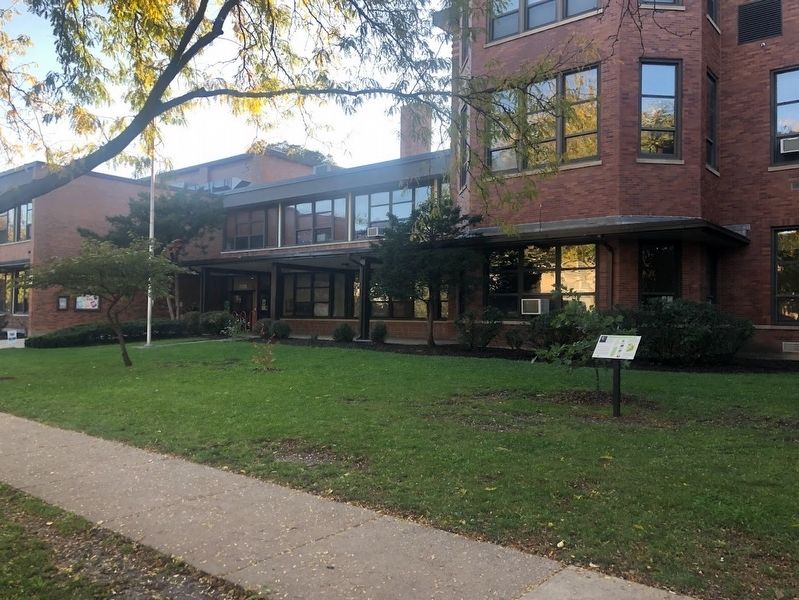
3. Irving School in Oak Park, IL
Katydid
A variety of tiny moth species, walking sticks, and katydids grow into adults on the oak tree's leaves and branches. These insects add to forest ecosystems and provide more types of food for birds.
The white oak is monoecious, which means that sepa (staminate) and female (pistillate) flowers are produced on the same tree. Male flowers are the greenish-yellow catkins about 2-3½ inches long that develop near the tips of last year's branches. Greenish-red female flowers are produced at the tips of new shoots on very short stalks (less than 1/8-inch long) called peduncles. These flowers bloom in the spring for one to two weeks, and they are cross-pollinated by the wind. This process creates the fruit of the white oak, which is the acorn.
This white oak was planted to honor beloved Irving Elementary School Principal John Hodge upon his retirement after the 2021-2022 school year and is made possible by generous donations from South East Oak Park Community Organization (SEOPCO) and individual Oak Park community members. SEOPCO's mission is To create a positive identity for South East Oak Park and to empower its citizens to act on behalf of their neighborhood.
Erected 2022 by South East Oak Park Community Organization (SEOPCO).
Topics. This historical marker is listed in these topic lists: Animals • Education • Environment • Horticulture & Forestry. A significant historical year for this entry is 2022.
Location. 41° 52.095′ N, 87° 46.98′ W. Marker is in Oak Park, Illinois, in Cook County. It is on South Cuyler Avenue 0.1 miles south of Harvard Street. The marker is in front of Irving Elementary School. Touch for map. Marker is at or near this postal address: 1125 South Cuyler Avenue, Oak Park IL 60304, United States of America. Touch for directions.

Regionally, this marker is in Greater Chicago. It is also in the American Midwest. Globally, it is in North America, on the Great Lakes, in the Western Hemisphere, in the Western World, and in the Anglosphere. Historically, it finds itself in what was once the Viceroyalty of New France, the territory of the Mississippian Culture, and the Northwest Territory.
Other nearby markers. At least 8 other markers are within walking distance of this marker: The New [Green] Bungalow (approx. 0.3 miles away); "Family-Style" Electric Home (approx. 0.3 miles away); Oak Park Conservatory (approx. 0.4 miles away); FitzGerald's Nightclub (approx. 0.4 miles away); A Brief History of FitzGerald's (approx. 0.4 miles away); Elvira Rubinstein (approx. 0.4 miles away); Staff Sergeant John Thomas Brennan (approx. half a mile away); Gold Star Men of the World War (approx. 0.6 miles away). Touch for a list and map of all markers in Oak Park.
Another marker is no longer nearby. Milly's Pizza in the Pan (was approx. 0.6 miles away but has been permanently removed).
Also see . . . Tall and mighty just like Irving Principal John Hodge. An article about the tree's unveiling from the Wednesday Journal of Oak Park and River Forest (Submitted on January 31, 2025, by Sean P. Flynn of Oak Park, Illinois.)
Credits. This page was last revised on January 31, 2025. It was originally submitted on January 31, 2025, by Sean P. Flynn of Oak Park, Illinois. This page has been viewed 137 times since then and 22 times this year. Photos: 1, 2, 3. submitted on January 31, 2025, by Sean P. Flynn of Oak Park, Illinois.
