
Near Ieper in West-Vlaanderen, Flanders, Belgium — Northwestern Europe
Lieutenant-Colonel John McCrae
1872-1918
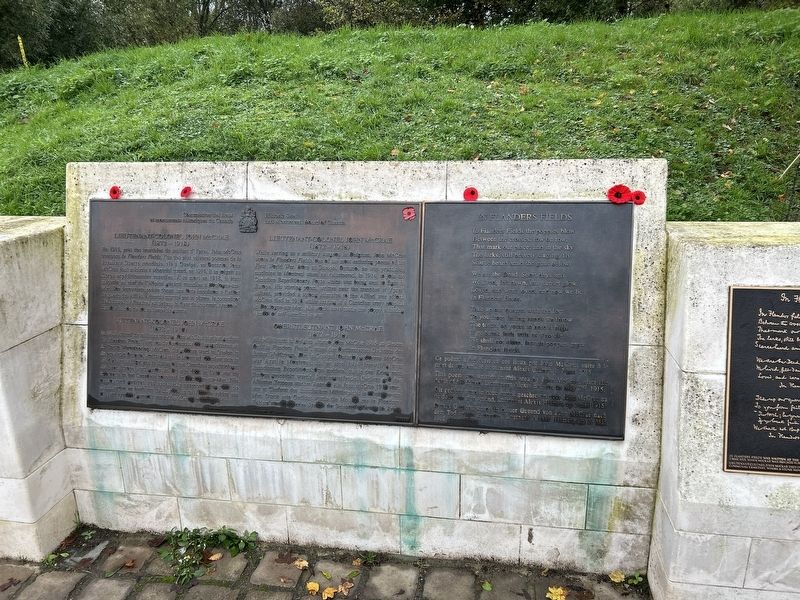
Photographed by Steve Stoessel, November 12, 2024
1. Lieutenant-Colonel John McCrae Marker

Lieutenant-Colonel John McCrae (1872 - 1918)
En 1915, près des tranchées du saillant d'Ypres, John McCrae composa In Flanders Fields, l'un des plus célèbres poèmes de la Première Guerre mondiale. Né à Guelph, en Ontario, John McCrae était médecin a Montréal quand, en 1914, il se joignit au Corps expéditionnaire canadien, À sa mort en 1918, il était médecin en cher de l'Hôpital général canadien à Boulogne-sur-Mer. Son émouvante poésie dona une forte impulsion à l'effort de guerre des Alliés. À jamais marqué par sa plume, le coquelicot des champs de Flandres est devenu la fleur du souvenir, symbole durable du don de soi en temps de guerre.
In 1915 scheer de militaire chirurg John McCrae hier her gedicht In Flanders Fields, een van de beroemdste oorlogsgedichten uit de Eerste Wereldoorlog. McCrae, die geboren werd in Guelph in de provincie Ontario, werkte als arts in Montreal vooraleer zich in 1914 als vrijwilliger aan te sluiten bij her Canadese expeditieleger dar naar Europa werd gezonden, Bij zijn dood in 1918 was hij hoofdarts in het Canadese hospitaal in Boulogne-sur-Mer.
this page online
While serving as a military surgeon in Belgium, John McCrae wrote In Flanders Fields, one of the most enduring poems of the First World War. Born at Guelph, Ontario, he was practicing medicine in Montreal when he volunteered, in 1914, to join the Canadian Expeditionary Force which was being sent to fight in Europe. His stirring poem, written near the trenches at Ypres’ salient, provided a strong stimulus to the Allied war effort. McCrae died in 1918 while serving at a Canadian army hospital in Boulogne sur-Mer. His words have made the poppy a lasting symbol of self-sacrifice in war.
Als Militärarzt in Belgien schrieb John McCrae 1915 an diesem Ort "In Flanders Fields", eines der berühmtesten Gedichte des Ersten Weltkriegs. Der in Guelph (Ontario) geborene McCrae war Arzt in Montreal, als er sich 1914 freiwillig zum kanadischen Expeditionskorps meldete, das in den
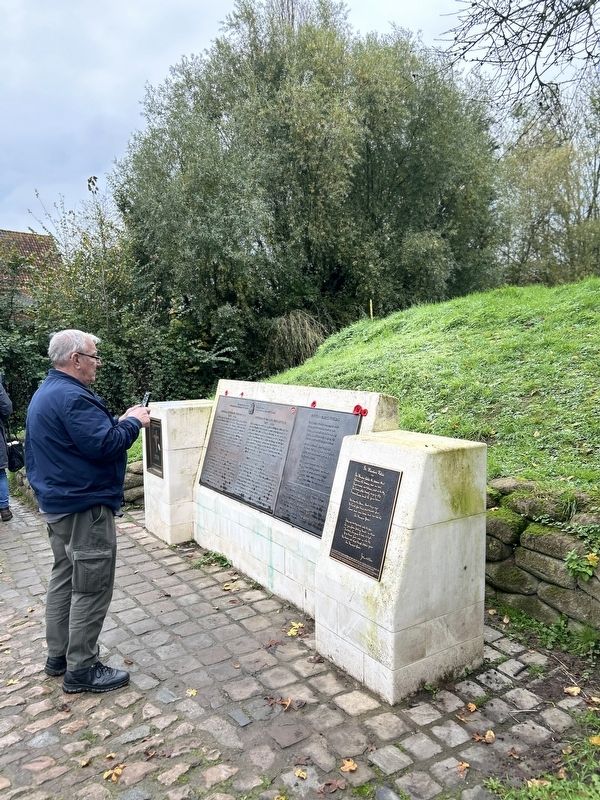
Photographed by Steve Stoessel, November 12, 2024
2. Lieutenant-Colonel John McCrae Marker
In Flanders Fields the poppies blow
Between the crosses, row on row,
That mark our place; and in the sky
The larks, still bravely singing, fly
Scarce heard amid the guns below.
We are the Dead. Short days ago
We lived, felt dawn, saw sunset glow,
Loved, and were loved, and now we lie
In Flanders Fields.
Take up our quarrel with the foe:
To you from failing hands we throw
The torch, be yours to hold it high.
If ye break faith with us who die
We shall not sleep, though poppies grow
In Flanders fields.
Erected by Commission of Historic Sites and Monuments Board of Canada.
Topics and series. This memorial is listed in these topic lists: Science & Medicine • War, World I. In addition, it is included in the In Flanders Fields series list.
Location. 50° 52.297′ N, 2° 52.391′ E. Memorial is near Ieper, Vlaanderen (Flanders), in West-Vlaanderen. It can be reached from the intersection of Diksmuidseweg (National Route 313) and Nordorring. Touch for map. Memorial is at or near this postal address: Diksmuidseweg 148, Ieper, Vlaanderen 8900, Belgium. Touch for directions.

Regionally, it is in Europe, the European Union, Atlantic Europe, the Benelux Low Countries, the Schengen Area, Western Europe, and the Western World. Historically, it finds itself in what was once the Roman Empire and specifically also the Holy Roman Empire.
Other nearby markers. At least 8 other markers are within 3 kilometers of this marker, measured as the crow flies: In Flanders Fields (here, next to this marker); McCrae Site, the Canal Bank 1914-1918 / Site McCrae de Canadijk 1914-1918 (a few steps from this marker); Medische hulppost John McCrae / Medical Aid Post John McCrae (within shouting distance of this marker); Kanaaldijk - Site John McCrae (within shouting distance of this marker); 49th (West Riding) Division Memorial / Gedenkteken 49ste (West Riding) Divisie (within shouting distance of this marker); Essex Farm Cemetery (within shouting distance of this marker); 49th West Riding Division (about 90 meters away, measured in a direct line); St. George’s Memorial Church (approx. 2.3 kilometers away). Touch for a list and map of all markers in Ieper.
Credits. This page was last revised on February 3, 2025. It was originally submitted on February 2, 2025, by Steve Stoessel of Niskayuna, New York. This page has been viewed 116 times since then and 7 times this year. Photos: 1, 2. submitted on February 2, 2025, by Steve Stoessel of Niskayuna, New York.
