Near Jackson in Cape Girardeau County, Missouri — The American Midwest (Upper Plains)
They Passed This Way
Trail of Tears State Park
| — | Trail of Tears National Historic Trail | — |
Photographed by Jason Voigt, February 1, 2025
1. They Passed This Way Marker
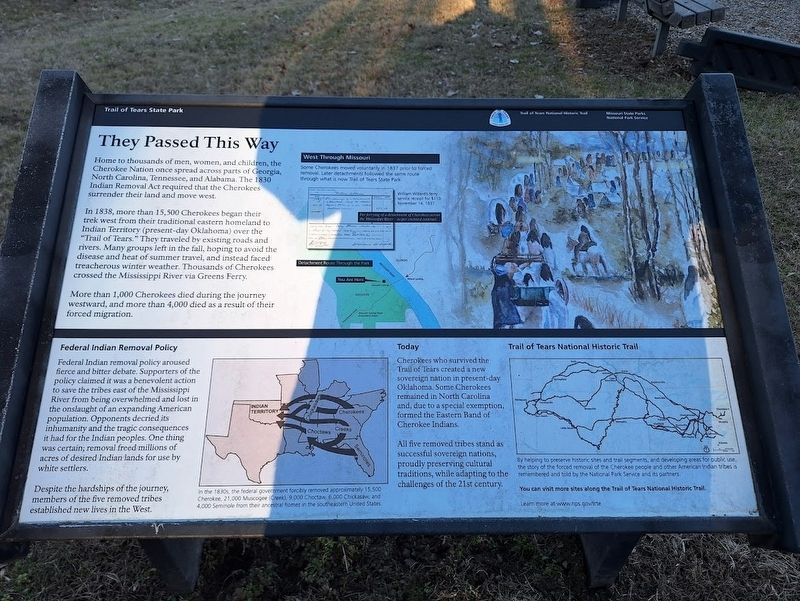
Home to thousands of men, women, and children, the Cherokee Nation once spread across parts of Georgia, North Carolina, Tennessee, and Alabama. The 1830 Indian Removal Act required that the Cherokees surrender their land and move west.
In 1838, more than 15,500 Cherokees began their trek west from their traditional eastern homeland to Indian Territory (present-day Oklahoma) over the "Trail of Tears." They traveled by existing roads and rivers. Many groups left in the fall, hoping to avoid the disease and heat of summer travel, and instead faced treacherous winter weather. Thousands of Cherokees crossed the Mississippi River via Greens Ferry.
More than 1,000 Cherokees died during the journey westward, and more than 4,000 died as a result of their forced migration.
West Through Missouri
Some Cherokees moved voluntarily in 1837 prior to forced removal. Later detachments followed the same route through what is now Trail of Tears State Park.
(caption:)
William Willard's ferry service receipt for $110, November 14, 1837
Federal Indian Removal Policy
Federal Indian removal policy aroused fierce and bitter
this page online
Despite the hardships of the journey, members of the five removed tribes established new lives in the West.
Today
Cherokees who survived the Trail of Tears created a new sovereign nation in present-day Oklahoma. Some Cherokees remained in North Carolina, and due to a special exemption, formed the Eastern Band of Cherokee Indians.
All five removed tribes stand as successful sovereign nations, proudly preserving cultural traditions, while adapting to the challenges of the 21st century.
(photo captions:)
·In the 1830s, the federal government forcibly removed approximately 15,500 Cherokee, 21,000 Muscogee (Creek), 9,000 Choctaw, 6,000 Chickasaw, and 4,000 Seminole from their ancestral homes in the southeastern United States.
·By

Photographed by Jason Voigt, February 1, 2025
2. They Passed This Way Marker
Marker is located at a shelter/play area in Trail of Tears State Park.
Erected by Missouri State Parks and National Park Service.
Topics and series. This historical marker is listed in these topic lists: Indigenous Peoples and Communities • Settlements & Settlers. In addition, it is included in the Trail of Tears series list. A significant historical year for this entry is 1830.
Location. 37° 27.112′ N, 89° 27.603′ W. Marker is near Jackson, Missouri, in Cape Girardeau County. It is on Moccasin Springs Road 2 miles east of Hill Road, on the right when traveling west. Marker is located at Trail of Tears State Park. Touch for map. Marker is at or near this postal address: 2599 Moccasin Springs Rd, Jackson MO 63755, United States of America. Touch for directions.

Regionally, this marker is in Southeast Missouri. It is also in the American Ozarks, in the Lewis & Clark Corridor, in the Corn Belt, and in the Great River Road Region. Globally, it is in North America, the Western Hemisphere, the Western World, and the Anglosphere. Historically, it finds itself in what was once the territory of the Mississippian Culture, the Louisiana Purchase, and the Antebellum South.
Other nearby markers. At least 8 other markers are within 10 miles of this marker, measured as the crow flies: Bushyhead Memorial (approx. 0.4 miles away); Father Jacques Marquette (approx. 1.2 miles away); The Lewis and Clark Expedition Across Missouri (approx. 1.2 miles away); Veterans Memorial (approx. 3.2 miles away in Illinois); Lewis and Clark in Illinois (approx. 3.6 miles away in Illinois); Scientific Mission (approx. 3.6 miles away in Illinois); Anna-Jonesboro (approx. 7.4 miles away in Illinois); In Memory of Wayland R. Presley (approx. 9.3 miles away in Illinois). Touch for a list and map of all markers in Jackson.
Also see . . .
1. Trail of Tears State Park (Missouri State Parks). General information and history of the park. (Submitted on February 2, 2025, by Jason Voigt of Glen Carbon, Illinois.)
2. Trail of Tears (National Park Service). Information about the National Historic Trail. (Submitted on February 2, 2025, by Jason Voigt of Glen Carbon, Illinois.)
Credits. This page was last revised on May 30, 2026. It was originally submitted on February 2, 2025, by Jason Voigt of Glen Carbon, Illinois. This page has been viewed 243 times since then and 38 times this year. Photos: 1, 2. submitted on February 2, 2025, by Jason Voigt of Glen Carbon, Illinois.
