San Saba in Roma in Città metropolitana di Roma Capitale, Latium, Rome, Italy — Central Italy (Tyrrhenian Coast)
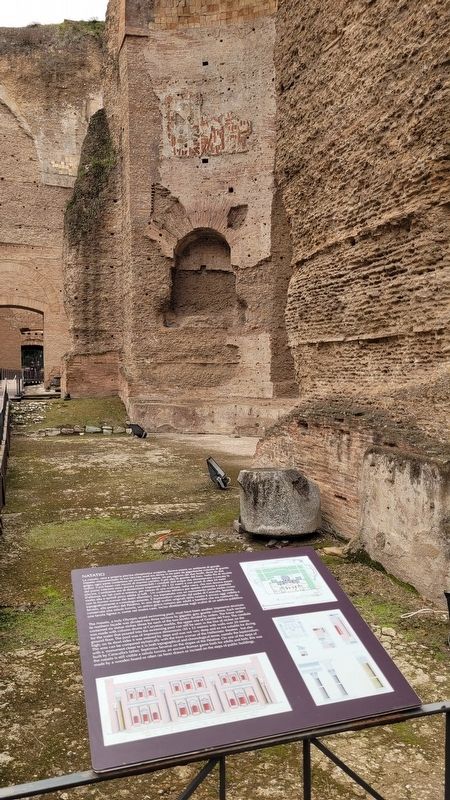
Natatio

Photographed by James Hulse, February 27, 2024
1. Natatio Marker

La natatio, vera e propria piscina olimpionica scoperta, doveva essere un ambiente di grande impatto monumentale: la sua facciata nord era divisa in tre parti da gigantesche colonne di granito grigio; ogni parte conteneva sei nicchie per statue, tre per ognuno dei due livelli, divisi da due ordini: il più basso con rocchi di marmo caristio, il più alto di granito del Foro. Nella fila di nicchie del piano inferiore sono ancora riconoscibili i condotti dell'acqua che alimentavano a cascata la piscina. L'ambiente era di dimensioni imponenti (50 x 22 metri) e con pareti di oltre 20 metri d'altezza; sui lati corti si entrava, per mezzo di una scalinata, nella vasca, che non doveva essere molto alta e quindi poco adatta ai tuffi. Un confronto stilistico per questo ambiente è possibile con le frontes scenae dei teatri ellenistici, ma soprattutto con un monumento anche molto vicino topograficamente e cronologicamente, il Septizodium costruito dal padre di Caracalla, Settimio Severo, alle pendici del Palatino. In uno degli scalini originali della natatio è ancora oggi visibile e conservata una tabula lusoria, un
this page online
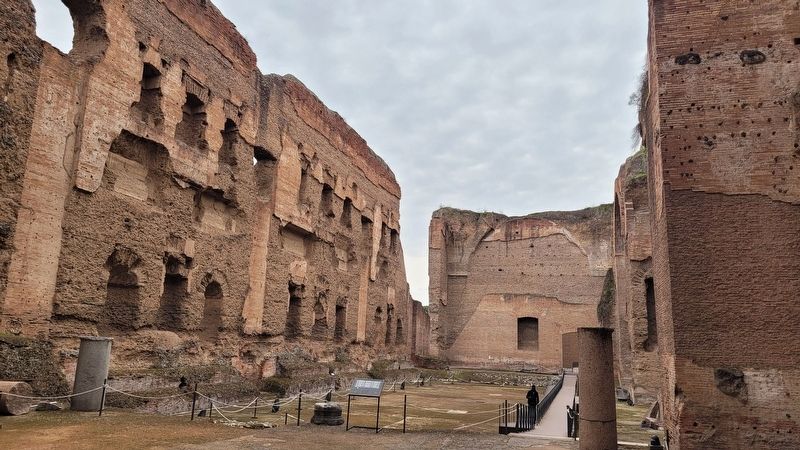
The Natatio, a truly Olympic-sized swimming pool, must have been another impressive structure. Its northern façade was divided into three sections by gigantic grey granite columns. Each section contained six statue niches (three for each of the two levels) divided by orders. The lower order was made with column drums of Carystian marble, the upper one of Granito del Foro. The conduits for the water that poured into the swimming pool can still be seen in the line of niches on the ground floor. The pool was of impressive dimensions (50 x 22 metres) with walls over 20 metres high; on its short sides it was entered by steps and was not very deep and so not suitable for diving. The area can be compared stylistically with the frons scenae of the Hellenistic theatres, but also with a monument closer to it in both topographical and chronological terms, namely the Septizodium, built by Caracalla's father, Septimius Severus on the slopes of the Palatine. On one of the
Photographed by James Hulse, February 27, 2024
2. Natatio Marker
Topics. This historical marker is listed in these topic lists: Anthropology & Archaeology • Sports.
Location. 41° 52.78′ N, 12° 29.605′ E. Marker is in Roma, Lazio (Latium, Rome), in Città metropolitana di Roma Capitale. It is in San Saba. It is at the intersection of Viale delle Terme di Caracalla and Via Antonina on Viale delle Terme di Caracalla. The marker is located on the grounds to the Baths of Caracalla. Touch for map. Marker is at or near this postal address: Viale delle Terme di Caracalla 28, Roma, Lazio 00153, Italy. Touch for directions.

Regionally, it is in Europe, the European Union, the Schengen Area, a coastal Mediterranean country, and the Western World. Historically, it finds itself in what was once the Roman Empire.
Other nearby markers. At least 8 other markers are within walking distance of this marker: La Natatio E I Giochi / Swimming Pools and Games (a few steps from this marker); Tabula Lusoria / Game Board (a few steps from this marker); Frigidarium / Cold Room (within shouting distance of this marker); a different marker also named Frigidarium / Cold Room (within shouting distance of this marker); Particolare di Mosaico a Motivo Figurato / Detail of Figurative Mosaic (within shouting distance of this marker); Palestra Occidentale / Western Gym (about 90 meters away, measured in a direct line); Palestra Orientale / Eastern Gym (about 90 meters away); Particolare di Mosaico a Motivo Geometrico / Detail of Geometric Mosaic Pattern (about 90 meters away). Touch for a list and map of all markers in Roma.
More about this marker.
Photographed by James Hulse, February 27, 2024
3. The view of the Natatio
Also see . . . Baths of Caracalla. Wikipedia
>The Baths of Caracalla (Italian: Terme di Caracalla) in Rome, Italy, were the city's second largest Roman public baths, or thermae, after the Baths of Diocletian. The baths were likely built between AD 212 (or 211) and 216/217, during the reigns of emperors Septimius Severus and Caracalla. They were in operation until the 530s and then fell into disuse and ruin.(Submitted on February 3, 2025, by James Hulse of Medina, Texas.)
Credits. This page was last revised on February 3, 2025. It was originally submitted on February 2, 2025, by James Hulse of Medina, Texas. This page has been viewed 124 times since then and 11 times this year. Photos: 1, 2, 3. submitted on February 3, 2025, by James Hulse of Medina, Texas.
