San Saba in Roma in Città metropolitana di Roma Capitale, Latium, Rome, Italy — Central Italy (Tyrrhenian Coast)
Palestra Orientale
⎯⎯⎯
Eastern Gym
Photographed by James Hulse, February 27, 2024
1. Palestra Orientale / Eastern Gym Marker

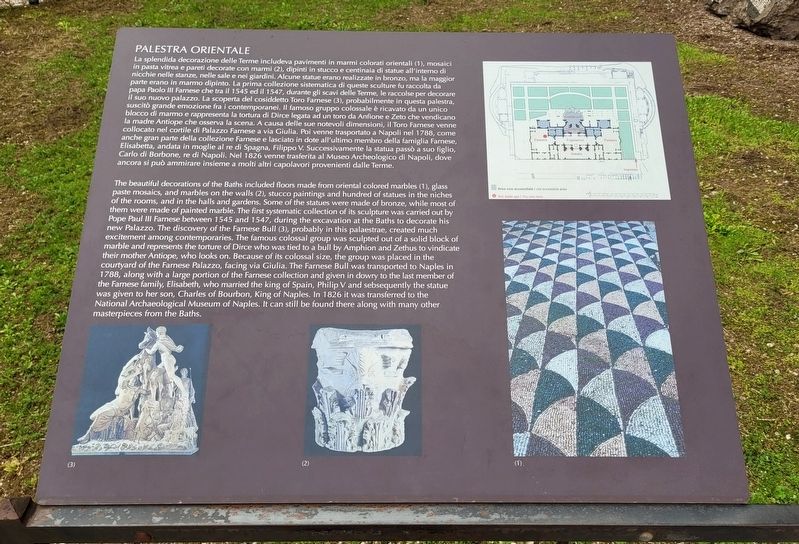
La splendida decorazione delle Terme includeva pavimenti in marmi colorati orientali (1), mosaici in pasta vitrea e pareti decorate con marmi (2), dipinti in stucco e centinaia di statue all'interno di nicchie nelle stanze, nelle sale e nei giardini. Alcune statue erano realizzate in bronzo, ma la maggior parte erano in marmo dipinto. La prima collezione sistematica di queste sculture fu raccolta da papa Paolo III Farnese che tra il 1545 ed il 1547, durante gli scavi delle Terme, le raccolse per decorare il suo nuovo palazzo. La scoperta del cosiddetto Toro Farnese (3), probabilmente in questa palestra, suscitò grande emozione fra i contemporanei. Il famoso gruppo colossale è ricavato da un unico blocco di marmo e rappresenta la tortura di Dirce legata ad un toro da Anfione e Zeto che vendicano la madre Antiope che osserva la scena. A causa delle sue notevoli dimensioni, il Toro Farnese venne collocato nel cortile di Palazzo Farnese a via Giulia. Poi venne trasportato a Napoli nel 1788, come anche gran parte della collezione Farnese e lasciato in dote all'ultimo membro della famiglia Farnese, Elisabetta,
this page online
The beautiful decorations of the Baths included floors made from oriental colored marbles (1), glass paste mosaics, and marbles on the walls (2), stucco paintings and hundred of statues in the niches of the rooms, and in the halls and gardens. Some of the statues were made of bronze, while most of them were made of painted marble. The first systematic collection of its sculpture was carried out by Pope Paul III Farnese between 1545 and 1547, during the excavation at the Baths to decorate his new Palazzo. The discovery of the Farnese Bull (3), probably in this palaestrae, created much excitement among contemporaries. The famous colossal group was sculpted out of a solid block of marble and represents the torture of Dirce who was tied to a bull by Amphion and Zethus to vindicate their mother Antiope, who looks on. Because of its colossal size, the group was placed
Photographed by James Hulse, February 27, 2024
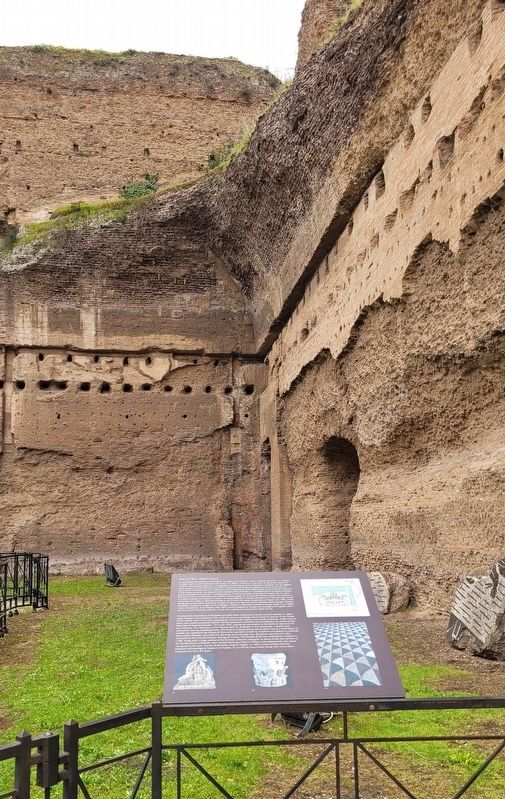
2. Palestra Orientale / Eastern Gym Marker
Topics. This historical marker is listed in these topic lists: Anthropology & Archaeology • Architecture • Arts, Letters, Music. A significant historical year for this entry is 1545.
Location. 41° 52.734′ N, 12° 29.62′ E. Marker is in Roma, Lazio (Latium, Rome), in Città metropolitana di Roma Capitale. It is in San Saba. It is at the intersection of Viale delle Terme di Caracalla and Via Antonina on Viale delle Terme di Caracalla. The marker is located on the grounds to the Baths of Caracalla. Touch for map. Marker is in this post office area: Roma, Lazio 00153, Italy. Touch for directions.

Regionally, it is in Europe, the European Union, the Schengen Area, a coastal Mediterranean country, and the Western World. Historically, it finds itself in what was once the Roman Empire.
Other nearby markers. At least 8 other markers are within walking distance of this marker: Particolare di Mosaico a Motivo Figurato / Detail of Figurative Mosaic (a few steps from this marker); Particolare di Mosaico a Motivo Geometrico / Detail of Geometric Mosaic Pattern (within shouting distance of this marker); Frigidarium / Cold Room (within shouting distance of this marker); a different marker also named Frigidarium / Cold Room (about 90 meters away, measured in a direct line); Natatio (about 90 meters away); Tabula Lusoria / Game Board
Photographed by James Hulse, February 27, 2024
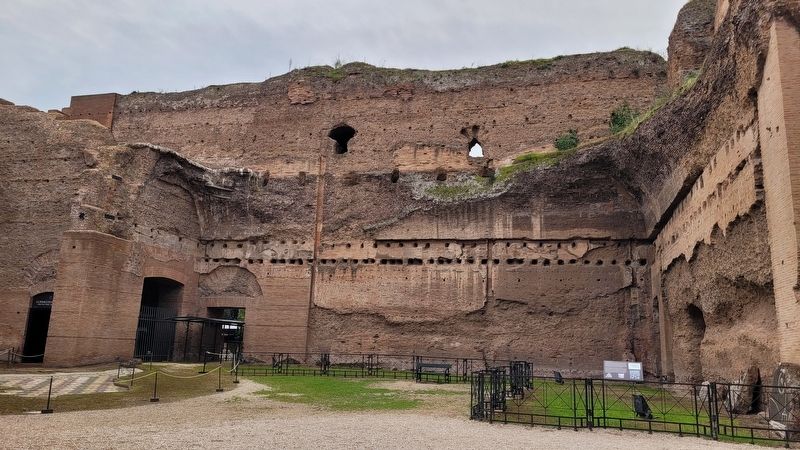
3. The view of the Eastern Gym Marker
More about this marker. There is a small entry fee to visit the Baths of Caracalla.
Also see . . . Baths of Caracalla. Wikipedia
The Baths of Caracalla (Italian: Terme di Caracalla) in Rome, Italy, were the city's second largest Roman public baths, or thermae, after the Baths of Diocletian. The baths were likely built between AD 212 (or 211) and 216/217, during the reigns of emperors Septimius Severus and Caracalla. They were in operation until the 530s and then fell into disuse and ruin.(Submitted on February 3, 2025, by James Hulse of Medina, Texas.)
Credits. This page was last revised on February 3, 2025. It was originally submitted on February 2, 2025, by James Hulse of Medina, Texas. This page has been viewed 103 times since then and 17 times this year. Photos: 1, 2, 3. submitted on February 3, 2025, by James Hulse of Medina, Texas.
