Ripa in Roma in Città metropolitana di Roma Capitale, Latium, Rome, Italy — Central Italy (Tyrrhenian Coast)
Il Circo Massimo
⎯⎯⎯
The Circus Maximus
Photographed by James Hulse, February 27, 2024
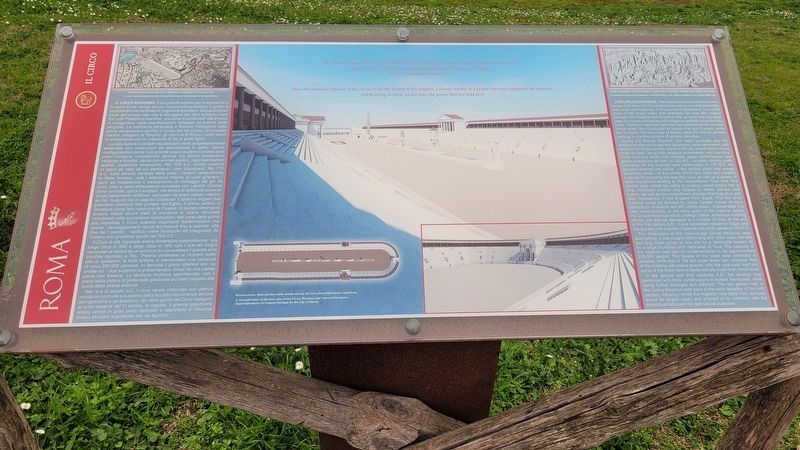
1. Il Circo Massimo / The Circus Maximus Marker

II più grande edificio per lo spettacolo e lo sport di tutti i tempi, era un monumento grandioso in grado di ospitare alcune centinaia di migliaia di spettatori. Occupava gran parte dell'ampia valle che si allungava per oltre seicento metri tra i colli Palatino e Aventino, una zona in cui sin dall'età arcaica si svolgevano varie manifestazioni collegate ad antiche feste religiose. La tradizione attribuisce a Romolo l'istituzione delle prime competizioni ippiche in onore del dio Conso (Consualia) mentre risalgono ai Tarquini, gli ultimi re di Roma, i primi lavori di allestimento con la creazione di file di sedili lignei.
La valle durante il periodo repubblicano viene progressivamente sistemata con costruzioni ed attrezzature in parte stabili, configurandosi come il più grande spazio pubblico urbano dove poter svolgere competizioni ippiche ma anche processioni religiose e trionfali, cacce con animali esotici, rappresentazioni teatrali, pubbliche esecuzioni. Nel 329 a.C. furono costruiti in legno gli stalli da cui partivano i carri (carceres). Nel 170 a.C. sulla striscia centrale della pista i censori restaurarono le Mete (metae), cioè i segnacoli intorno ai quali giravano i carri, ed installarono il
this page online
II Circo di età imperiale aveva dimensioni notevolissime: era lungo circa m 600 e largo circa m 140, con i due lati lunghi raccordati al centro da un emiciclo su cui svettava il grande arco trionfale dedicato a Tito. Poteva contenere un numero molto alto di spettatori, le fonti antiche ci tramandano una capienza di circa 250.000 persone. In facciata il piano inferiore era su arcate ed i due superiori si presentavano chiusi da una parete piena con finestre. La struttura risultava
Photographed by James Hulse, February 27, 2024
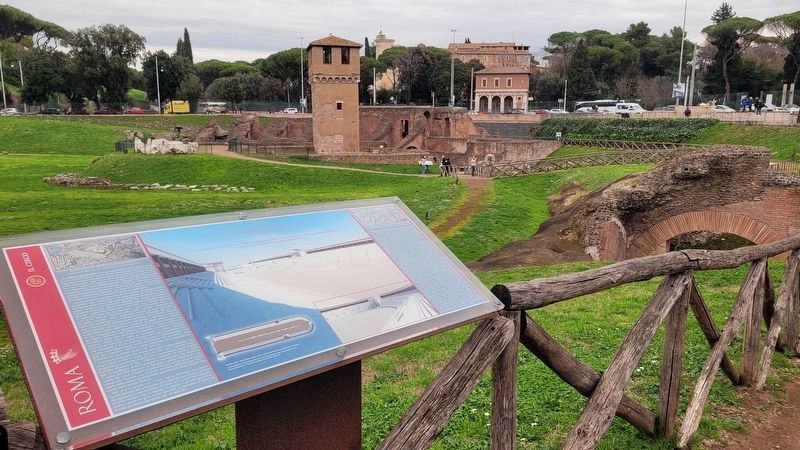
2. The southeastern end of the Circus Maximus and Marker
Nel II e III secolo d.C. il circo venne rinforzato con ulteriori murature costruite a supporto della facciata ma continuò ancora ad ingrandirsi e ad abbellirsi. Gli ultimi giochi nel Circo risalgono ai primi decenni del VI secolo. In seguito il grande ippodromo antico venne in gran parte demolito e depredato e l'enorme invaso sfruttato soprattutto per usi agricoli.
Didascalie
(Foto #1) Nuova ricostruzione del Circo Massimo nel plastico di Roma antica
(Foto #2) Là l'immenso fianco del circo sfida la bellezza dei templi, degna sede del popolo vincitore del mondo, degno di esser visto non meno degli spettacoli ai quali in esso si assisterà. Plinio il Giovane, Panegirico, 51
(Foto #3) Ricostruzione della pianta e delle vedute interne del Circo (Sovrintendenza Capitolina)
(Foto #4) Corsa di quadrighe nel Circo Massimo, metà III sec. d.C (Foligno, Palazzo Trinci, Museo della Città)
The largest sports and entertainment venue of all time, the Circus Maximus was a monumental facility that could hold hundreds of thousands of spectators. It covered most of the broad valley that stretched for over 600

Photographed by James Hulse, February 27, 2024
3. The view of the Circus Maximus looking down the track
During the Roman Republic, the valley gradually saw the addition of other structures and equipment, some permanent, and became the largest public space in the city where chariot races could be held, along with religious processions and triumphs, hunts involving exotic wild animals, stage performances and public executions as well. In 329 B.C., wooden starting stalls (carceres) for the chariots were constructed. In 170 B.C. the censors restored the metae the conical pillars that served as turning posts in the centre of the race track and installed a device for counting the laps (the ova), as well as a variety of other equipment relating to the competitions. Over time, this central area, called the spina or euripus, would evolve into a long, rectilinear median strip topped by altars, statues, and basins, as well as two magnificent obelisks that Augustus and later Constantius

Photographed by James Hulse, February 27, 2024
4. The northwestern view of the Circus Maximus
The dimensions of this imperial-age Circus Maximus were astonishing. It was roughly 600m long and 140m wide, with the two long sides joined at one end by a hemicycle topped off by a large triumphal arch dedicated to Titus. The capacity of this stadium was said by contemporaries to be approximately 250,000 people. The facade of the lower level consisted of arcades, while that of the two upper levels had windows. Part of the building was below ground, with the race track itself and some of the lower tiers of seats actually lower than street level.
In the second and third centuries A.D., the stadium was reinforced with brick constructions to bolster the facade, while being further enlarged and adorned. The last games held in the Circus Maximus date

Photographed by James Hulse, February 27, 2024
5. The Arches Severiane on the Palatine looking down on the Circus Maximus
Captions
(Photo #1) A new reconstruction of the Circus Maximus in the model of ancient Rome
(Photo #2) There the intense expanse of the circus rivals the beauty of the temples, a throne worthy of a people that had conquered the nations, worth seeing in itself, no less than the games that are held in it.
(Photo #3) A reconstruction of the floor plan of the Circus Maximus and views of the interior (Superintendency of Cultural Heritage for the City of Rome)
(Photo #4) A chariot race in the Circus Maximus, mid-third century AD. (Foligno, Palazzo Trinci, Museo della Citta)
Erected by Rome.
Topics. This historical marker is listed in these topic lists: Anthropology & Archaeology • Sports.
Location. 41° 53.057′ N, 12° 29.263′ E. Marker is in Roma, Lazio (Latium, Rome), in Città metropolitana di Roma Capitale. It is in Ripa. It is at the intersection of Viale Aventino and Via del Circo Massimo on Viale Aventino. The marker is located on the south end of the Circus Maximus Archaeological Site. Touch for map. Marker is in this post office area: Roma, Lazio 00186, Italy. Touch for directions.

Regionally, it is in Europe, the European Union, the Schengen Area, a coastal Mediterranean country, and the Western World. Historically, it finds itself in what was once the Roman Empire.
Other nearby markers. At least 8 other markers are within walking distance of this marker: I Giochi nel Circo / The Games Held in the Circus Maximus (here, next to this marker); I Marmi / The Marbles (within shouting distance of this marker); La Struttura / The Circus Structure (within shouting distance of this marker); L'Acqua Mariana / The Mariana Water (within shouting distance of this marker); L'Arco di Tito / The Arch of Titus (within shouting distance of this marker); Frammenti Dell'Arco di Tito / Fragments From the Arch of Titus (within shouting distance of this marker); La Torre della Moletta / The Moletta Tower (within shouting distance of this marker); Il Mulino e le Macine / The Mill and the Millstones (within shouting distance of this marker). Touch for a list and map of all markers in Roma.
More about this marker. There is a small entry fee to visit the Circus Maximus Archaeological Site.
Also see . . . Circus Maximus. Wikipedia
The Circus Maximus (Latin for "largest circus"; Italian: Circo Massimo) is an ancient Roman chariot-racing stadium and mass entertainment venue in Rome, Italy. In the valley between the Aventine and Palatine hills, it was the first and largest stadium in ancient Rome and its later Empire. It measured 621 m (2,037 ft) in length and 118 m (387 ft) in width and could accommodate over 150,000 spectators. In its fully developed form, it became the model for circuses throughout the Roman Empire.(Submitted on February 3, 2025, by James Hulse of Medina, Texas.)
Credits. This page was last revised on February 4, 2025. It was originally submitted on February 2, 2025, by James Hulse of Medina, Texas. This page has been viewed 124 times since then and 12 times this year. Photos: 1, 2, 3, 4, 5. submitted on February 3, 2025, by James Hulse of Medina, Texas.
