Ripa in Roma in Città metropolitana di Roma Capitale, Latium, Rome, Italy — Central Italy (Tyrrhenian Coast)
I Marmi
⎯⎯⎯
The Marbles
Photographed by James Hulse, February 27, 2024
1. I Marmi / The Marbles Marker

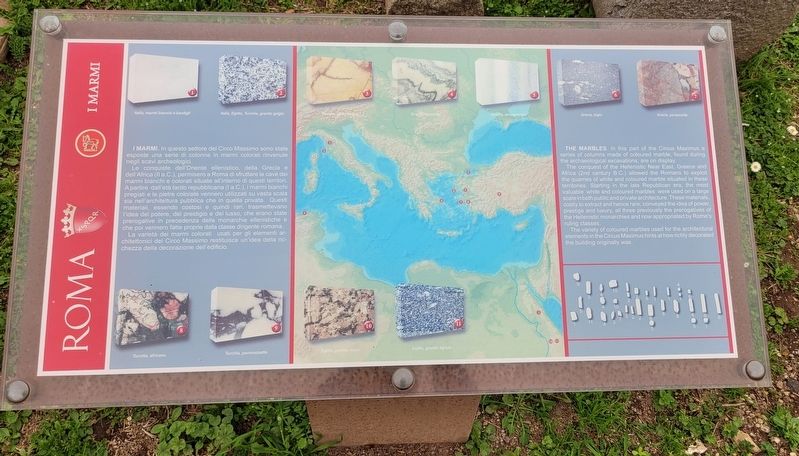
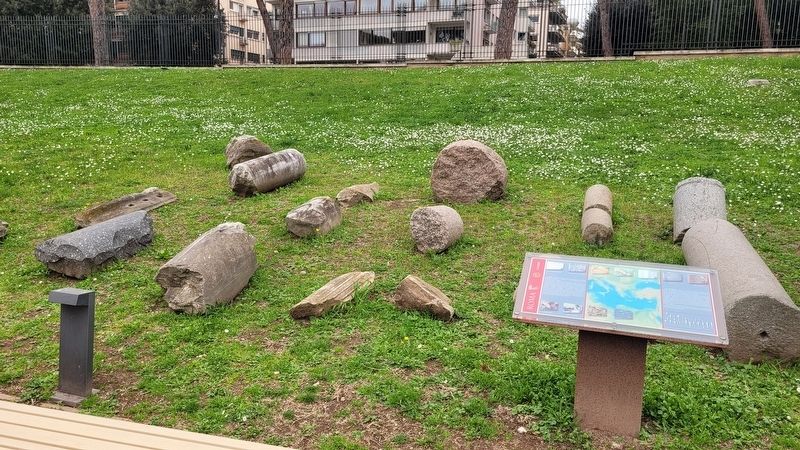
In questo settore del Circo Massimo sono state esposte una serie di colonne in marmi colorati rinvenute negli scavi archeologici.
Le conquiste dell'Oriente ellenistico, della Grecia e dell'Africa (II a.C.), permisero a Roma di sfruttare le cave dei marmi bianchi e colorati situate all'interno di questi territori. A partire dall'età tardo repubblicana (I a.C.), i marmi bianchi pregiati e le pietre colorate vennero utilizzati su vasta scala sia nell'architettura pubblica che in quella privata. Questi materiali, essendo costosi e quindi rari, trasmettevano l'idea del potere, del prestigio e del lusso, che erano state prerogative in precedenza delle monarchie ellenistiche e che poi vennero fatte proprie dalla classe dirigente romana.
La varietà dei marmi colorati usati per gli elementi architettonici del Circo Massimo restituisce un'idea della ric-chezza della decorazione dell'edificio.
Didascalie
(Foto #1) Italia, marmi bianchi e bardigli
(Foto #2) Italia, Egitto, Turchia, granito grigio
(Foto #3) Tunisia, giallo antico
(Foto #4) Grecia, cipollino
(Foto #5) Turchia, proconnesio
(Foto #6) Grecia, bigio
(Foto #7) Grecia, portasanta
(Foto #8) Turchia, africano
(Foto #9) Turchia, pavonazzetto
(Foto #10) Egitto, granito rosso
(Foto #11) Egitto, granito tigrato
In
this page online
The conquest of the Hellenistic Near East, Greece and Africa (2nd century B.C.) allowed the Romans to exploit the quarries of white and coloured marble situated in these territories. Starting in the late Republican era, the most valuable white and coloured marbles were used on a large scale in both public and private architecture. These materials, costly to extract and hence rare, conveyed the idea of power, prestige and luxury, all three previously the prerogatives of the Hellenistic monarchies and now appropriated by Rome's ruling classes.
The variety of coloured marbles used for the architectural elements in the Circus Maximus hints at how richly decorated the building originally was.
Captions
Photo #1: Italy, white marble and bardiglio
Photo #2: Italy, Egypt, Turkey, grey granite
Photo #3: Tunisia, antique yellow
Photo #4: Greece, cipollino
Photo #5: Turkey, Proconnesian
Photo #6: Greece, bigio
Photo #7: Greece, portasanta
Photo #8: Turkey, African
Photo #9: Turkey, pavonazzetto
Photo #10: Egypt, red granite
Photo #11: Egypt, tiger-striped granite
Erected by Rome.
Photographed by James Hulse, February 27, 2024
2. The Marbles and Marker
Topics. This historical marker is listed in these topic lists: Anthropology & Archaeology • Architecture.
Location. 41° 53.063′ N, 12° 29.242′ E. Marker is in Roma, Lazio (Latium, Rome), in Città metropolitana di Roma Capitale. It is in Ripa. It is at the intersection of Viale Aventino and Via del Circo Massimo on Viale Aventino. The marker is located on the south end of the Circus Maximus Archaeological Site. Touch for map. Marker is in this post office area: Roma, Lazio 00153, Italy. Touch for directions.

Regionally, it is in Europe, the European Union, the Schengen Area, a coastal Mediterranean country, and the Western World. Historically, it finds itself in what was once the Roman Empire.
Other nearby markers. At least 8 other markers are within walking distance of this marker: I Giochi nel Circo / The Games Held in the Circus Maximus (within shouting distance of this marker); Il Circo Massimo / The Circus Maximus (within shouting distance of this marker); La Struttura / The Circus Structure (within shouting distance of this marker); L'Arco di Tito / The Arch of Titus
Photographed by James Hulse, February 27, 2024
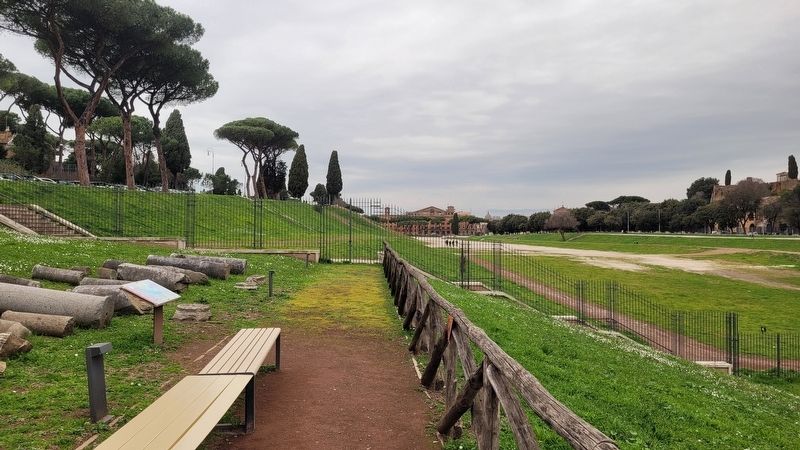
3. The Marbles and the Marker with a view of the Circus Maximum
More about this marker. There is a small entry fee to visit the Circus Maximus Archaeological Site.
Also see . . . Circus Maximus. Wikipedia
The Circus Maximus (Latin for "largest circus"; Italian: Circo Massimo) is an ancient Roman chariot-racing stadium and mass entertainment venue in Rome, Italy. In the valley between the Aventine and Palatine hills, it was the first and largest stadium in ancient Rome and its later Empire. It measured 621 m (2,037 ft) in length and 118 m (387 ft) in width and could accommodate over 150,000 spectators. In its fully developed form, it became the model for circuses throughout the Roman Empire.(Submitted on February 4, 2025, by James Hulse of Medina, Texas.)
Credits. This page was last revised on February 4, 2025. It was originally submitted on February 3, 2025, by James Hulse of Medina, Texas. This page has been viewed 85 times since then and 12 times this year. Photos: 1, 2, 3. submitted on February 4, 2025, by James Hulse of Medina, Texas.
