Ripa in Roma in Città metropolitana di Roma Capitale, Latium, Rome, Italy — Central Italy (Tyrrhenian Coast)
I Giochi nel Circo
⎯⎯⎯
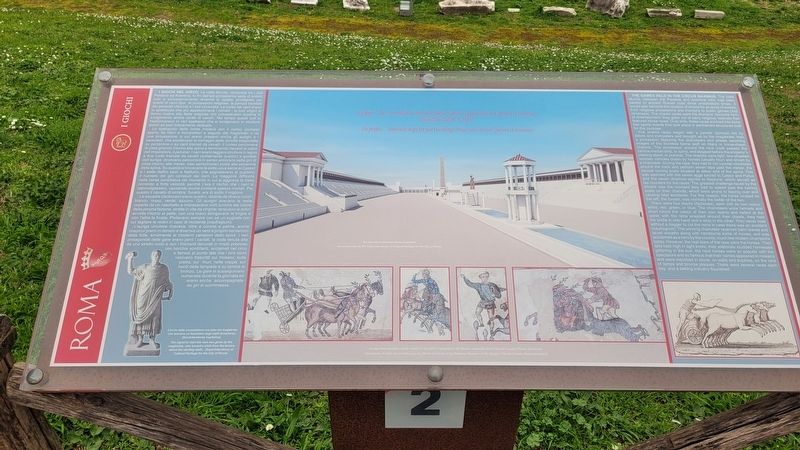
The Games Held in the Circus Maximus
Photographed by James Hulse, February 27, 2024
1. I Giochi nel Circo / The Games Held in the Circus Maximus Marker

La valle Murcia, compresa tra i colli Palatino ed Aventino, fu fin dall'età protostorica sede di antichi culti e successivamente divenne lo spazio privilegiato per eventi di vario tipo: le processioni religiose, la pompa trionfale dei generali vittoriosi e i ludi circenses. Le corse dei carri erano lo spettacolo che più appassionava i romani: le loro origini si fanno risalire alle feste religiose che prevedevano durante lo svolgimento anche corse di cavalli. Nel tempo questi ludi si trasformarono in veri spettacoli che si svolgevano in strutture stabili ad essi interamente dedicate.
Lo spettacolo delle corse iniziava con il corteo (pompa) aperto da littori e trombettieri e seguito dal magistrato e da una processione in cui erano presenti anche gli aurighi e i sacerdoti, che scortavano le immagini delle divinità trasportate su portantine o su carri trainati da cavalli. Il corteo percorreva la pista girando intorno alla spina e terminando davanti al palco dell'imperatore, il pulvinar. I carri erano leggere strutture in legno a due ruote trainate da cavalli (solitamente quattro) e guidate dall'auriga: dovevano
this page online
Le squadre (factiones) erano quattro, distinte da diversi colori: bianco, rosso, verde, azzurro. Gli aurighi avevano la testa coperta da un caschetto e indossavano corti tuniche del colore della propria fazione, strette in vita da cinghie; tenevano le redini avvolte intorno al petto, con una mano stringevano le briglie e con l'altra la frusta. Portavano sempre con sé un pugnale con cui tagliare le redini in caso di incidente (naufragium).
L'auriga vincitore riceveva, oltre a corone e palme, anche cospicui premi in denaro e diveniva un vero e proprio beniamino delle folle, similmente

Photographed by James Hulse, February 27, 2024
2. The view of the marker in the Circus Maximus
Didascalie
(Foto #1) L'avvio della competizione era dato dal magistrato che lanciava un fazzoletto dagli stalli di partenza. (Sovrintendenza Capitolina)
(Foto #2) il popolo...due cose soltanto ansioso desidera il pano en groda del emo (panom el feuises) Grovenale Satire, X. 80-81
(Foto #3) Ricostruzione Sovrintendenza Capitolina
(Foto #4) Auriga delle squadre rossa e azzurra (Archivio Fotografico del Museo regionale della Villa del Casale, Piazza Armerino)
The Valle Murcia, between the Palatine and Aventine hills, had been sacred to ancient Roman cults since protohistoric times. It would later become the location of choice for an array of events,

Photographed by James Hulse, February 27, 2024
3. The view down the Circus Maximus
The chariot races began with a parade (pompa) led by lictors and trumpeters and brought up by the magistrate; then a procession featuring the charioteers and priests escorting images of the divinities borne aloft on litters or horse-drawn chariots. The procession around the race track passed the central median strip, or spina, and stopped before the emperor's viewing stand, or pulvinar. The chariots were light, two-wheeled wooden vehicles drawn by horses (usually four) and driven by a charioteer. During the race, they had to run counter-clockwise around the track and perform seven laps past the metae, the conical turning posts situated at either end of the spina. This was adorned with the seven eggs sacred to Castor and Pollux and the seven dolphins sacred to Neptune, which served as lap counters for the races. The greatest challenge faced by the drivers was the moment they had to speed past the turning posts on their chariots, which were prone to tipping over and causing fatal accidents. For this reason, the horse located on the left, the funalis, was normally the better of the two.
There were four teams (factiones), each with its own colour: white, red, green, or blue. The charioteers wore helmets and short tunics the colour of their own teams and belted at the waist; with the reins wrapped around their chests, they held the bridle in one hand and a whip in the other. They never rode without a dagger to cut the reins in case there was an accident (naufragium). The winning charioteer received palm leaves and laurel wreaths along with handsome sums of money, and was acclaimed as a hero by the crowds, much like modern champions today. However, the real stars of the race were the horses. Their tails held high in tight knots, their elaborate studded harnesses glittering in the sun, the race horses were so popular with the spectators and so famous that their names appeared in mosaics and were inscribed in stone, on walls and trophies, on the rims of lamps and bronze plaques. There were several races each day, and a betting industry flourished.
Captions
(Photo #1) The signal to start the race was given by the magistrate, who tossed a cloth from the terrace above the starting stalls. (Superintendency of Cultural Heritage for the City of Rome)
(Photo #2) the people.... anxiously hope for just two things, bread and circuses (panem et circenses)
(Photo #3) Reconstruction by the Superintendency of Cultural Heritage for the City of Rome
(Photo #4) Charioteers for the red and blue teams (Photo Archives of the Regional Museum of the Roman Villa del Casale, Piazza Armerina)
Erected by Rome.
Topics. This historical marker is listed in these topic lists: Anthropology & Archaeology • Sports.
Location. 41° 53.058′ N, 12° 29.258′ E. Marker is in Roma, Lazio (Latium, Rome), in Città metropolitana di Roma Capitale. It is in Ripa. It is at the intersection of Viale Aventino and Via del Circo Massimo on Viale Aventino. The marker is located on the south end of the Circus Maximus Archaeological Site. Touch for map. Marker is in this post office area: Roma, Lazio 00153, Italy. Touch for directions.

Regionally, it is in Europe, the European Union, the Schengen Area, a coastal Mediterranean country, and the Western World. Historically, it finds itself in what was once the Roman Empire.
Other nearby markers. At least 8 other markers are within walking distance of this marker: Il Circo Massimo / The Circus Maximus (here, next to this marker); I Marmi / The Marbles (within shouting distance of this marker); La Struttura / The Circus Structure (within shouting distance of this marker); L'Acqua Mariana / The Mariana Water (within shouting distance of this marker); L'Arco di Tito / The Arch of Titus (within shouting distance of this marker); Frammenti Dell'Arco di Tito / Fragments From the Arch of Titus (within shouting distance of this marker); La Torre della Moletta / The Moletta Tower (within shouting distance of this marker); Il Mulino e le Macine / The Mill and the Millstones (within shouting distance of this marker). Touch for a list and map of all markers in Roma.
More about this marker. There is a small entry fee to visit the Circus Maximus Archaeological Site.
Also see . . . Circus Maximus. Wikipedia
The Circus Maximus (Latin for "largest circus"; Italian: Circo Massimo) is an ancient Roman chariot-racing stadium and mass entertainment venue in Rome, Italy. In the valley between the Aventine and Palatine hills, it was the first and largest stadium in ancient Rome and its later Empire. It measured 621 m (2,037 ft) in length and 118 m (387 ft) in width and could accommodate over 150,000 spectators. In its fully developed form, it became the model for circuses throughout the Roman Empire.(Submitted on February 4, 2025, by James Hulse of Medina, Texas.)
Credits. This page was last revised on February 4, 2025. It was originally submitted on February 3, 2025, by James Hulse of Medina, Texas. This page has been viewed 101 times since then and 12 times this year. Photos: 1, 2, 3. submitted on February 4, 2025, by James Hulse of Medina, Texas.
