Cerny-en-Laonnois in Aisne, Upper France, France — Western Europe
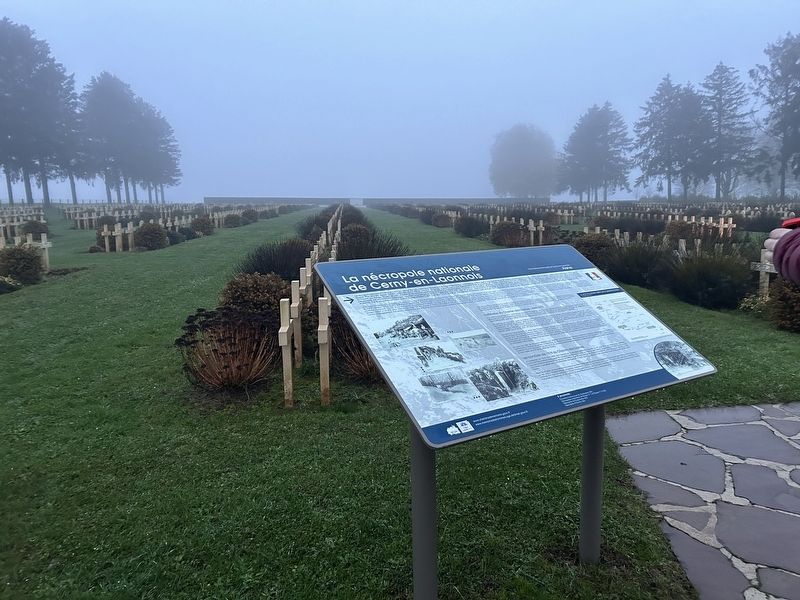
La nécropole nationale de Cerny-en-Laonnois

Photographed by Steve Stoessel, November 18, 2024
1. La nécropole nationale de Cerny-en-Laonnois Marker

Aisne
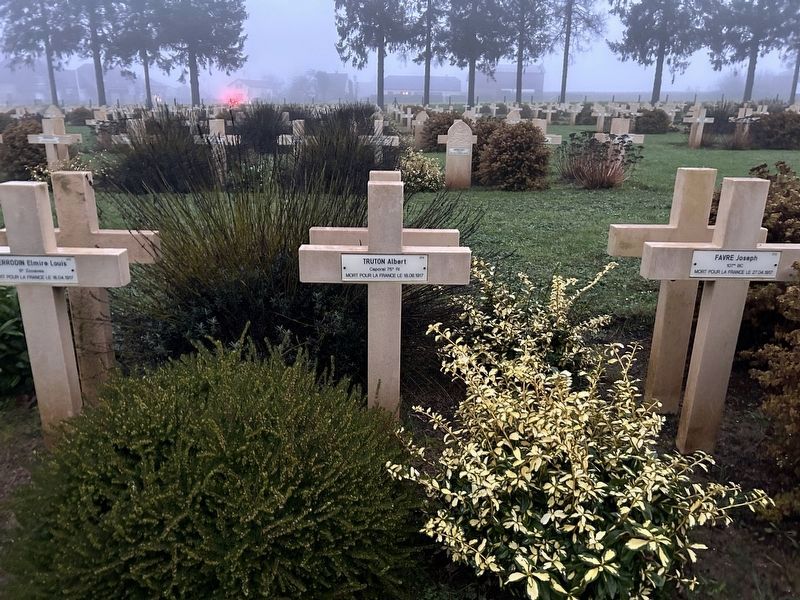
La nécropole nationale de Cerny-en-Laonnois est l'un des principaux lieux de mémoire du Chemin des Dames. Aménagé de 1919à 1925, il regroupe les corps de soldats tombés tout au long de la guerre dans ce secteur emblématique de l'histoire de la Grande Guerre. Plus de 5 200 soldats français y reposent dont 2 386 en ossuaire. Cinquante-quatre Russes y sont également inhumés. A proximité, un cimetière allemand réunit 4 346 soldats dont 3 993 en ossuaire. De l'autre côté de l'axe routier, est érigé le mémorial du Chemin des Dames. Au sein de cette chapelle se déroulent d'importantes cérémonies commémoratives. Sur le parvis de cet édifice, se dresse une Lanterne des Morts conservant ainsi le souvenir des soldats décédés durant ce conflit. Cet ensemble mémoriel est complété par un monument britannique rappelant l'engagement du Britisch Expeditionnary Forces dans ce secteur, notamment le 1 or bataillon du North Loyal Lancashire Regiment qui s'est battu, en septembre 1914, autour de l'ancienne sucrerie, dominant le plateau. Parmi les soldats inhumés, repose le corps d'Albert
this page online
Photographed by Steve Stoessel, November 18, 2024
2. La nécropole nationale de Cerny-en-Laonnois Marker
L'offensive du Chemin des Dames - Avril 1917. A la veille du printemps 1917, les Français projettent de déployer une puissante offensive dans ce secteur épargné. Mais, le repli allemand sur la ligne Hindenburg impose au général Nivelle de revoir les orientations de cette opération. Chargés de rompre les lignes allemandes, plus d'un million d'hommes appuyés par 5 310 pièces d'artillerie et 128 chars sont engagés.
Au matin du 16 avril 1917, après un intense bombardement dont l'efficacité est limitée, les premières

Photographed by Steve Stoessel, November 18, 2024
3. La nécropole nationale de Cerny-en-Laonnois Marker
Au bord de l'effondrement, le moral des Français vacille. Devant l'échec de cette offensive, des mouvements de mutineries éclatent dans les rangs de quelques unités, qui refusent de monter en première ligne. Devant l'amplification de cette contestation en mai 1917, les autorités militaires réagissent avec fermeté. Les arrestations sont nombreuses. Les soldats considérés comme les plus actifs sont jugés et condamnés par des tribunaux militaires. Plus de 500 condamnations à mort sont prononcées, puis commuées par le pouvoir politique. Près de trente sont, pourtant, exécutés. En parallèle, un système de rotation plus efficace et de permissions est instauré.
Au
Photographed by Steve Stoessel, November 18, 2024
4. Grave of Albert Truton
Les combats de 1918 au Chemin des Dames
Au printemps de 1918, le Chemin des Dames est à nouveau âprement disputé. Le 27 mai 1918, les Allemands déferlent, bousculant les positions françaises. Is occupent rapidement la crète du Chemin des Dames et atteignent la Veste. Soissons est occupée et Reims est sous les tirs directs de l'artillerie. Le 30, les Allemands atteignent la Marne. Les Français se replient, le front est rompu. L'assaillant est à 60 kilomètres de Paris où le bruit sourd du canon se fait entendre. C'est la seconde bataille de la Marne.
Mais, le 18 juillet, ce mouvement s'enraye et les Alliés contre-attaquent et repoussent les forces exsangues de l'ennemi. Appuyée par les chars, l'armée Mangin progresse rapidement. Soissons est libérée le 2 août. Au cours des semaines suivantes, les combats font rage au centre et à l'est du Chemin des Dames, Les Allemands abandonnent définitivement le plateau aux troupes françaises et italiennes, le 10 octobre, un mois avant l'armistice du 11 novembre 1918.
The Chemin des Dames offensive - April 1917. On the eve of spring 1917, the French planned to deploy a powerful offensive in this spared sector. However, the German retreat to the Hindenburg Line forced General Nivelle to review the orientations of this operation. Tasked with breaking the German lines, more than a million men supported by 5,310 artillery pieces and 128 tanks were engaged.
On the morning of April 16, 1917, after an intense bombardment of limited effectiveness, the first waves set off. After climbing the slopes of the plateau, they came up against barbed wire, often intact, and were mowed down by German machine gun fire. At the cost of significant sacrifices, the French reached the crest of the plateau. On the 17th, despite difficult weather conditions, they continued their efforts. The fighting continued but the offensive was a failure. Nivelle's authority wavered. From April 16 to 30, 147,000 men had fallen, including 40,000 dead.
On the verge of collapse, French morale wavered. Faced with the failure of this offensive, mutinies broke out in the ranks of some units, which refused to go to the front line. Faced with the amplification of this protest in May 1917, the military authorities reacted firmly. There were many arrests. The soldiers considered to be the most active were tried and sentenced by military tribunals. More than 500 death sentences were pronounced, then commuted by the political authorities. Nearly thirty were, however, executed. At the same time, a more efficient rotation and leave system was established.
During the summer, new attacks with more limited objectives were launched against the strategic positions of the Plateau, notably at Craonne and Laffaux. In the autumn, the Battle of Malmaison took place, targeting the old fort of Malmaison to the west of the Chemin des Dames, which was taken on 23 October and led the Germans to abandon the Chemin des Dames plateau and retreat to the north of the Allette valley.
The fighting of 1918 at the Chemin des Dames
In the spring of 1918, the Chemin des Dames was once again fiercely contested. On 27 May 1918, the Germans swept in, overwhelming the French positions. They quickly occupied the crest of the Chemin des Dames and reached the Veste. Soissons was occupied and Reims was under direct artillery fire. On the 30th, the Germans reached the Marne. The French retreated, the front was broken. The attacker was 60 kilometres from Paris where the dull sound of cannon could be heard. This is the second battle of the Marne.
But on July 18, this movement stalls and the Allies counterattack and push back the exhausted enemy forces. Supported by tanks, Mangin's army advances rapidly. Soissons is liberated on August 2. Over the next few weeks, fighting rages in the center and east of the Chemin des Dames. The Germans definitively abandon the plateau to the French and Italian troops on October 10, one month before the armistice of November 11, 1918.
Topics. This historical marker is listed in these topic lists: Cemeteries & Burial Sites • War, World I. A significant historical date for this entry is June 8, 1917.
Location. 49° 26.57′ N, 3° 39.998′ E. Marker is in Cerny-en-Laonnois, Hauts-de-France (Upper France), in Aisne. It is at the intersection of Chemin des Dames (Hauts-de-France Route 18CD) and Hr Grande Rue ( Route 967), on the left when traveling east on Chemin des Dames. Touch for map. Marker is in this post office area: Cerny-en-Laonnois, Hauts-de-France 02860, France. Touch for directions.

Regionally, it is in the North Atlantic Region, Europe, the European Union, Atlantic Europe, the Schengen Area, Western Europe, a coastal Mediterranean country, and the Western World. Historically, it finds itself in what was once a French colony and also the Roman Empire.
Other nearby markers. At least 8 other markers are within 5 kilometers of this marker, measured as the crow flies: Cerny-en-Laonnois (within shouting distance of this marker); La Mort de Masse (within shouting distance of this marker); Les Britanniques sur le Chemin des Dames (within shouting distance of this marker); Un Long Chemin de Mémoire (within shouting distance of this marker); 41ème Bataillon de Chasseurs à Pied (approx. 4.7 kilometers away); Aux morts de la 164e Division (approx. 4.7 kilometers away); A la Gloire du 4 Régiment de Zouaves (approx. 4.7 kilometers away); « Ils N'ont Pas Choisi Leur Sepulture » (approx. 4.8 kilometers away). Touch for a list and map of all markers in Cerny-en-Laonnois.
Credits. This page was last revised on February 6, 2025. It was originally submitted on February 3, 2025, by Steve Stoessel of Niskayuna, New York. This page has been viewed 123 times since then and 13 times this year. Photos: 1, 2, 3, 4. submitted on February 3, 2025, by Steve Stoessel of Niskayuna, New York.
