
Berry-au-Bac in Aisne, Upper France, France — Western Europe
Un Siècle de Blindés en France
Photographed by Steve Stoessel, November 18, 2024
1. UN SIÈCLE DE BLINDÉS EN FRANCE Marker

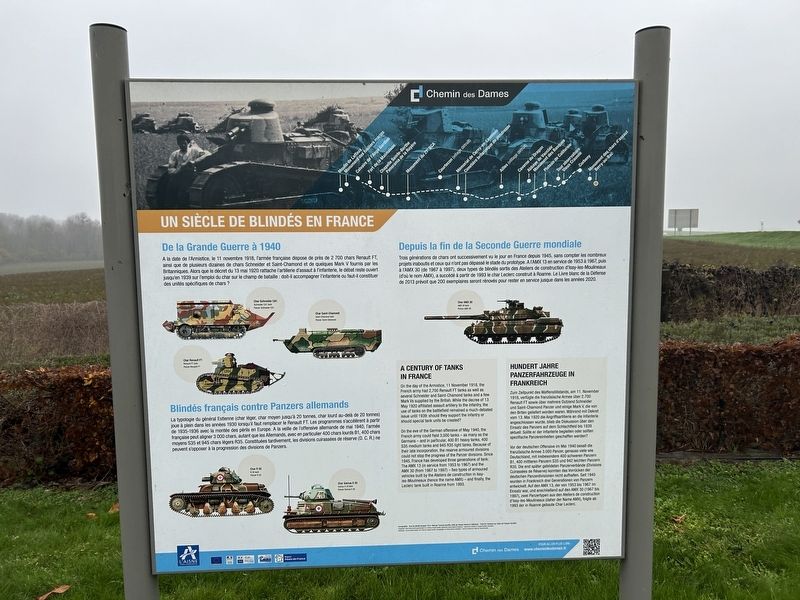
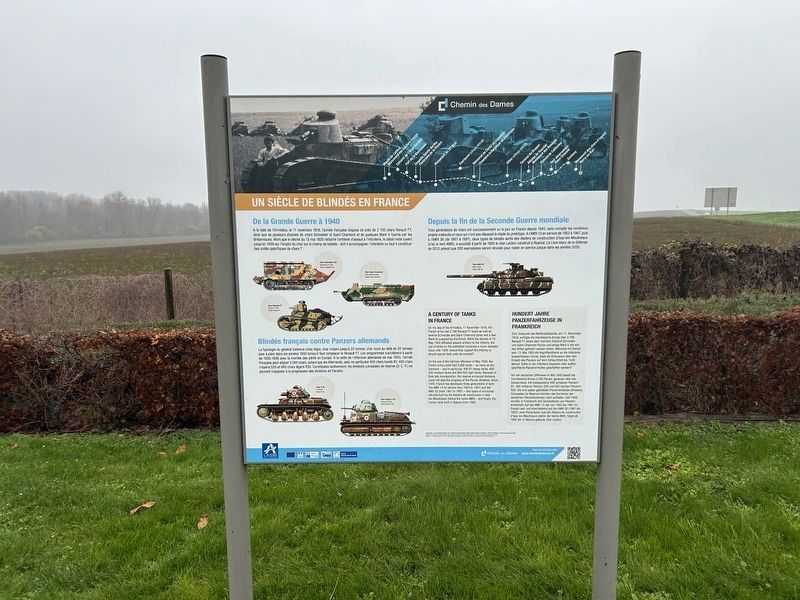
De la Grande Guerre à 1940 A la date de l'Armistice, le 11 novembre 1918, l'armée française dispose de près de 2 700 chars Renault FT, ainsi que de plusieurs dizaines de chars Schneider et Saint-Chamond et de quelques Mark V fournis par les Britanniques. Alors que le décret du 13 mai 1920 rattache l'artillerie d'assaut à l'infanterie, le débat reste ouvert jusqu'en 1939 sur l'emploi du char sur le champ de bataille : doit-il accompagner l'infanterie ou faut-il constituer des unités spécifiques de chars
Blindés français contre Panzers allemands
La typologie du général Estienne (char léger, char moyen jusqu'à 20 tonnes, char lourd au-delà de 20 tonnes) joue à plein dans les années 1930 lorsqu'il faut remplacer le Renault FT. Les programmes s'accétèrent à partir de 1935-1936 avec la montée des périls en Europe. A la veille de l'offensive allemande de mai 1940, l'armée française peut aligner 3 000 chars, autant que les Allemands, avec en particulier 400 chars lourds B1, 400 chars moyens S35 et 945 chars légers R35. Constituées tardivement, les divisions cuirassées de réserve (D. C. R.) ne peuvent s'opposer à la
this page online
Depuis la fin de la Seconde Guerre mondiale
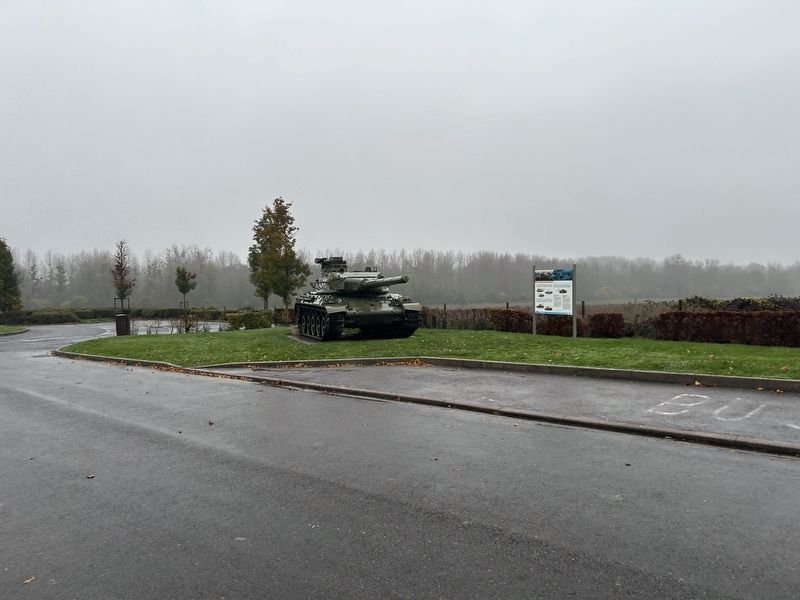
Trois générations de chars ont successivement vu le jour en France depuis 1945, sans compter les nombreux projets inaboutis et ceux qui n'ont pas dépassé le stade du prototype. A l'AMX 13 en service de 1953 à 1967, puis à l'AMX 30 (de 1967 à 1997), deux types de blindés sortis des Ateliers de construction d'Issy-les-Moulineaux (d'où le nom AMX), a succédé à partir de 1993 le char Leclerc construit à Roanne. Le Livre blanc de la Défense de 2013 prévoit que 200 exemplaires seront rénovés pour rester en service jusque dans les années 2020.
On the day of the Armistice, 11 November 1918, the French army had 2,700 Renault FT tanks as well as several Schneider and Saint-Chamond tanks and a few Mark Vs supplied by the British. While the decree of 13 May 1920 affiliated assault artillery to the infantry, the use of tanks on the battlefield remained a much-debated issue until 1939: should they support the infantry or should special tank units be created?
On the eve of the German offensive of May 1940, the French army could field
Photographed by Steve Stoessel, November 18, 2024
2. Un Siècle de Blindés en France Marker
Zum Zeitpunkt des Waffenstillstands, am 11. November 1918, verfügte die französische Armee über 2.700 Renault FT sowie über mehrere Dutzend Schneider und Saint-Chamond Panzer und einige Mark V, die von den Briten geliefert worden waren. Während mit Dekret vom 13. Mai 1920 die Angriffsartillerie an die Infanterie angeschlossen wurde, blieb die Diskussion über den Einsatz des Panzers auf dem Schlachtfeld bis 1939 aktuell: Sollte er der Infanterie begleiten oder sollten spezifische Panzereinheiten geschaffen werden?
Vor der deutschen Offensive
Photographed by Steve Stoessel, November 18, 2024
3. Un Siècle de Blindés en France Marker
Topics. This historical marker is listed in these topic lists: Roads & Vehicles • War, World I • War, World II. A significant historical date for this entry is May 13, 1920.
Location. 49° 24.794′ N, 3° 53.268′ E. Marker is in Berry-au-Bac, Hauts-de-France (Upper France), in Aisne. It can be reached from the intersection of Hauts-de-France Route 925 and Route 1044. Touch for map. Marker is in this post office area: Berry-au-Bac, Hauts-de-France 02190, France. Touch for directions.

Regionally,
Photographed by Steve Stoessel, November 18, 2024
4. Un Siècle de Blindés en France Marker
Other nearby markers. At least 8 other markers are within walking distance of this marker: Le Chemin des Dames (a few steps from this marker); Le Char Schneider CA-1 (a few steps from this marker); La Nissance d’une Nouvelle Arme (within shouting distance of this marker); 1918: La Victoire du Char (within shouting distance of this marker); The Offensive of April 16, 1917 / L’offensive du 16 Avril 1917 (within shouting distance of this marker); 16 Avril 1917: Le Premier Engagement des Chars (within shouting distance of this marker); Berry-au-Bac et la Mémoire de l’Arme Blindée (within shouting distance of this marker); Aux Morts Des Chars d'Assaut (within shouting distance of this marker). Touch for a list and map of all markers in Berry-au-Bac.
Credits. This page was last revised on February 4, 2025. It was originally submitted on February 3, 2025, by Steve Stoessel of Niskayuna, New York. This page has been viewed 118 times since then and 25 times this year. Photos: 1. submitted on February 3, 2025, by Steve Stoessel of Niskayuna, New York. 2, 3, 4. submitted on February 4, 2025, by Steve Stoessel of Niskayuna, New York.
