
Near Berry-au-Bac in Aisne, Upper France, France — Western Europe
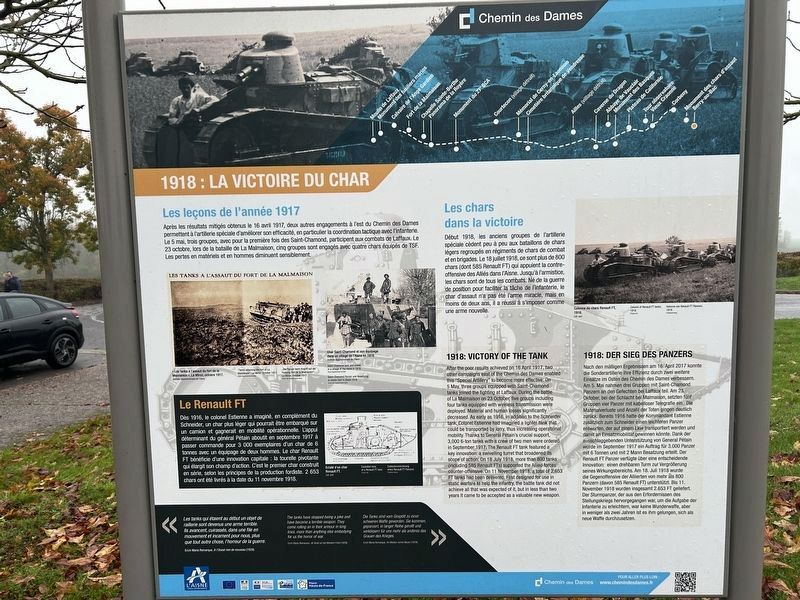
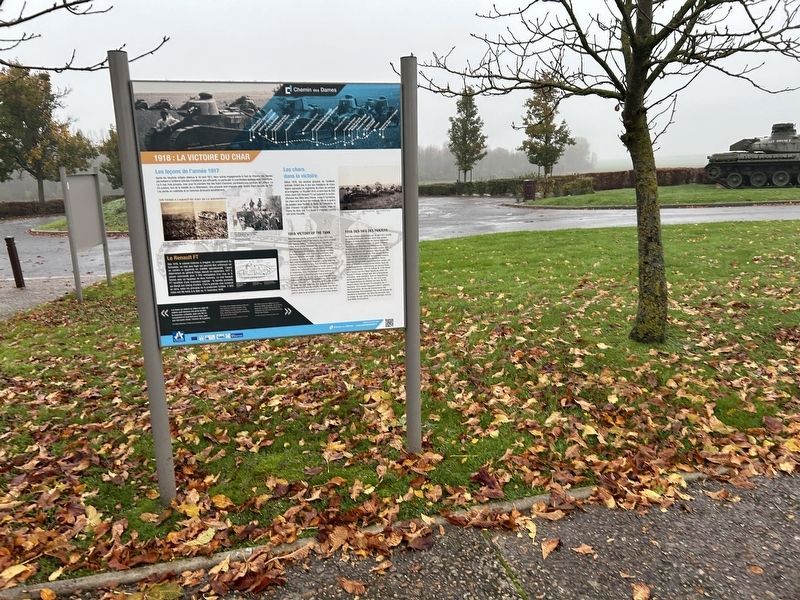
1918: La Victoire du Char
1918: The Victory of the Tank
| — | Chemin des Dames | — |
Photographed by Steve Stoessel, November 18, 2024
1. 1918: La Victoire du Char Marker

Les leçons de l'année 1917
Après les résultats mitigés obtenus le 16 avril 1917, deux autres engagements à l'est du Chemin des Dames permettent à l'artillerie spéciale d'améliorer son efficacité, en particulier la coordination tactique avec l'infanterie. Le 5 mai, trois groupes, avec pour la première fois des Saint-Chamond, participent aux combats de Laffaux. Le 23 octobre, lors de la bataille de La Malmaison, cinq groupes sont engagés avec quatre chars équipés de TSF. Les pertes en matériels et en hommes diminuent sensiblement.
Les chars dans la victoire
Début 1918, les anciens groupes de l'artillerie spéciale cèdent peu à peu aux bataillons de chars légers regroupés en régiments de chars de combat et en brigades. Le 18 juillet 1918, ce sont plus de 800 chars (dont 585 Renault FT) qui appuient la contre-offensive des Alliés dans l'Aisne. Jusqu'à l'armistice, les chars sont de tous les combats. Né de la guerre de position pour faciliter la tâche de l'infanterie, le char d'assaut n'a pas été l'arme miracle, mais en moins de deux ans, il a réussi a s'imposer comme une arme nouvelle.
After
this page online
Photographed by Steve Stoessel, November 18, 2024
2. 1918: La Victoire du Char Marker
Nach den mäßigen Ergebnissen am 16. April 2017 konnte die Sonderartillerie ihre Effizienz durch zwei weitere Einsätze im Osten des Chemin des Dames verbessern. Am 5. Mai nahmen drei Gruppen mit Saint-Chamond Panzern an den Gefechten bei Laffaux teil. Am 23. Oktober, bei der Schlacht bei Malmaison, setzten fünf Gruppen vier Panzer mit kabelloser Telegrafie ein. Die Materialverluste und Anzahl der Toten gingen deutlich zurück. Bereits 1916 hatte der Kommandant Estienne zusätzlich zum Schneider einen leichteren Panzer entworfen, der auf einem Lkw transportiert werden und damit an Einsatzmobilität gewinnen könnte. Dank der ausschlaggebenden Unterstützung von General Pétain wurde im September 1917 ein Auftrag für 3.000 Panzer mit 6 Tonnen und mit 2 Mann Besatzung erteilt. Der Renault FT Panzer verfügte über eine entscheidende Innovation: einen drehbaren Turm zur Vergröberung seines Wirkungsbereichs. Am 18. Juli 1918 wurde die Gegenoffensive der Alliierten von mehr als 800 Panzern (davon 585 Renault FT) unterstützt. Bis 11.November 1918 wurden insgesamt 2.653 FT
Photographed by Steve Stoessel, November 18, 2024
3. 1918: La Victoire du Char Marker
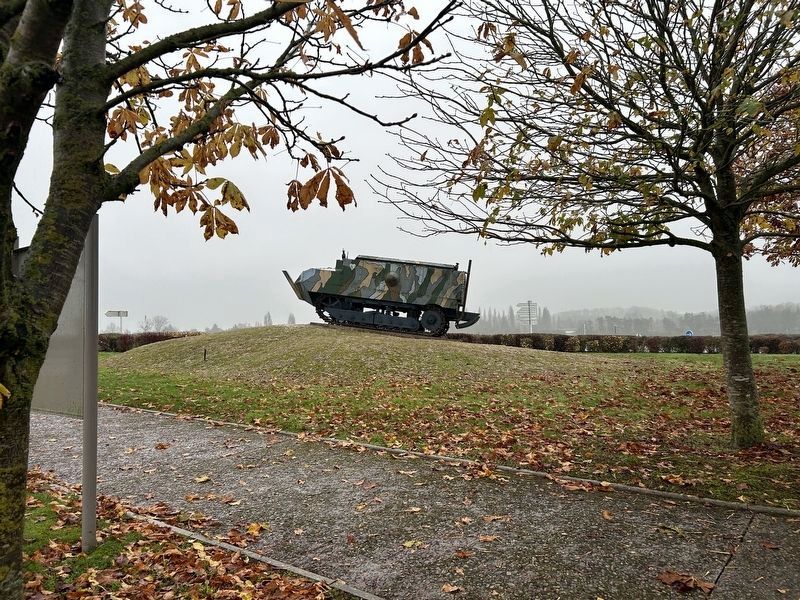
Dès 1916, le colonel Estienne a imaginé, en complément du Schneider, un char plus léger qui pourrait être embarque sur un camion et gagnerait en mobilité opérationnelle. L'appui déterminant du général Pétain aboutit en septembre 1917 à passer commande pour 3 000 exemplaires d'un char de 6 tonnes avec un équipage de deux hommes. Le char Renault FT bénéficie d'une innovation capitale : la tourelle pivotante qui élargit son champ d'action. C'est le premier char construit en série, selon les principes de la production fordiste. 2 653 chars ont été livrés à la date du 11 novembre 1918.
[Photo Captions]
Topics. This historical marker is listed in these topic lists: Roads & Vehicles • War, World I. A significant historical date for this entry is April 16, 1917.
Location. 49° 24.792′ N, 3° 53.241′ E. Marker is near Berry-au-Bac, Hauts-de-France (Upper France), in Aisne. It can be reached from the intersection of Hauts-de-France Route 925 and Route 1044. Touch for map. Marker is in this post office area: Berry-au-Bac, Hauts-de-France 02190, France. Touch for directions.

Regionally, it is in the North Atlantic Region, Europe, the European Union, Atlantic Europe, the Schengen Area, Western Europe, a coastal Mediterranean country, and the Western World. Historically, it finds itself in what was once a French colony and also the Roman Empire.
Other nearby markers. At least 8 other markers are within walking distance of this marker: La Nissance d’une Nouvelle Arme (here, next to this marker); The Offensive of April 16, 1917 / L’offensive du 16 Avril 1917 (a few steps from this marker); Le Char Schneider CA-1 (a few steps from this marker); 16 Avril 1917: Le Premier Engagement des Chars (a few steps from this marker); Berry-au-Bac et la Mémoire de l’Arme Blindée (a few steps from this marker); Le Chemin des Dames (within shouting distance of this marker); Un Siècle de Blindés en France (within shouting distance of this marker); Cholera Crossroads (within shouting distance of this marker). Touch for a list and map of all markers in Berry-au-Bac.
Credits. This page was last revised on February 4, 2025. It was originally submitted on February 3, 2025, by Steve Stoessel of Niskayuna, New York. This page has been viewed 151 times since then and 26 times this year. Photos: 1, 2, 3. submitted on February 3, 2025, by Steve Stoessel of Niskayuna, New York.
