Kottakakom in Kochi, Kerala, India — भारत (South Asia)
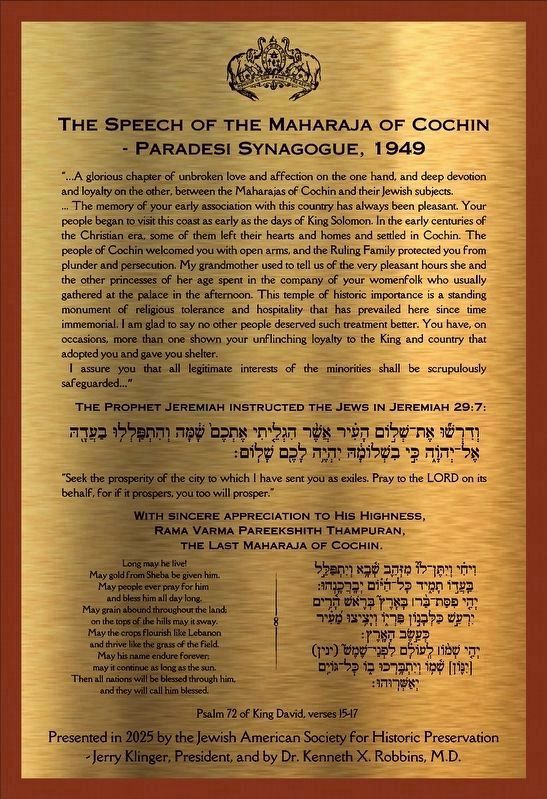
The Speech of the Maharaja of Cochin
Paradesi Synagogue, 1949
Photographed by Devan Varma
1. The Speech of the Maharaja of Cochin Marker
“…A glorious chapter of unbroken love and affection on the one hand, and deep devotion and loyalty on the other, between the Maharajas of Cochin and their Jewish subjects.... The memory of your early association with this country has always been pleasant. Your people began to visit this coast as early as the days of King Solomon. In the early centuries of the Christian era, some of them left their hearts and homes and settled in Cochin. The people of Cochin welcomed you with open arms, and the Ruling Family protected you from plunder and persecution. My grandmother used to tell us of the very pleasant hours she and the other princesses of her age spent in the company of your womenfolk who usually gathered at the palace in the afternoon. This temple of historic importance is a standing monument of religious tolerance and hospitality that has prevailed here since time immemorial. I am glad to say no other people deserved such treatment better. You have, on occasions, more than one shown your unflinching loyalty to the King and country that adopted you and gave you shelter. I assure you that all legitimate interests of the minorities shall be scrupulously safeguarded…
The Prophet Jeremiah instructed the Jews in Jeremiah 29:7:(Hebrew)
"Seek the prosperity of the city to which I have sent you as exiles. Pray to the LORD on its behalf, for if it prospers, you too will prosper."
"With sincere appreciation to His Highness, Rama Varma Pareekshith Thampuran, the Last Maharaja of Cochin.
Long may he live! May gold from Sheba be given him. May people ever pray for him and bless him all day long. May grain abound throughout the land; on the tops of the hills may it sway. May the crops flourish like Lebanon and thrive like the grass of the field. May his name endure forever; may it continue as long as the sun.
this page online
Psalm 72 of King David, verses 15-17 (Hebrew)
Presented in 2025 by the Jewish American Society for Historic Preservation, Jerry Klinger President, and Dr. Kenneth X. Robbins M.D.
Erected 2025 by Jewish American Society for Historic Preservation, the Cochin Royal Family Heritage Historical Society, and Dr. Kenneth X. Robbins M.D.
Topics. This historical marker is listed in this topic list: Notable Events. A significant historical year for this entry is 1949.
Location. 9° 56.624′ N, 76° 20.568′ E. Marker is in Kochi, Kerala. It is in Kottakakom. It can be reached from Kalikotta Palace Road. Touch for map. Marker is in this post office area: Kochi, Kerala 68230-1, India. Touch for directions.

Regionally, it is in Asia, specifically in South Asia, in the Indian Subcontinent, on the Arabian Sea, on the Bay of Bengal, and in the Anglosphere. Historically, it finds itself in what was once the Mughal Empire, Portuguese colonies, and a British colony.
Other nearby markers. At least 2 other markers are within 13 kilometers of this marker, measured
Photographed by Devan Varma
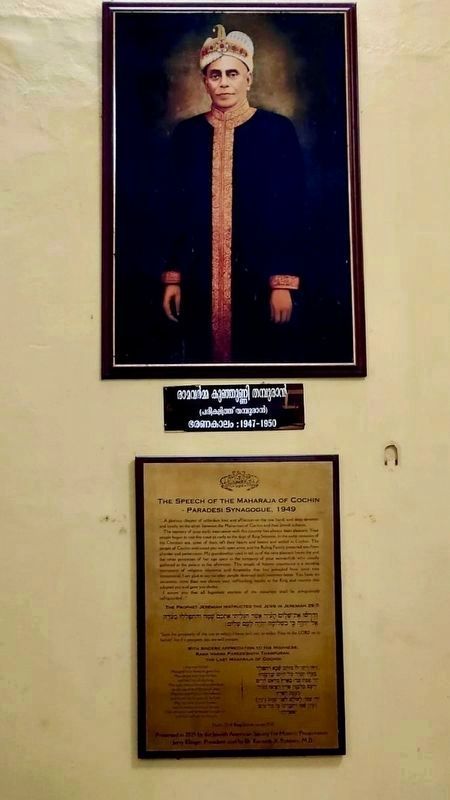
2. The Speech of the Maharaja of Cochin Marker at Kalikotta Palace
More about this marker. The marker is located below the portrait of His Highness, Rama Varma Pareekshith Thampuran, the Last Maharaja of Cochin.
Also see . . .
1. The Cochin Jews Of Kerala.
Varied traditions about the origin of the Cochin Jews appear in travelers’ accounts and in Hebrew chronicles from Malabar, some written as early as the 17th century. Some records say the first Jews sailed to South India on the ships of King Solomon; others say they came during the Babylonian exile; others that they fled to Malabar after the destruction of the Second Temple; and others refer to a fourth-century migration from Majorca.(Submitted on February 3, 2025, by Jerry Klinger of Boynton Beach, Florida.)
2. Cochin in Jewish History.
After the discovery of the sea‑route to India around the Cape of Good Hope, when the Portuguese King Manuel (1469‑1521) began from 1497 on to send continuous naval expeditions to the West Coast of India in order to control and monopolize the spice trade between India and the West, the Portuguese succeeded in establishing their first firm foothold on the Malabar Coast the very territory on the Indian West Coast which had been for many centuries a seat of Jewish settlements.(Submitted on February 3, 2025, by Jerry Klinger of Boynton Beach, Florida.)
3. The Jewish Story.
The oldest documentary evidence of a Jewish community in Kerala dates from 1000 CE when a Jewish leader named Joseph Rabban received a set of engraved copper plates from the Hindu ruler of Cranganore. These plates, which are still preserved in the Cochin Paradesi synagogue, list economic and ceremonial privileges including exemption(Submitted on February 3, 2025, by Jerry Klinger of Boynton Beach, Florida.)from paying taxes, the right to collect tolls, and the honour of using particular lamps, umbrellas, drums, and trumpets associated with high ritual status. By this time the Jews were firmly established in the area.Photographed by Devan Varma, February 3, 20253. The Speech of the Maharaja of Cochin Marker
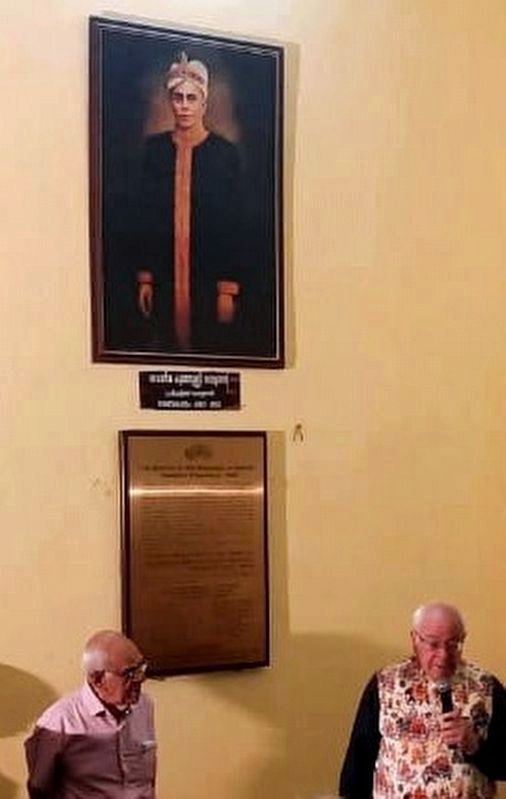
4. Speech of the Maharaja - The Question of Dual Loyalty.
It was an extraordinary event, in an extraordinary location with a message that spanned thousands of years. It resonates today in a world or rising antisemitism and accusations of Jewish dual loyalty.(Submitted on February 7, 2025, by Jerry Klinger of Boynton Beach, Florida.)
February 3, 2025, a historical marker, was presented in the Royal Cochin (India) Family Kalikotta Palace in Kochi, Kerala. The 2’x3’ foot brass marker mounted on rosewood is sited below the portrait of His Highness, Rama Varma Pareekshith Thampuran, the Last Maharaja of Cochin.
Additional keywords. Jews of Cochin
Credits. This page was last revised on February 8, 2025. It was originally submitted on February 3, 2025, by Jerry Klinger of Boynton Beach, Florida. This page has been viewed 223 times since then and 21 times this year. Photos: 1, 2, 3. submitted on February 3, 2025, by Jerry Klinger of Boynton Beach, Florida. • J. Makali Bruton was the editor who published this page.
