Hanau in Main-Kinzig-Kreis, Hesse, Germany — Central Europe
Johann Winter von Güldenbronn
Photographed by Andrew Ruppenstein, February 3, 2025
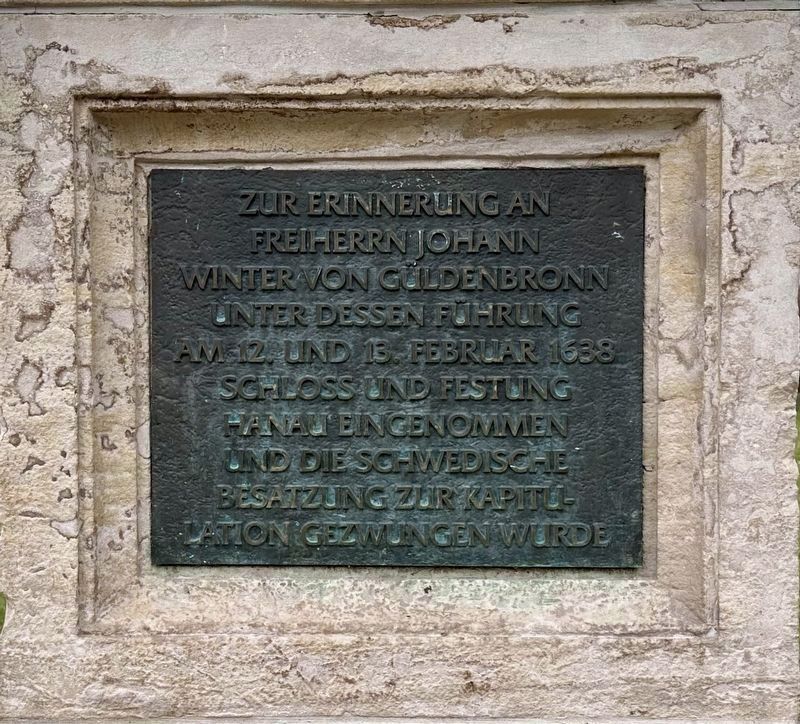
1. Johann Winter von Güldenbronn memorial - front panel

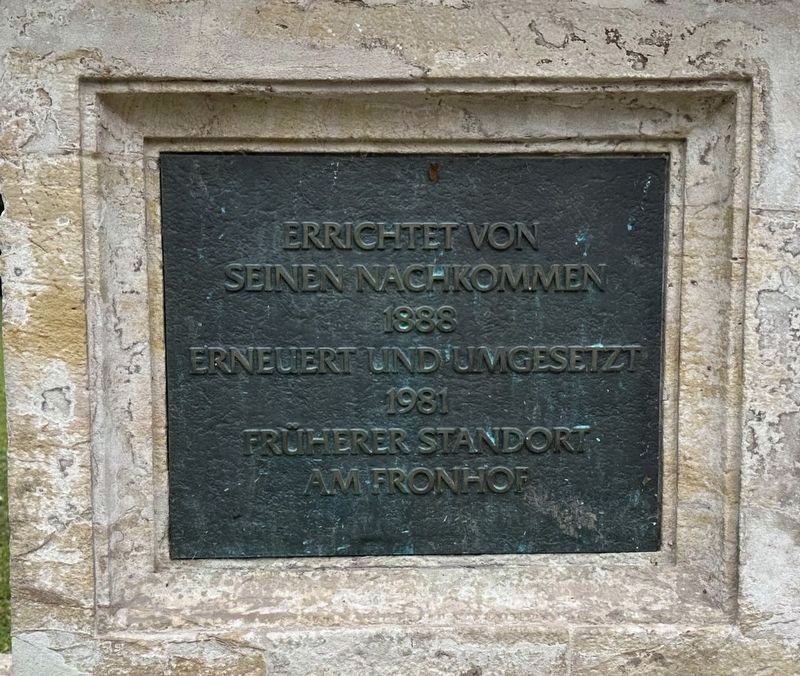
Errichtet von seinen Nachkommen 1888
Erneuert und umgesetzt 1981
Früherer Standort am Fronhof
In memory of Baron Johann Winter von Güldenbronn, under whose leadership the castle and fortress of Hanau were captured on February 12 and 13, 1638, thus forcing the Swedish garrison to surrender.
Erected by his descendants in 1888
Renovated and relocated in 1981
Former location at Fronhof
Erected 1888.
Topics. This memorial is listed in this topic list: Wars, Non-US. A significant historical date for this entry is February 12, 1638.
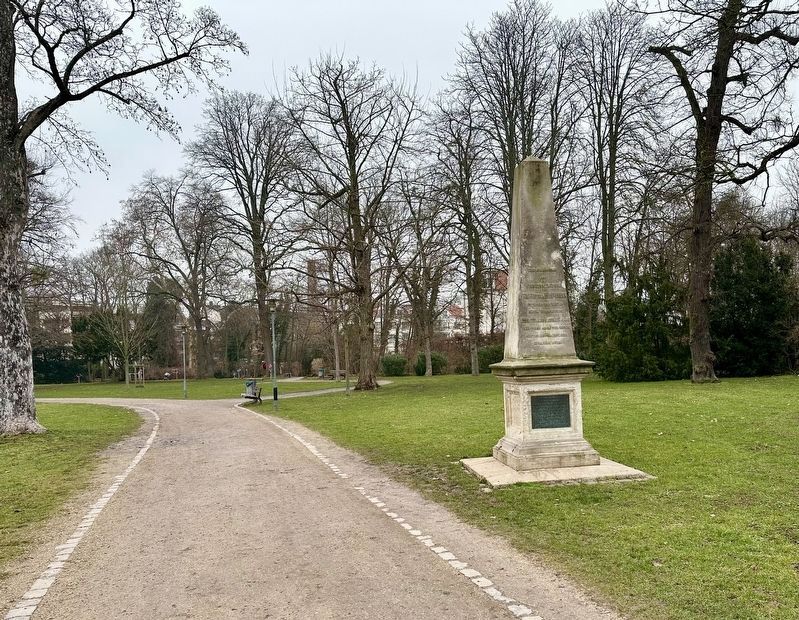
Location. 50° 8.287′ N, 8° 55.259′ E. Memorial is in Hanau, Hessen (Hesse), in Main-Kinzig-Kreis. It is on Nordstraße, on the left when traveling north. The memorial is in the Schlossgarten, just a few steps in from the Nordstrasse entrance to the park. Touch for map. Memorial is in this post office area: Hanau HE 63450, Germany. Touch for directions.

Regionally,
this page online
Other nearby markers. At least 8 other markers are within walking distance of this marker: Wohnhaus der Kaufsmannsfamilie Friedrich Hirsch / Familial Residence of Merchant Friedrich Hirsch (about 150 meters away, measured in a direct line); Marie Hassenpflug und Hanau (about 180 meters away); Zum Gedenken an die Jüdischen Gemeinde Hanau / In memory of the Jewish Community of Hanau II (about 210 meters away); Zum Gedenken an die Jüdischen Gemeinde Hanau / In Memory of the Jewish Community of Hanau I (about 210 meters away); Hanau Synagogue Memorial (about 210 meters away); Kanzleibau / Chancellery Building (about 240 meters away); Pumpenstock / Water Pumping Station (approx. 0.2 kilometers away); Dietrich Bonhoeffer (approx. 0.3 kilometers away). Touch for a list and map of all markers in Hanau.
Also see . . . Johann Winter von Güldenborn (Wikipedia, in German). Conquest
Photographed by Andrew Ruppenstein, February 3, 2025
2. Johann Winter von Güldenbronn memorial - rear panel
(Submitted on February 4, 2025.)
The ruling Count of Hanau-Münzenberg, Philipp Moritz, had abandoned the imperial cause at the approach of King Gustav II Adolf and fled with his family to the Netherlands after the Battle of Nördlingen. The Swedish general Jakob von Ramsay remained in command of the city of Hanau for years. He also remained in the Hanau Fortress when Count Philipp Moritz managed to reconcile with the emperor in 1637, switch back to his side and return to Hanau. General Ramsay simply imprisoned the count in his castle in Hanau. He was obviously hoping to succeed the count as ruler of Hanau-Münzenberg.
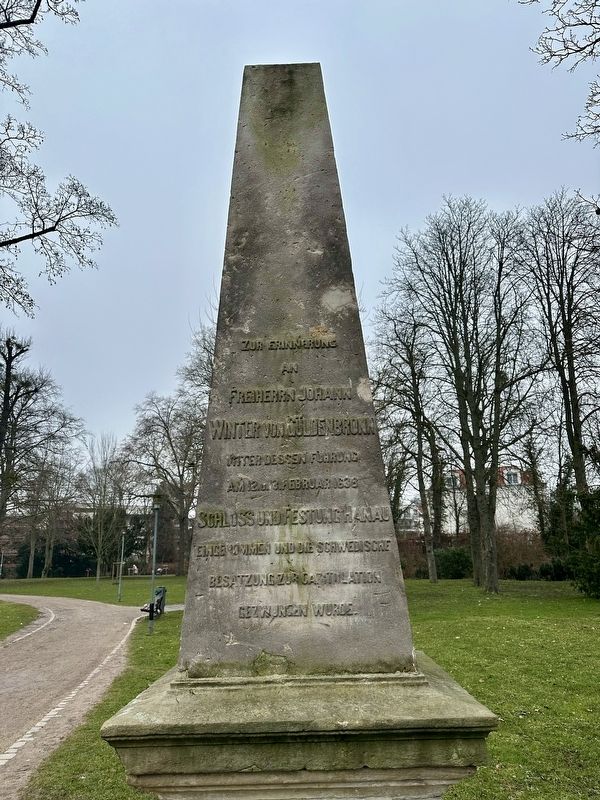
On February 12th 1638, however, forces friendly to the count seized the fortress in a military coup carried out by friendly members of the Wetterau Counts' Association and carried out by Major Johann Winter. Early in the morning, Winter's soldiers entered the fortress at the Herrnmühle, first freed the count who was imprisoned in the city palace and then occupied the fortifications of the old town. This put the garrison in a hopeless situation because the new town was unfortified compared to the old town. GeneralRamsay was then arrested himself and taken to Dillenburg, where he succumbed to the injuries he had sustained during this action a year and a half later. Count Philipp Moritz was reinstated in the government.Photographed by Andrew Ruppenstein, February 3, 20253. Johann Winter von Güldenbronn - front of obelisk with inscriptionThe inscription on the obelisk is the same as on the front panel directly below it.
Photographed by Andrew Ruppenstein, February 3, 2025
4. Johann Winter von Güldenbronn memorial
Credits. This page was last revised on February 4, 2025. It was originally submitted on February 4, 2025, by Andrew Ruppenstein of Lamorinda, California. This page has been viewed 112 times since then and 16 times this year. Photos: 1, 2, 3, 4. submitted on February 4, 2025, by Andrew Ruppenstein of Lamorinda, California.
