Ripa in Roma in Città metropolitana di Roma Capitale, Latium, Rome, Italy — Central Italy (Tyrrhenian Coast)
L'Arco di Tito
⎯⎯⎯
The Arch of Titus

Photographed by James Hulse, February 27, 2024
1. L'Arco di Tito / The Arch of Titus Marker

L'Arco di Tito. Le fonti antiche narrano che nel Circo Massimo esisteva già in età repubblicana un arco fatto costruire da Lucio Stertinio nel 196 a.C.; forse lo stesso fatto distruggere nel 68 d.C. da Nerone.
Nell'81 d.C. nella parte curvilinea del Circo venne edificato un nuovo arco dedicato all'imperatore Tito, nell'anno della sua morte, dal Senato e dal Popolo Romano per la celebrazione della vittoria sui Giudei e la distruzione di Gerusalemme del 70 d.C., come ricorda la lunga iscrizione che era incisa con lettere bronzee sull'attico e il cui testo è giunto fino a noi L'arco si trovava lungo il percorso del corteo trionfale organizzato dai generali e dagli imperatori vittoriosi al ritorno dalle campagne belliche; la processione prendeva avvio dal Campo Marzio ed entrava nel Circo Massimo sfilando nella pista e, passando sotto l'arco, si dirigeva fino al tempio di Giove Capitolino sul Campidoglio.
Il monumento è raffigurato sulla Forma Urbis e su rilievi, mosaici e su varie monete.
L'arco a tre fornici intercomunicanti, alto circa 20 metri e largo circa 17 metri, era realizzato in marmo lunense
this page online
Nell'area restano visibili i tre piedistalli delle colonne dei fornici laterali con due basi delle colonne e i piedistalli retrostanti di due lesene. Sono anche conservati i blocchi in travertino di due piloni e frammenti dei fusti delle colonne scanalate.
In età tardoantica la zona fu interessata da un riutilizzo sistematico dei materiali dell'arco. Nel IX-X secolo avvenne un primo crollo degli elementi strutturali appartenenti alle parti alte del monumento; rimasero tuttavia in piedi ancora le colonne e qualche frammento della muratura, che poi vennero distrutti al più tardi nel XII secolo quando anche le colonne furono fatte a pezzi e riutilizzate in nuove costruzioni.
Didascalie
(Foto #1) Rilievo con corsa di quadrighe nel Circo Massimo, metà III d.C. Particolare con la raffigurazione dell'Arco di Tito, Museo di Palazzo Trinci (Foligno)
(Foto #2) "Già comincia la sfilata, raccoglietevi e tacete, è il momento di applaudire. Avanza il corteo sfavillante d'ore". Ovidio, Amori III, 2, 43-44.
(Foto #3) Ricostruzione dell'arco di Tito (Sovrintendenza Capitolina-Laboratorio di Rilevo e Tecniche Digitali, Dip, di Architettura UniRoma Tre)
(Foto #4) Pianta ricostruttiva dell'arco di Tito (Sovrintendenza Capitolina)
(Foto #5) L'arco di Tito al centro dell'emiciclo del Circo Massimo (ricostruzione Sovrintendenza Capitolina)
(Foto #6) Il percorso della processione trionfale (Sovrintendenza Capitolina)
(Foto #7) Il rinvenimento dei resti dell'Arco di Tito nel 2015
The Arch of Titus.

Photographed by James Hulse, February 27, 2024
2. The Arch of Titus Marker
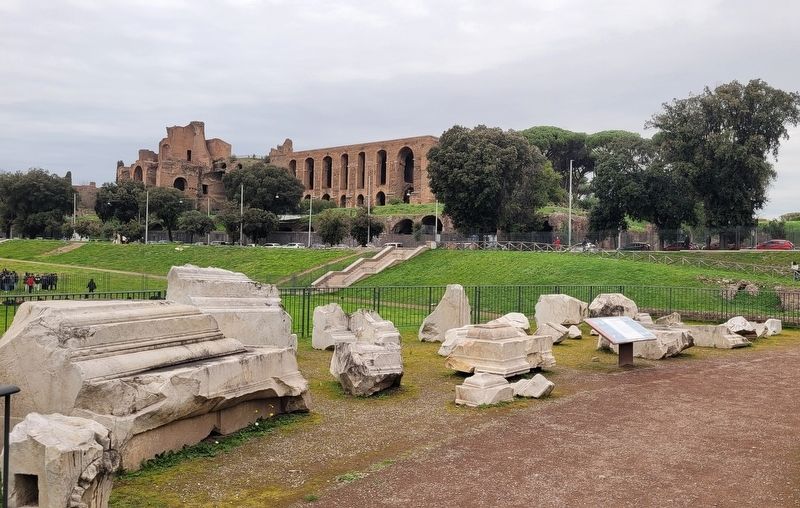
The Arch of Titus archaeological site is located to the right of the medieval tower.
In 81 A.D., a new arch was built on the curved end of the Circus Maximus and dedicated to the Emperor Titus, in the year of his death, by the Senate and the people of Rome, to celebrate the victory over the Jews and the destruction of Jerusalem in 70 A.D., as the lengthy inscription in bronze letters on the entablature declared, the text of which has come down to us.
The arch was situated along the route taken by the triumphal processions arranged by victorious Roman generals and emperors upon their return from their military campaigns. Processions would start in the Campus Martius, enter the Circus Maximus and march down the track, then pass under the arch and proceed towards the temple of Jupiter Capitolinus on the Capitoline Hill.
The arch may be seen on the ancient marble map, the Forma Urbis, and in mosaics, reliefs and coins. Almost 20 metres high and roughly 17 metres wide, and featuring three interconnecting
Photographed by James Hulse, February 27, 2024
3. Fragments of the Arch of Titus
Today, the three pedestals of the columns around the side archways can still be seen, along with two bases of the original columns and the pedestals of two rear pilasters. The travertine blocks of two piers and fragments of the shafts of the fluted columns are also still visible.
In the Late Antique period, the area was pillaged for its marble and the components of the arch were repurposed for use elsewhere. In the ninth and tenth centuries, the tallest portions of the arch collapsed, while the columns and fragments of the walls were still standing; these would be destroyed for good in the twelfth century, when the columns were broken up and used in new buildings.
Captions
(Photo #1) Relief depicting a quadriga race in the Circus Maximus. Mid-3rd century A.D. Detail showing the Arch of Titus, Museo di Palazzo Trinci (Foligno)
(Photo #2) "But now the procession is coming - keep silence all, and attend! The time for applause is here. The golden procession is coming".
(Photo #3) Reconstruction of the Arch of Titus (Superintendency of Cultural Heritage for the City of Rome-Roma Tre University, Department of Architecture)
(Photo #4) A reconstructed floor plan of the Arch of Titus (Superintendency of Cultural Heritage for the City of Rome)
(Photo #5) The Arch of Titus at the centre of the hemicycle of the Circus Maximus (reconstruction by the Superintendency of Cultural Heritage for the City of Rome)
(Photo #6) The route of the triumphal procession (Superintendency of Cultural Heritage for the City of Rome)
(Photo #7) The excavation of the remains of the Arch of Titus in 2015
Erected by Rome.
Topics. This historical marker is listed in these topic lists: Anthropology & Archaeology • Architecture. A significant historical year for this entry is 2015.
Location. 41° 53.072′ N, 12° 29.295′ E. Marker is in Roma, Lazio (Latium, Rome), in Città metropolitana di Roma Capitale. It is in Ripa. It is at the intersection of Viale Aventino and Via del Circo Massimo on Viale Aventino. The marker is located on the south end of the Circus Maximus Archaeological Site. Touch for map. Marker is in this post office area: Roma, Lazio 00186, Italy. Touch for directions.

Regionally, it is in Europe, the European Union, the Schengen Area, a coastal Mediterranean country, and the Western World. Historically, it finds itself in what was once the Roman Empire.
Other nearby markers. At least 8 other markers are within walking distance of this marker: La Torre della Moletta / The Moletta Tower (a few steps from this marker); La Struttura / The Circus Structure (a few steps from this marker); Il Mulino e le Macine / The Mill and the Millstones (a few steps from this marker); L'Acqua Mariana / The Mariana Water (within shouting distance of this marker); Frammenti Dell'Arco di Tito / Fragments From the Arch of Titus (within shouting distance of this marker); L'Emiciclo / The Hemicycle (within shouting distance of this marker); Circo Massimo (within shouting distance of this marker); Il Circo Massimo / The Circus Maximus (within shouting distance of this marker). Touch for a list and map of all markers in Roma.
More about this marker. There is a small entry fee to visit the Circus Maximus Archaeological Site.
Also see . . . Circus Maximus. Wikipedia
The Circus Maximus (Latin for "largest circus"; Italian: Circo Massimo) is an ancient Roman chariot-racing stadium and mass entertainment venue in Rome, Italy. In the valley between the Aventine and Palatine hills, it was the first and largest stadium in ancient Rome and its later Empire. It measured 621 m (2,037 ft) in length and 118 m (387 ft) in width and could accommodate over 150,000 spectators. In its fully developed form, it became the model for circuses throughout the Roman Empire.(Submitted on February 5, 2025, by James Hulse of Medina, Texas.)
Credits. This page was last revised on February 5, 2025. It was originally submitted on February 4, 2025, by James Hulse of Medina, Texas. This page has been viewed 129 times since then and 10 times this year. Photos: 1, 2, 3. submitted on February 5, 2025, by James Hulse of Medina, Texas.
