Ripa in Roma in Città metropolitana di Roma Capitale, Latium, Rome, Italy — Central Italy (Tyrrhenian Coast)
Frammenti Dell'Arco di Tito
⎯⎯⎯
Fragments From the Arch of Titus

Photographed by James Hulse, February 27, 2024
1. Frammenti Dell'Arco di Tito / Fragments From the Arch of Titus Marker

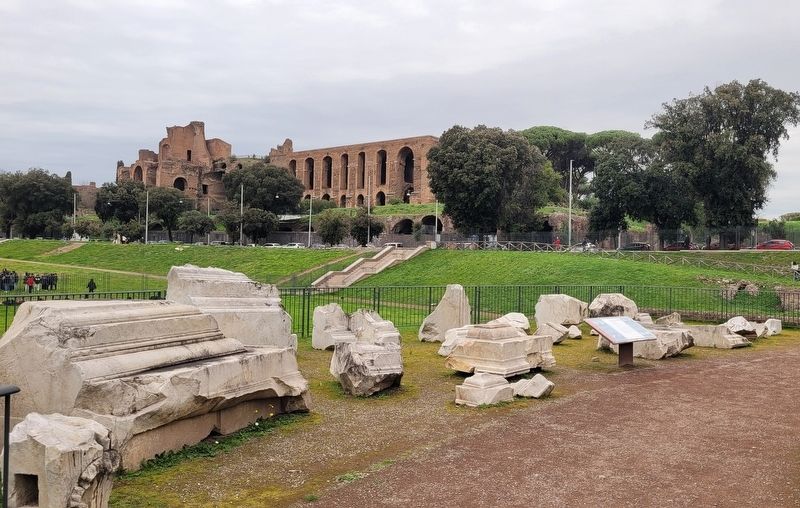
Frammenti Dell'Arco di Tito. Sulla terrazza della torre sono stati allestiti grandi frammenti architettonici pertinenti alla decorazione dell'Arco di Tito, rinvenuti per la maggior parte nelle indagini archeologiche degli anni 2014-2015. I frammenti, tutti intagliati nel marmo lunense estratto dalle cave di Carrara, appartengono alla decorazione della zona dell'attico e della trabeazione del monumento. Nel pannello è proposta una ricostruzione dell'alzato dell'arco in cui compaiono inseriti i frammenti nella loro collocazione originaria.
Nelle indagini archeologiche sono stati rivenuti frammenti della grande iscrizione a lettere bronzee che era incisa sull'attico ed il cui testo completo è giunto fino a noi grazie alla trascrizione che ne fece un pellegrino, l'Anonimo di Einsiedeln, nel IX secolo. Due conservano rispettivamente la cornice inferiore e superiore che chiudeva lo specchio epigrafico, permettendo così un loro posizionamento quasi certo. L'iscrizione ricorda la dedica dell'arco nell'81 d.C. da parte del Senato e del Popolo Romano all'imperatore Tito per celebrare il suo trionfo sui Giudei
this page online
Didascalie
(Foto #1) L'arco di Tito al centro dell'emiciclo del Circo Massimo, rilievo della Sovrintendenza Capitolina-Laboratorio di Rilievo e Tecniche Digitali, UniRoma Tre, Dip. di Architettura, (Ricostruzione grafica: ARPS S.r.l.)
Fragments From the Arch of Titus. On the roof terrace of the tower large architectural fragments from the decoration of the Arch of Titus have been arranged; most of them came to light during archaeological excavations in 2014-1015. The fragments are all made of Lunense marble from the quarries in Carrara, and pertain to the decoration of the arch's trabeated entablature. In this panel, a graphic representation shows a reconstruction of the archway with the fragments inserted in their original positions.
The archaeological excavations brought to light fragments of the large inscription in bronze letters that was carved on the entablature,
Photographed by James Hulse, February 27, 2024
2. The view of the Fragments From the Arch of Titus and Marker
Captions
(Photo #1) The Arch of Titus at the centre of the hemicycle of the Circo Massimo, reconstruction by the Superintendency of Cultural Heritage for the City of Rome - Roma Tre University, Department of Architecture, (Graphic reconstruction: ARPS S.r.l.)
Erected by Rome.
Topics. This historical marker is listed in this topic list: Anthropology & Archaeology. A significant historical year for this entry is 81 CE.
Location. 41° 53.086′ N, 12° 29.29′ E. Marker is in Roma, Lazio (Latium, Rome), in Città metropolitana di Roma Capitale. It is in Ripa. It is at the intersection of Viale Aventino and Via del Circo Massimo on Viale Aventino. The marker is located on the south end of the Circus Maximus Archaeological Site. Touch for map. Marker is in this post office area: Roma, Lazio 00186, Italy. Touch for directions.

Regionally, it is in Europe, the European Union, the Schengen Area, a coastal Mediterranean country, and the Western World. Historically, it finds itself in what was once the Roman Empire.
Other nearby markers. At least 8 other markers are within walking distance of this marker: Il Mulino e le Macine / The Mill and the Millstones (a few steps from this marker); La Torre della Moletta / The Moletta Tower (a few steps from this marker); L'Arco di Tito / The Arch of Titus (within shouting distance of this marker); Circo Massimo (within shouting distance of this marker); Le Latrine / The Latrines (within shouting distance of this marker); L'Età Moderna / The Modern Age (within shouting distance of this marker); Il Fornice XII / Vaulted Chamber XII (within shouting distance of this marker); L'Emiciclo / The Hemicycle (within shouting distance of this marker). Touch for a list and map of all markers in Roma.
More about this marker. There is a small entry fee to visit the Circus Maximus Archaeological Site.
Also see . . . Circus Maximus. Wikipedia
The Circus Maximus (Latin for "largest circus"; Italian: Circo Massimo) is an ancient Roman chariot-racing stadium and mass entertainment venue in Rome, Italy. In the valley between the Aventine and Palatine hills, it was the first and largest stadium in ancient Rome and its later Empire. It measured 621 m (2,037 ft) in length and 118 m (387 ft) in width and could accommodate over 150,000 spectators. In its fully developed form, it became the model for circuses throughout the Roman Empire.(Submitted on February 5, 2025, by James Hulse of Medina, Texas.)
Credits. This page was last revised on February 5, 2025. It was originally submitted on February 5, 2025, by James Hulse of Medina, Texas. This page has been viewed 102 times since then and 9 times this year. Photos: 1, 2. submitted on February 5, 2025, by James Hulse of Medina, Texas.
