Central Omaha in Douglas County, Nebraska — The American Midwest (Upper Plains)
The Dodge Street Overpass
Combining Form and Function in a "Structure of Beauty"
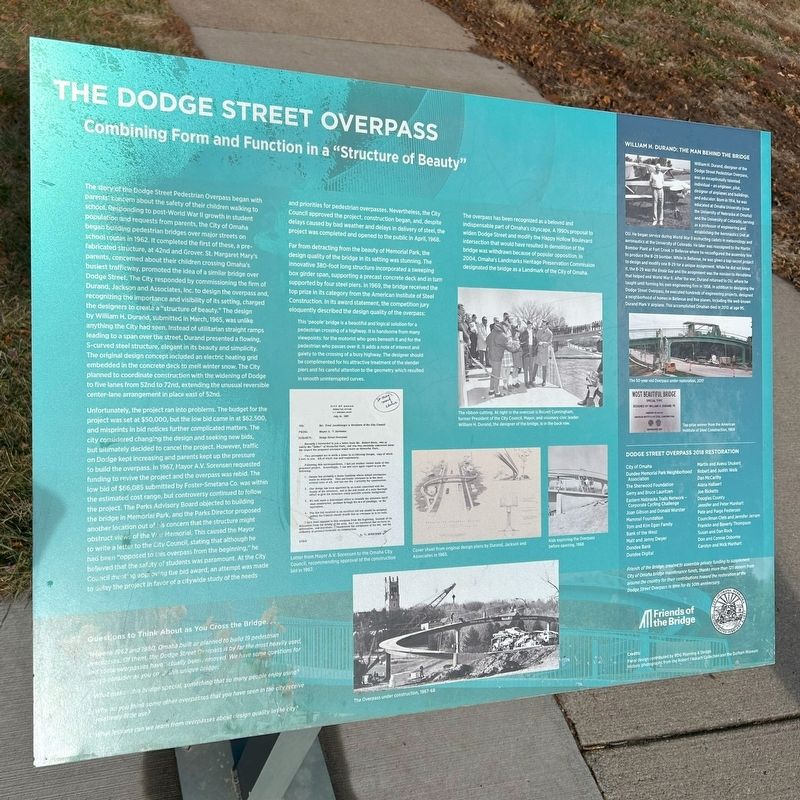
December 28, 2024
1. The Dodge Street Overpass Marker
this page online
Unfortunately, the project ran into problems. The budget for the project was set at $50,000, but the low bid came in at $62,500, and misprints in bid notices further complicated matters. The city considered changing the design and seeking new bids, but ultimately decided to cancel the project. However, traffic on Dodge kept increasing and parents kept up the pressure to build the overpass. In 1967, Mayor A.V. Sorensen requested funding to revive the project and the overpass was rebid. The low bid of $66,085 submitted by Foster-Smetana Co. was within the estimated cost range, but controversy continued to follow the project. The Parks Advisory Board objected to building the bridge in Memorial Park, and the Parks Director proposed another location out of his concern that the structure might obstruct views of the War Memorial. This caused the Mayor to write a letter to the City Council, stating that although he had been "opposed to this
December 28, 2024
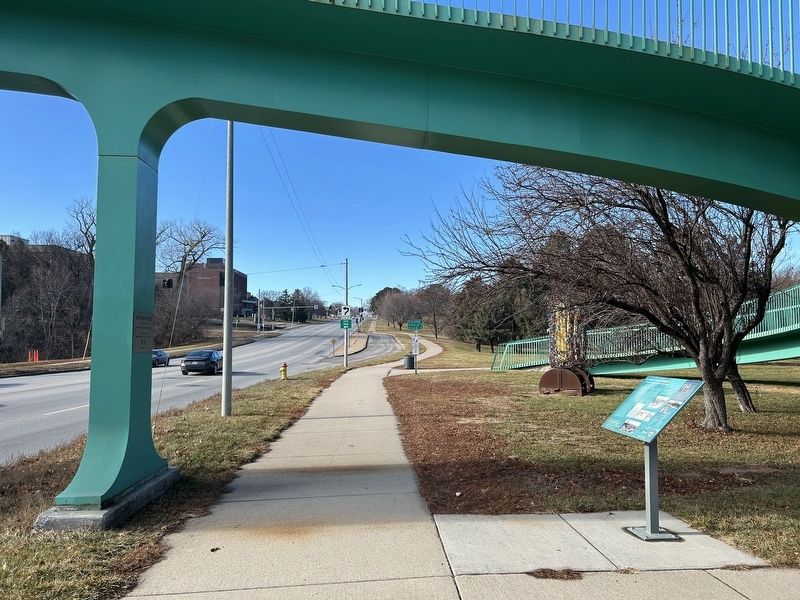
2. The Dodge Street Overpass Marker, from the east
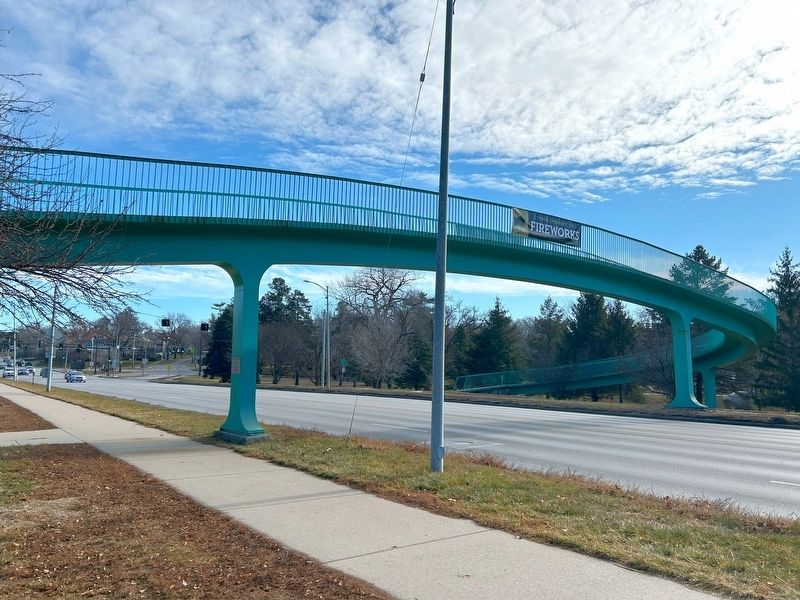
Far from detracting from the beauty of Memorial Park, the design quality of the bridge in its setting was stunning. The innovative 380-foot long structure incorporated a sweeping box girder span, supporting a precast concrete deck and in turn supported by four steel piers. In 1969, the bridge received the top prize in its category from the American Institute of Steel Construction. In its award statement, the competition jury eloquently described the design quality of the overpass:
This 'people' bridge is a beautiful and logical solution for a pedestrian crossing of a highway. It is handsome from many viewpoints: for the motorist who goes beneath it and for thepedestrian who passes over it. It adds a note of interest and gaiety to the crossing of a busy highway. The designer should be complimented for his attractive treatment of the slender piers and his careful attention to the geometry which resulted in smooth uninterrupted curves.December 28, 20243. The Dodge Street Overpass
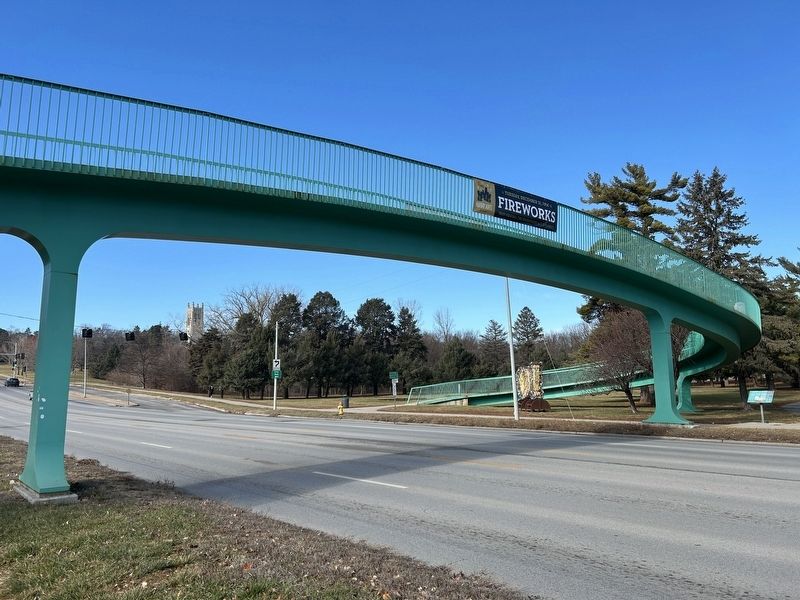
The overpass has been recognized as a beloved and indispensable part of Omaha's cityscape. A 1990s proposal to widen Dodge Street and modify the Happy Hollow Boulevard intersection that would have resulted in demolition of the bridge was withdrawn because of popular opposition. In 2004, Omaha's Landmarks Heritage Preservation Commission designated the bridge as a Landmark of the City of Omaha.
The ribbon-cutting. At right in the overcoat is Robert Cunningham, former President of the City Council, Mayor, and visionary civic leader. William H. Durand, the designer of the bridge, is in the back row.
Letter from Mayor A.V. Sorenson to the Omaha City Council, recommending approval of the construction bid in 1967.
Cover sheet from original design plans by Durand, Jackson and Associates in 1965.
Kids exploring the Overpass before opening, 1968
The Overpass under construction, 1967-68
Questions
December 28, 2024
4. The Dodge Street Overpass
Between 1962 and 1980, Omaha built or planned to build 19 pedestrian overpasses. Of them, the Dodge Street Overpass is by far the most heavily used, and some overpasses have actually been removed. We have some questions for you to consider as you cross this unique bridge:
1. What makes this bridge special, something that so many people enjoy using?
2. Why do you think some other overpasses that you have seen in the city receive relatively little use?
3. What lessons can we learn from overpasses about design quality in the city?
William H. Durand: The Man Behind the Bridge
William H. Durand, designer of the Dodge Street Pedestrian Overpass, was an exceptionally talented individual – an engineer, pilot, designer of airplanes and buildings, and educator. Born in 1914, he was educated at Omaha University (now the University of Nebraska at Omaha) and the University of Colorado, serving as a professor of engineering and establishing the Aeronautics Unit at OU. He began service during World War II instructing cadets in meteorology and aeronautics at the University of Colorado. He later

December 28, 2024
5. Most Beautiful Bridge Plaque
Most Beautiful Bridge
Special Type
Designed by William H. Durand, PE
Awarded in 1969 by American Institute of Steel Construction
Rededicated 2017
Special Type
Designed by William H. Durand, PE
Awarded in 1969 by American Institute of Steel Construction
Rededicated 2017
The 50-year old Overpass under restoration, 2017
Top prize winner from the American Institute of Steel Construction, 1969
Dodge Street Overpass 2018 Restoration
City of Omaha · Dundee Memorial Park Neighborhood Association · The Sherwood Foundation · Gerry and Bruce Lauritzen · Eastern Nebraska Trails Network – Corporate Cycling Challenge · Joan Gibson and Donald Wurster · Mammel Foundation · Tom and Kim Egan Family · Bank of the West · Matt and Jenny Dwyer · Dundee Bank · Dundee Digital · Martin and Aveva Shukert · Robert and Judith Welk · Dan McCarthy · Alana Hallaert · Joe Ricketts · Douglas County · Jennifer and Peter Manhart · Pete and Paige Festersen · Councilman Chris and Jennifer Jerram · Franklin and Beverly Thompson · Susan and Dan Rock · Don and Connie Osborne · Carolyn and Nick Manhart
Friends of the Bridge, created to assemble private funding to supplement City of Omaha bridge maintenance funds, thanks more than 125 donors from around the country for their contributions toward the restoration of the Dodge Street Overpass in time for its 50th anniversary.
Credits:
Panel design contributed by RDG Planning & Design
Historic photographs from the Robert Haskach Collection and the Durham Museum
Erected 2018 by Friends of the Bridge and City of Omaha.
Topics. This historical marker is listed in these topic lists: Bridges & Viaducts • Roads & Vehicles • War, World II. A significant historical month for this entry is April 1968.
Location. 41° 15.586′ N, 96° 0.185′ W. Marker is in Omaha, Nebraska, in Douglas County. It is in Central Omaha. It is on Dodge Street west of Farnam Street, on the right when traveling west. Located on the south side of Memorial Park. Touch for map. Marker is in this post office area: Omaha NE 68132, United States of America. Touch for directions.

Regionally, this marker is in Eastern Nebraska. It is also in the American Midwest, in the Lewis & Clark Corridor, in the Corn Belt, and on the prairies. Globally, it is in North America, the Western Hemisphere, the Western World, and the Anglosphere. Historically, it finds itself in what was once the Louisiana Purchase.
Other nearby markers. At least 8 other markers are within walking distance of this marker: Memorial Park (approx. 0.2 miles away); a different marker also named Memorial Park (approx. 0.2 miles away); Korean-Vietnam Peace Memorial (approx. 0.2 miles away); Douglas County World War II Memorial Shrine (approx. ¼ mile away); The Airborne Trooper (approx. 0.3 miles away); Medal of Honor (approx. 0.3 miles away); Airborne and Special Operations Medal of Honor (approx. 0.3 miles away); Freedom is Not Free (approx. 0.3 miles away). Touch for a list and map of all markers in Omaha.
Also see . . . The Dodge Street Overpass Between Elmwood and Memorial Parks. Omaha Exploration website entry (Submitted on February 5, 2025.)
Credits. This page was last revised on March 6, 2026. It was originally submitted on February 5, 2025. This page has been viewed 369 times since then and 71 times this year. Photos: 1, 2, 3, 4, 5. submitted on February 5, 2025.
