Near Consenvoye in Meuse, Alsace, Lorraine, Champagne-Ardenne, France — Western Europe
Consenvoye
German Military Cemetery
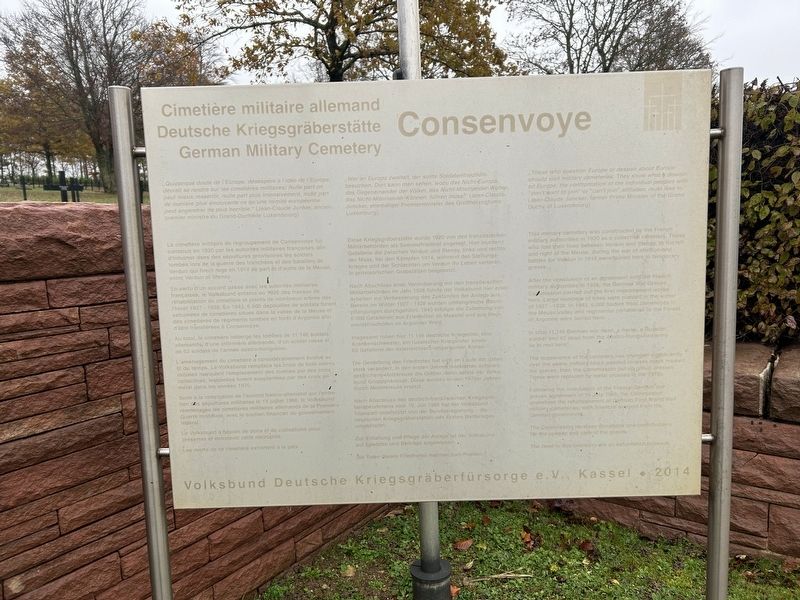
Photographed by Steve Stoessel, November 18, 2024
1. Consenvoye Marker

“Those who question Europe or despair about Europe should visit military cemeteries. They show what à disunited Europe, the confrontation of the individual peoples with "don't want to join" or "can't join" attitudes, must lead to." -(Jean-Claude Junker, former Prime Minister of the Grand Duchy of Luxembourg)
This military cemetery was constructed by the French military authorities in 1920 as a collective cemetery. Those who lost their lives between Verdun and Stendy, to the left and right of the Meuse, during the war of attrition/and battles for Verdun in 1914 were buried here in temporary graves.
After the conclusion of an agreement with the French military authorities in 1926, the German War Graves Commission carried out the first improvement works here. Large numbers of trees were planted in the winter of 1927 - 1928. In 1943, 6,000 bodies from cemeteries in the Meuse valley and regimental cemeteries in the Forest of Argonne were buried here
In total 11,146 German war dead, a horse, a Russian soldier and 62 dead from the Austro-Hungarian army lie at rest here.
The appearance of the cemetery has changed
this page online
Following the conclusion of the Franco-German War Graves Agreement of 19 July 1966, the Commission undertook the refurbishment of German First World War military cemeteries, with financial support from the German government.
The Commission receives donations and contributions for the upkeep and care of the graves.
The dead in this cemetery are an exhortation to peace
„Wer an Europa zweifelt, der sollte Soldatenfriedhöfe. besuchen. Dort kann man sehen, wozu das Nicht-Europa das Gegeneinander der Völker, das Nicht-Miteinander-Wollen, das Nicht-Miteinander-Können, führen muss!" - (Jean-Claude Juncker, ehemaliger Premierminister des Großherzogtums Luxemburg)
Diese Kriegsgräberstätte wurde 1920 von den französischen Militärbehörden als Sammelfriedhof angelegt. Hier wurden Gefallene die zwischen Verdun und Stenay, links und rechts der Maas, bei den Kämpfen 1914, während des Stellungskrieges und der Schlachten um Verdun ihr Leben

Photographed by Steve Stoessel, November 18, 2024
2. Consenvoye Marker
Nach Abschluss einer Vereinbarung mit den französischen Militärbehörden im Jahr 1926 führte der Volksbund hier erste Arbeiten zur Verbesserung des Zustandes der Anlage aus Bereits im Winter 1927 - 1928 wurden umfangreiche Baumpflanzungen durchgeführt. 1943 erfolgte die Zubettung von 6.000 Gefallenen aus Friedhöfen im Maastal und aus Regimentsfriedhöfen im Argonner Wald.
Insgesamt ruhen hier 11.146 deutsche Kriegstote, eine Krankenschwester, ein russischer Kriegstoter sowie 62 Gefallene der österreichisch-ungarischen Armee.
Die Gestaltung des Friedhofes hat sich im Laufe der Jahre stark verändert, In den ersten Jahren markierten schwarz gestrichene Holzkreuze die Gräber, dann setzte der Volksbund Gruppenkreuze. Diese wurden in den 1970er Jahren durch Metallkreuze ersetzt.
Nach Abschluss des deutsch-französischen Kriegsgräberabkommens vom 19. Juli 1966 hat der Volksbund - finanziell unterstützt von der Bundesregierung - die deutschen Kriegsgräberstätten des Ersten Weltkrieges umgestaltet.
Zur Erhaltung und Pflege der Anlage ist der Volksbund auf Spenden und Beiträge angewiesen.
Die Toten dieses Friedhofes mahnen zum Frieden
Quiconque doute de l'Europe, désespère à l'idée de l'Europe, devrait se rendre sur les cimetières militaires! Nulle part on peut mieux ressentir, nulle part plus intensivement, nulle part de manière plus émouvante ce qu'une inimité européenne peut engendrer de plus horrible." -(Jean-Claude Junker, ancien. premier ministre du Grand-Duchede Luxembourg)
Le cimetière militaire de regroupement de Consenvoye fut construit en 1920 par les autorités militaires françaises afin d'inhumer dans des sépultures provisoires les soldats tombés lors de la guerre des tranchées et des batailles de Verdun qui firent rage en 1914 de part et d'autre de la Meuse entre Verdun et Stenay.
En vertu d'un accora passe avec les autorités militaires françaises, le Volksbund entama en 1926 des travaux de réhabilitation du cimetière et planta de nombreux arbres des l'hiver 1927 - 1928. En 1943, 6 000 dépouilles de soldats furent exhumées de cimetières situés dans la vallée de la Meuse et des cimetières de régiments tombes en forêt d'Argonne afin d'être transférées. à Consenvoye.
Au total, le cimetière héberge les tombes de 11.146 soldats allemands, d'une infirmière allemande, d'un soldat russe el de 62 soldats de l'armée austro-hongroise.
L'aménagement du cimetière a considérablement évolué au fil du temps. Le Volksbund remplaça les croix de bois noires initiales marquant l'emplacement des tombes par des croix . collectives, lesquelles furent supplantées par des croix en métal dans les années 1970.
Suite à la conclusion de l'accord franco-allemand sur l'entretien ds sépultures militaires le 19 juillet 1966, le Volksbund réaménagea les cimetières militaires allemands de la Première Guerre mondiale avec le soutien financier du gouvernement fédéral.
Le Volksbund a besoin de dons et de cotisations pour préserver et entretenir cette nécropole.
Les morts de ce cimetière exhortent à la paix.
Erected 2014 by Volksbund Deutsche Kriegsgräberfürsorge e.V., Kassel • 2014.
Topics. This historical marker is listed in these topic lists: Cemeteries & Burial Sites • War, World I. A significant historical year for this entry is 1920.
Location. 49° 16.784′ N, 5° 17.797′ E. Marker is near Consenvoye, Grand Est (Alsace, Lorraine, Champagne-Ardenne), in Meuse. It is on Grand Est Route 964 1.1 kilometers south of Route de Damvillers ( Route 19), on the right when traveling north. Touch for map. Marker is in this post office area: Consenvoye, Grand Est 55110, France. Touch for directions.

Regionally, it is in the North Atlantic Region, Europe, the European Union, Atlantic Europe, the Schengen Area, Western Europe, a coastal Mediterranean country, and the Western World. Historically, it finds itself in what was once a French colony, the Roman Empire, and specifically the Holy Roman Empire.
Other nearby markers. At least 8 other markers are within 11 kilometers of this marker, measured as the crow flies: In Memory / A la Mémoire / Im Gedenken (a few steps from this marker); Deutscher Soldatenfriedhof Consenvoye (a few steps from this marker); In Memory (approx. 3.7 kilometers away); Présence de troupes austro-hongroises (approx. 3.7 kilometers away); La peré Barnabé (approx. 3.9 kilometers away); 5th U.S. Division (approx. 8.5 kilometers away); La nécropole nationale de Brieulles-sur-Meuse (approx. 11 kilometers away); Montfaucon American Monument (approx. 11.3 kilometers away). Touch for a list and map of all markers in Consenvoye.
Credits. This page was last revised on February 6, 2025. It was originally submitted on February 6, 2025, by Steve Stoessel of Niskayuna, New York. This page has been viewed 185 times since then and 47 times this year. Photos: 1, 2. submitted on February 6, 2025, by Steve Stoessel of Niskayuna, New York.
