St. George in Washington County, Utah — The American Mountains (Southwest)
Temple & Honeymoon Trails

Photographed by Bill Kirchner, August 28, 2012
1. Temple & Honeymoon Trails Marker
The Temple Trail
The temple trail is the route used from 1871 to 1877 to haul timber from Mt. Trumbull, Arizona, to St. George, Utah, for the building of the St. George LDS Temple. Pioneers traveled 80 miles along the rough, dirt road, hauling by horse drawn wagon, one million board feet of timber. In places, rock was laid by hand to build up a roadway which would support the heavy logging wagons. Negotiating the trail laced with washes, canyons, and sandy areas, from the valley bottom to the rim of Hurricane Fault, demonstrated the resourcefulness and faith of these Pioneers.
The Temple Trail is still an obscure wagon road which has faded with the passage of time. The depressions formed by the wagon wheels are still visible in some places. The staging sites for the Temple Trail are at the Sawmill at Mt. Trumbull and here at the St. George Temple.
The early settlers who were called to St. George were given an assignment to build a Temple in an inhospitable desert from scarce raw materials. They not only completed the tremendous task, but did so before building their own homes. The surrounding communities and the vast,
this page online
The Bureau of Land Management joins with the people of the area in honoring this historic colonizing event.
Old Arizona Road
Honeymoon Trail The original Old Arizona Road linked the Little Colorado settlements in Arizona to northern Utah through Kanab, Utah and Lee's Ferry, Arizona. Its southwestern extension, linked these same southern settlements to St. George, Utah, through Pipe Springs and the Arizona Strip. Settlers first began traveling this route in the 1860's and the road was established in the early 1870's. The Old Arizona Road soon became a major communication and transportation artery in addition to serving religious and economic functions.
The St. George LDS Temple opened in 1877. Many faithful members of the church traveled the Old Arizona Road from southern Arizona to the temple to be married or participate in other rites of the church. The name "Honeymoon Trail" comes from this use.
Religious use of the road declined with the arrival of railroads in northern Arizona and ceased in 1928 with the building of

Photographed by Bill Kirchner, August 28, 2012
2. The Temple Marker text
Topics. This historical marker is listed in these topic lists: Religion & Religious Structures • Roads & Vehicles • Settlements & Settlers. A significant historical year for this entry is 1871.
Location. Marker has been reported missing. It was located near 37° 6.026′ N, 113° 34.632′ W. Marker was in St. George, Utah, in Washington County. It was on South 300 East, on the right when traveling south. Touch for map. Marker was at or near this postal address: 490 South 300 East, Saint George UT 84770, United States of America. Touch for directions.

Regionally, this marker was in Utah’s Color Country. It was also in the American Southwest, in the Mountain West, and on the Colorado Plateau. Globally,
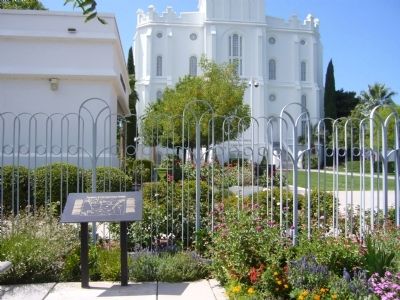
Photographed by Bill Kirchner, August 28, 2012
3. Temple & Honeymoon Trails Marker
Other nearby markers. At least 8 other markers are within walking distance of this location: Horatio Pickett House (approx. 0.4 miles away); D.A. McGregor Hospital (approx. half a mile away); Dixie Academy (approx. 0.6 miles away); Forever Dixie (approx. 0.6 miles away); The Electric Theatre (approx. 0.6 miles away); Tabernacle (approx. 0.6 miles away); St. George Stake Tabernacle (approx. 0.6 miles away); Erastus Fairbanks Snow (approx. 0.6 miles away). Touch for a list and map of all markers in St. George.
Related marker. Click here for another marker that is related to this marker. Honeymoon Trail marker located in Mesa, Arizona
Also see . . . Washington County Historical Society. Route Map, History and Photos of the Honeymoon Trail. (Submitted on June 19, 2020, by Bill Kirchner of Tucson, Arizona.)
Photographed by Bill Kirchner, August 28, 2012
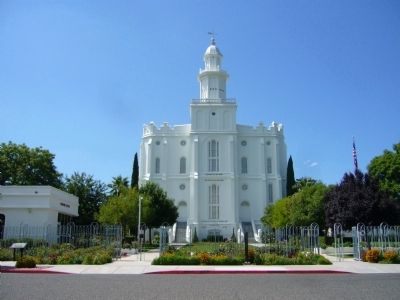
4. St. George Utah Temple
The Temple & Honeymoon Trails Marker is at the far left.

Photographed by Jeremy Snow, February 6, 2025
5. Temple & Honeymoon Trails Marker Missing
Credits. This page was last revised on February 7, 2025. It was originally submitted on September 9, 2012, by Bill Kirchner of Tucson, Arizona. This page has been viewed 1,555 times since then and 41 times this year. Last updated on February 6, 2025, by Jeremy Snow of Cedar City, Utah. Photos: 1, 2, 3, 4. submitted on September 9, 2012, by Bill Kirchner of Tucson, Arizona. 5. submitted on February 6, 2025, by Jeremy Snow of Cedar City, Utah. • J. Makali Bruton was the editor who published this page.
