Celio in Roma in Città metropolitana di Roma Capitale, Latium, Rome, Italy — Central Italy (Tyrrhenian Coast)
I "Buchi" del Colosseo
⎯⎯⎯
The "Holes" of the Colosseum
Photographed by James Hulse, February 27, 2024
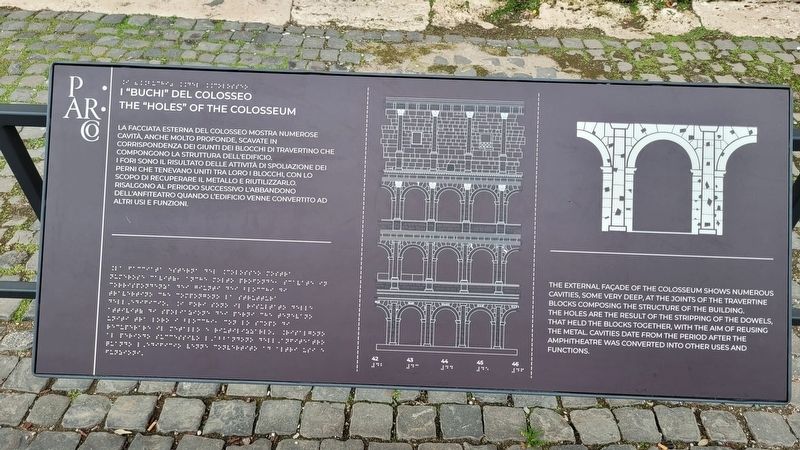
1. I "Buchi" del Colosseo / The "Holes" of the Colosseum Marker

La facciata esterna del colosseo mostra numerose cavità, anche molto profonde, scavate in corrispondenza dei giunti dei blocchi di travertino che compongono la struttura dell'edificio. I fori sono il risultato delle attività di spoliazione dei perni che tenevano uniti tra loro i blocchi, con lo scopo di recuperare il metallo e riutilizzarlo. Risalgono al periodo successivo l'abbandono dell'anfiteatro quando l'edificio venne convertito ad altri usi e funzioni.
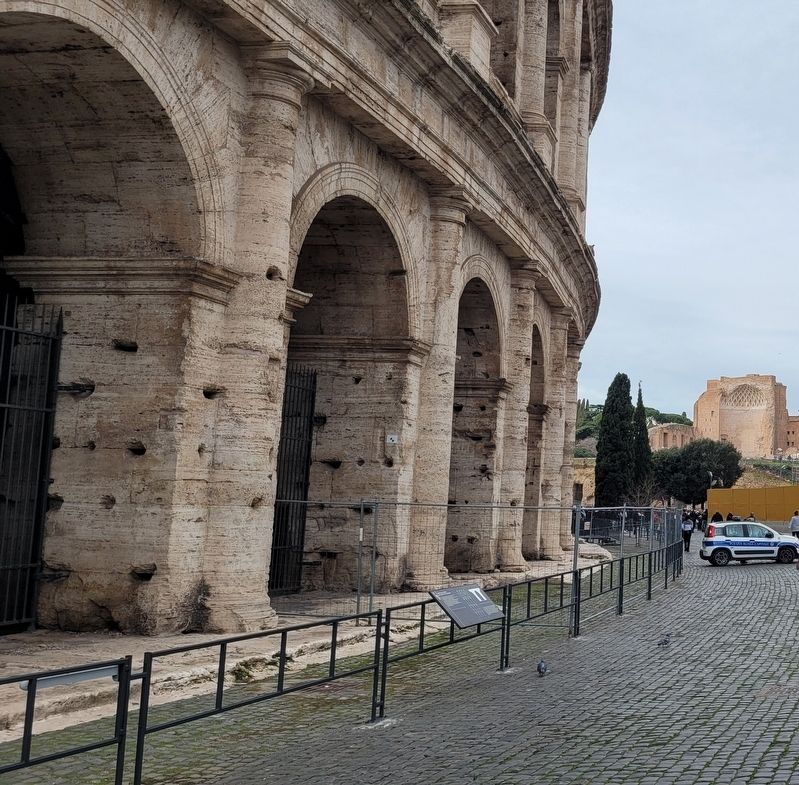
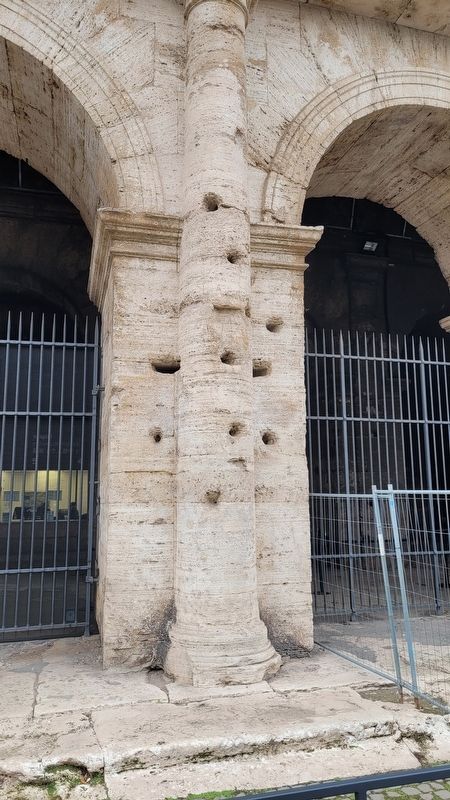
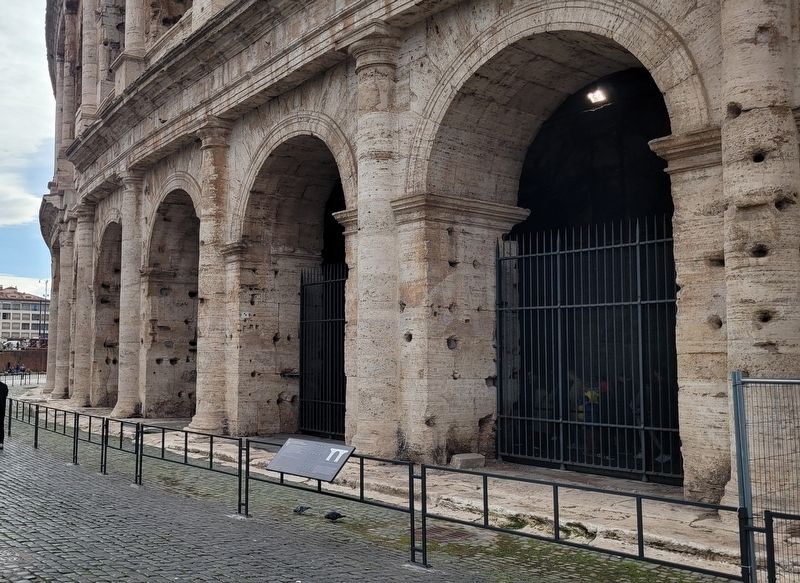
The external façade of the colosseum shows numerous cavities, some very deep, at the joints of the travertine blocks composing the structure of the building. The holes are the result of the stripping of the dowels, that held the blocks together, with the aim of reusing the metal. Cavities date from the period after the amphitheatre was converted into other uses and functions.
Erected by Parco.
Topics. This historical marker is listed in this topic list: Anthropology & Archaeology.
Location. 41° 53.46′ N, 12° 29.54′ E. Marker is in Roma, Lazio (Latium, Rome), in Città metropolitana
this page online

Regionally, it is in Europe, the European Union, the Schengen Area, a coastal Mediterranean country, and the Western World. Historically, it finds itself in what was once the Roman Empire.
Other nearby markers. At least 8 other markers are within walking distance of this marker: L'ingresso Imperiale / The Imperial Entrance (within shouting distance of this marker); Come Si Entrava Al Colosseo / How People Entered the Colosseum (within shouting distance of this marker); Via dell'Impero (about 120 meters away, measured in a direct line); Il Colosseo 72-80 D.C. / The Colosseum 72-80 A.D. (about 120 meters away); L'Amphitheatrum Flavium / The Flavian Amphitheater (about 120 meters away); Lo Sperone Stern / The Stern Spur (about 150 meters away); Anfiteatro Flavio/The Flavian Amphitheatre (about 180 meters away); Monti (about
Photographed by James Hulse, February 27, 2024
2. The "Holes" of the Colosseum and Marker
Also see . . . Colosseum. Wikipedia
The Colosseum is built of travertine limestone, tuff (volcanic rock), and brick-faced concrete. It could hold an estimated 50,000 to 80,000 spectators at various points in its history, having an average audience of some 65,000; it was used for gladiatorial contests and public spectacles including animal hunts, executions, re-enactments of famous battles, dramas based on Roman mythology, and briefly mock sea battles. The building ceased to be used for entertainment in the early medieval era. It was later reused for such purposes as housing, workshops, quarters for a religious order, a fortress, a quarry, and a Christian shrine.(Submitted on February 7, 2025, by James Hulse of Medina, Texas.)
Photographed by James Hulse, February 27, 2024
3. Closeup up of the "Holes" of the Colosseum
Photographed by James Hulse, February 27, 2024
4. The "Holes" of the Colosseum and Marker
Credits. This page was last revised on February 7, 2025. It was originally submitted on February 6, 2025, by James Hulse of Medina, Texas. This page has been viewed 289 times since then and 112 times this year. Photos: 1, 2, 3, 4. submitted on February 7, 2025, by James Hulse of Medina, Texas.
