Celio in Roma in Città metropolitana di Roma Capitale, Latium, Rome, Italy — Central Italy (Tyrrhenian Coast)
I Cippi Perimetrali
⎯⎯⎯
The Perimeter Cippi

Photographed by James Hulse, February 27, 2024
1. I Cippi Perimetrali / The Perimeter Cippi Marker

Il perimetro del Colosseo è definito da un'area larga circa 17 metri pavimentata in travertino e delimitata da cippi nello stesso materiale. Dove ti trovi sono visibili parte della pavimentazione, cinque cippi nella posizione originaria e, all'esterno, un tratto di strada in basoli. I cippi, collocati a intervalli regolari, erano infissi nel terreno senza fondazioni ed erano parte di un sistema di contenimento della folla. Gli esemplari conservati sono inclinati verso il colosseo per la spinta esercitata dagli interri retrostanti formatisi in età post-antica.
The perimeter of the colosseum includes an area about 17 metres wide paved with travertine slabs and bounded by travertine small pillars named cippi, made with the same material. From where you are, you can see part of the paving, five cippi in their original position and, outside, a section of road in large paving stones. The cippi, placed at regular intervals, were fixed in the ground without foundations and were part of a system of meant to hold the crowd. The preserved specimens are leaning towards the colosseum because of the thrust
this page online
Erected by Parco.
Topics. This historical marker is listed in this topic list: Anthropology & Archaeology.
Location. 41° 53.399′ N, 12° 29.657′ E. Marker is in Roma, Lazio (Latium, Rome), in Città metropolitana di Roma Capitale. It is in Celio. It is at the intersection of Piazza del Colosseo and Via di S. Giovanni in Laterano on Piazza del Colosseo. The marker is located at the eastern side of the Colosseum. Touch for map. Marker is in this post office area: Roma, Lazio 00184, Italy. Touch for directions.

Regionally, it is in Europe, the European Union, the Schengen Area, a coastal Mediterranean country, and the Western World. Historically, it finds itself in what was once the Roman Empire.
Other nearby markers. At least 8 other markers are within walking distance of this marker: Lo Sperone Stern / The Stern Spur (within shouting distance of this marker); Ludus Magnus / Great Training Arena (within shouting distance of this marker); L'Amphitheatrum Flavium / The Flavian Amphitheater (about 90 meters away, measured
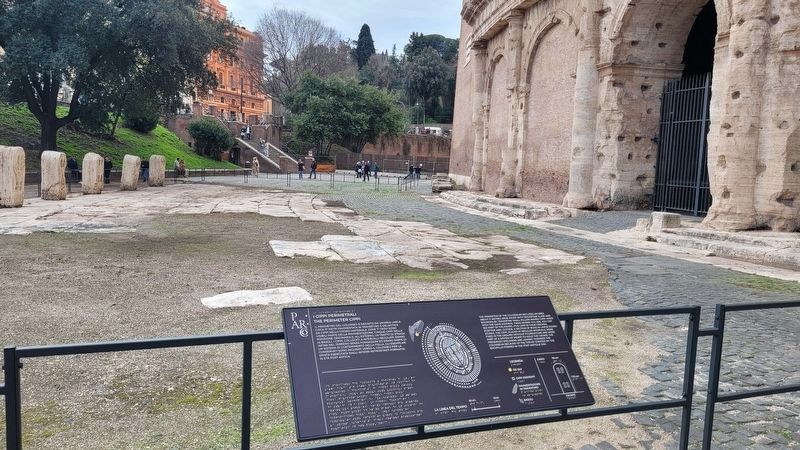
Photographed by James Hulse, February 27, 2024
2. The Perimeter Cippi and Marker
Also see . . . Colosseum. Wikipedia
The Colosseum is built of travertine limestone, tuff (volcanic rock), and brick-faced concrete. It could hold an estimated 50,000 to 80,000 spectators at various points in its history, having an average audience of some 65,000; it was used for gladiatorial contests and public spectacles including animal hunts, executions, re-enactments of famous battles, dramas based on Roman mythology, and briefly mock sea battles. The building ceased to be used for entertainment in the early medieval era. It was later reused for such purposes as housing, workshops, quarters for a religious order, a fortress, a quarry, and a Christian shrine.(Submitted on February 7, 2025, by James Hulse of Medina, Texas.)
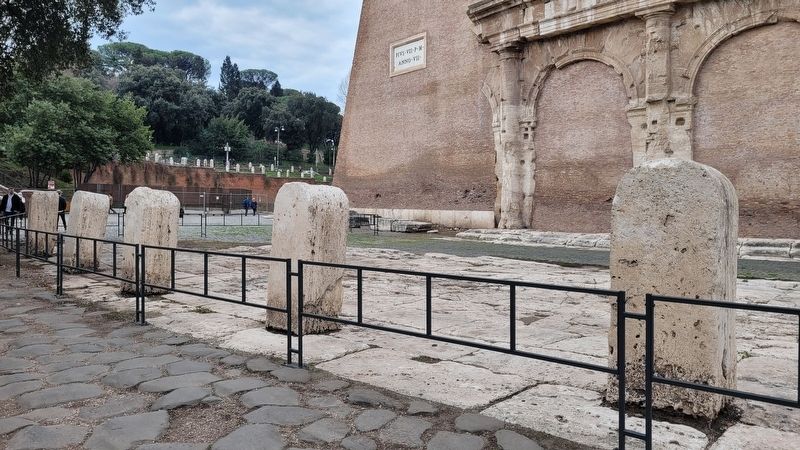
Photographed by James Hulse, February 27, 2024
3. The view of the remaining 5 Cippi next to the Colosseum
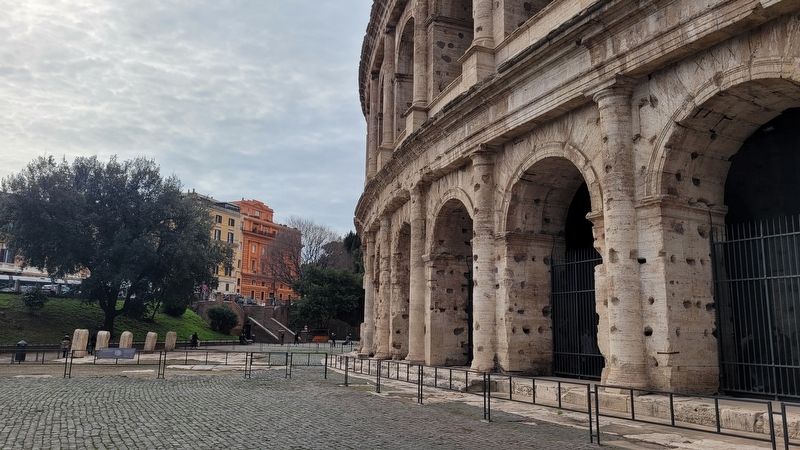
Photographed by James Hulse, February 27, 2024
4. The view of the Cippi, Marker and the Colosseum
Credits. This page was last revised on February 8, 2025. It was originally submitted on February 6, 2025, by James Hulse of Medina, Texas. This page has been viewed 130 times since then and 24 times this year. Photos: 1. submitted on February 7, 2025, by James Hulse of Medina, Texas. 2, 3, 4. submitted on February 8, 2025, by James Hulse of Medina, Texas.
