
Celio in Roma in Città metropolitana di Roma Capitale, Latium, Rome, Italy — Central Italy (Tyrrhenian Coast)
Lo Sperone Stern
⎯⎯⎯
The Stern Spur
Photographed by James Hulse, February 27, 2024
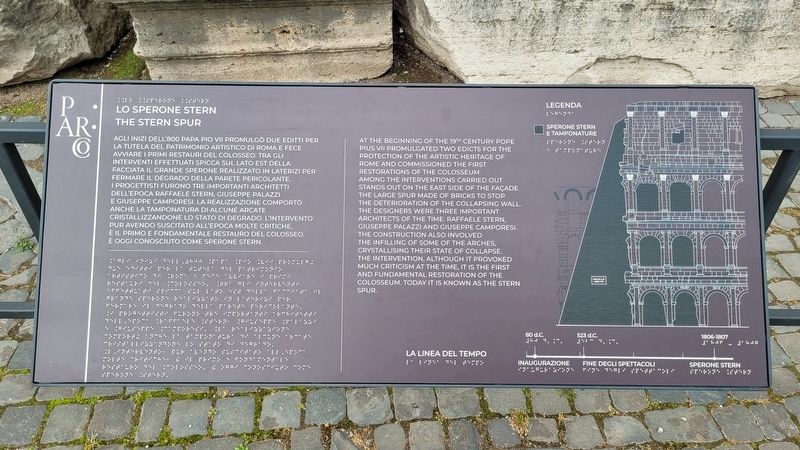
1. Lo Sperone Stern / The Stern Spur Marker

Agli inizi dell'800 Papa Pio VII promulgò due editti per la tutela del patrimonio artistico di Roma e fece avviare i primi restauri del Colosseo. Tra gli interventi effettuati spicca sul lato est della facciata il grande sperone realizzato in laterizi per fermare il degrado della parete pericolante. I progettisti furono tre importanti architetti dell'epoca Raffaele Stern, Giuseppe Palazzi e Giuseppe Camporesi. La realizzazione comportò anche la tamponatura di alcune arcate cristallizzandone lo stato di degrado. L'intervento pur avendo suscitato all'epoca molte critiche, è il primo e fondamentale restauro del Colosseo. È oggi conosciuto come Sperone Stern.
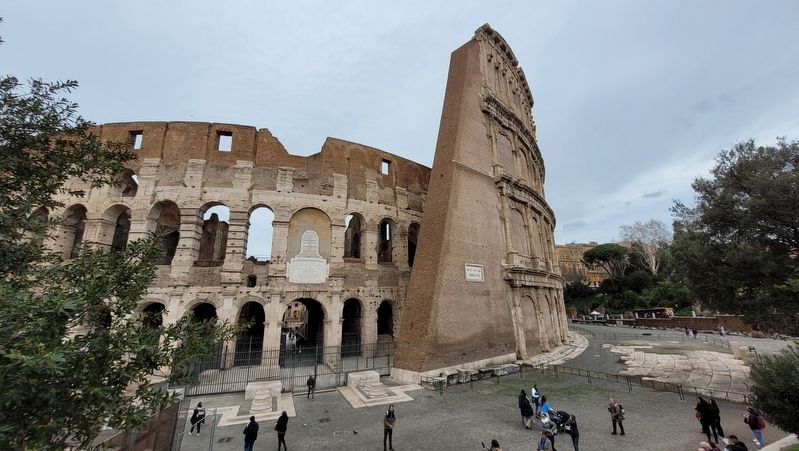
At the beginning of the 19th century Papa Pio VII promulgated two edicts for the protection of the artistic heritage of Rome and commissioned the first restorations of the Colosseum. Among the interventions carried out stands out on the east side of the façade the large spur made of bricks to stop the deterioration of the collapsing wall. The designers were three important architects of the time: Raffaele Stern, Giuseppe Palazzi and Giuseppe Camporesi. The construction also involved the infilling of some of the arches, crystallising their state of collapse. The intervention, although it provoked much criticism at the time, it is the first and fundamental restoration of the Colosseum. Today it is known as the Stern Spur.
Erected by Parco.
this page online
Topics. This historical marker is listed in this topic list: Anthropology & Archaeology.
Location. 41° 53.402′ N, 12° 29.61′ E. Marker is in Roma, Lazio (Latium, Rome), in Città metropolitana di Roma Capitale. It is in Celio. It is at the intersection of Piazza del Colosseo and Via dei SS. Quattro, on the right when traveling south on Piazza del Colosseo. The marker is located on the eastern side of the Colosseum. Touch for map. Marker is in this post office area: Roma, Lazio 00184, Italy. Touch for directions.

Regionally, it is in Europe, the European Union, the Schengen Area, a coastal Mediterranean country, and the Western World. Historically, it finds itself in what was once the Roman Empire.
Other nearby markers. At least 8 other markers are within walking distance of this marker: L'Amphitheatrum Flavium / The Flavian Amphitheater (a few steps from this marker); Il Colosseo 72-80 D.C. / The Colosseum 72-80 A.D. (within shouting distance of this marker); I Cippi Perimetrali / The Perimeter Cippi (within shouting distance of this marker); Come Si Entrava Al Colosseo / How People Entered the Colosseum
Photographed by James Hulse, February 27, 2024
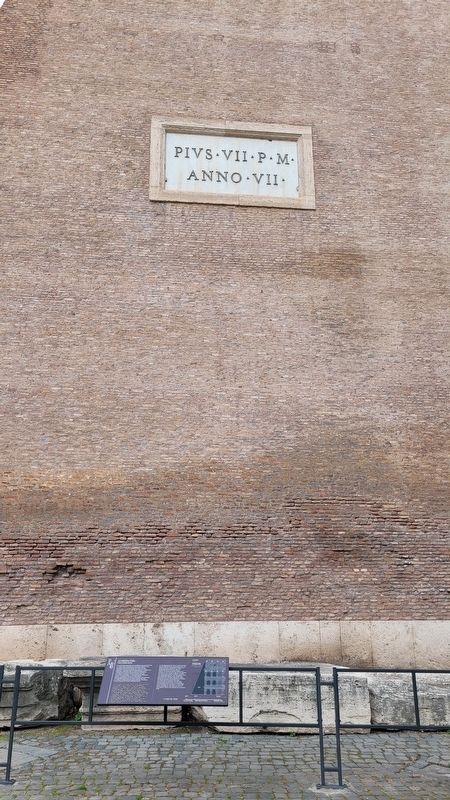
2. The Stern Spur and Marker
Also see . . . Colosseum. Wikipedia
The Colosseum is built of travertine limestone, tuff (volcanic rock), and brick-faced concrete. It could hold an estimated 50,000 to 80,000 spectators at various points in its history, having an average audience of some 65,000; it was used for gladiatorial contests and public spectacles including animal hunts, executions, re-enactments of famous battles, dramas based on Roman mythology, and briefly mock sea battles. The building ceased to be used for entertainment in the early medieval era. It was later reused for such purposes as housing, workshops, quarters for a religious order, a fortress, a quarry, and a Christian shrine.(Submitted on February 7, 2025, by James Hulse of Medina, Texas.)
Photographed by James Hulse, February 27, 2024
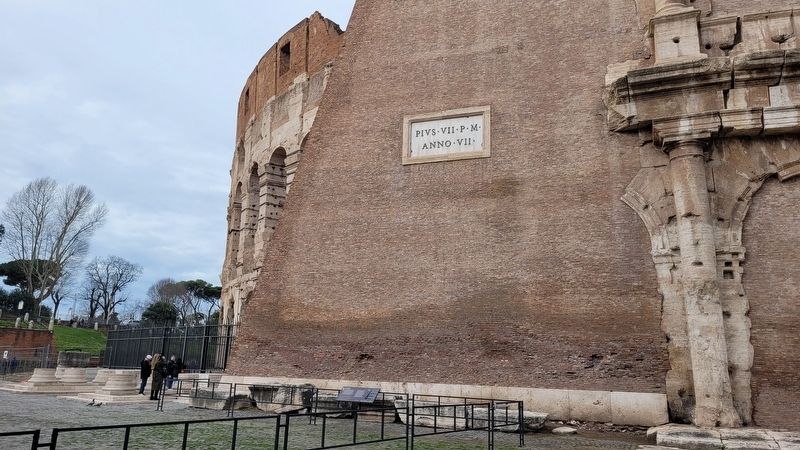
3. The view of the Stern Spur and Marker along the perimeter of the Colosseum
Photographed by James Hulse, February 27, 2024
4. The view of the Stern Spur on the Colosseum
Credits. This page was last revised on February 8, 2025. It was originally submitted on February 6, 2025, by James Hulse of Medina, Texas. This page has been viewed 589 times since then and 130 times this year. Photos: 1, 2, 3, 4. submitted on February 8, 2025, by James Hulse of Medina, Texas.
