Celio in Roma in Città metropolitana di Roma Capitale, Latium, Rome, Italy — Central Italy (Tyrrhenian Coast)
L'Amphitheatrum Flavium
⎯⎯⎯
The Flavian Amphitheater
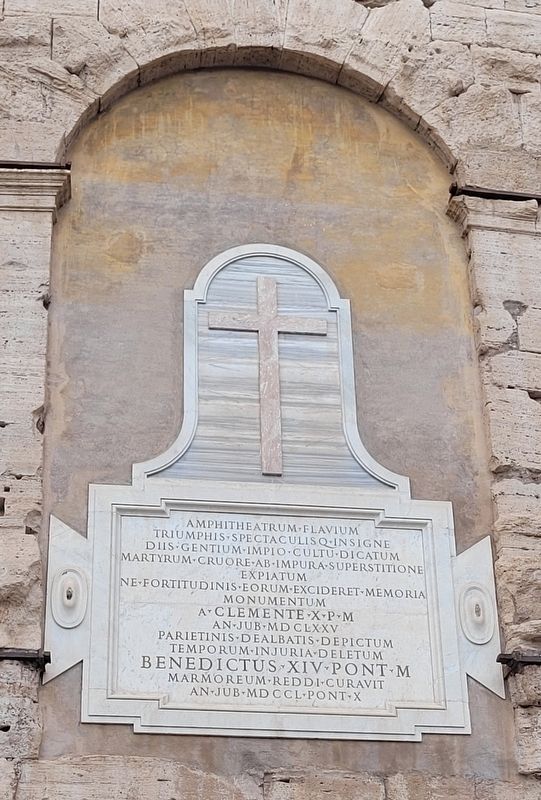
Photographed by James Hulse, February 27, 2024
1. L'Amphitheatrum Flavium / The Flavian Amphitheater Marker

L'Amphitheatrum Flavium, insignito di trionfi e spettacoli, fu dedicato agli dèi delle genti – culto impio. Fu espiato con il sangue dei martiri dall'impura superstizione, affinché non cadesse in oblio la memoria della loro forza. Monumento di Clemente IX nel Giubileo dell'anno 1675, dipinto sulle pareti imbiancate, fu distrutto dall'infortunio dei tempi. Papa Benedetto XIV fece restaurarlo in marmo nel Giubileo dell'anno 1750.
The Flavian Amphitheater, a landmark for triumphs and spectacles, was dedicated to the gods of the nations – profane worship. It was expiated by the blood of martyrs from impure superstition, so that the memory of their strength would not be lost. A monument by Pope Clement IX in the Jubilee Year 1675, depicted on the whitewashed walls, was destroyed by the injury of time. Pope Benedict XIV ordered it to be restored in marble in the Jubilee Year 1750.
Topics. This historical marker is listed in these topic lists: Anthropology & Archaeology • Religion & Religious Structures. A significant historical year for this entry is 1675.
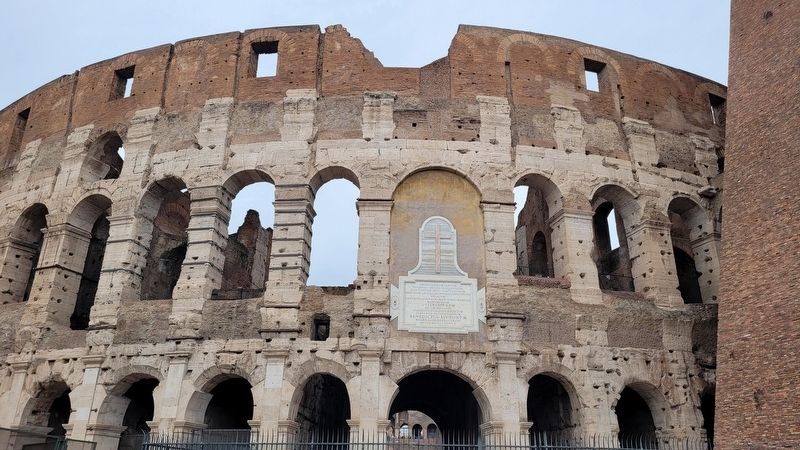
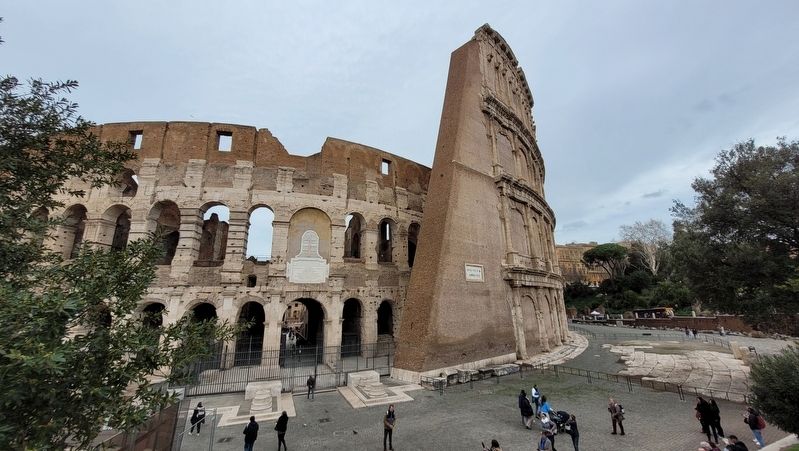
Location. 41° 53.403′ N, 12° 29.595′ E. Marker is in Roma, Lazio (Latium, Rome), in Città metropolitana di Roma Capitale. It is in Celio. It is at the intersection of Piazza del Colosseo and Via dei SS. Quattro, on the right when traveling south on Piazza del Colosseo. The marker is located on the wall of the eastern side of the Colosseum. Touch for map. Marker is in this post office area: Roma, Lazio 00184, Italy. Touch for directions.

Regionally, it is in Europe, the European Union, the Schengen Area, a coastal Mediterranean country, and the Western World. Historically, it finds itself in what was once the Roman Empire.
Other nearby markers. At least 8 other markers are within walking distance of this marker:
this page online
Also see . . . Colosseum. Wikipedia
The Colosseum is built of travertine limestone, tuff (volcanic rock), and brick-faced concrete. It could hold an estimated 50,000 to 80,000 spectators at various points in its history, having an average audience of some 65,000; it was used for gladiatorial contests and public spectacles including animal hunts, executions, re-enactments of famous battles, dramas based on Roman mythology, and briefly mock sea battles. The building ceased to be used for entertainment(Submitted on February 7, 2025, by James Hulse of Medina, Texas.)in the early medieval era. It was later reused for such purposes as housing, workshops, quarters for a religious order, a fortress, a quarry, and a Christian shrine.Photographed by James Hulse, February 27, 20242. The Flavian Amphitheater Marker on the Colosseum
Photographed by James Hulse, February 27, 2024
3. The view of the Colosseum
Credits. This page was last revised on February 8, 2025. It was originally submitted on February 6, 2025, by James Hulse of Medina, Texas. This page has been viewed 255 times since then and 66 times this year. Photos: 1, 2, 3. submitted on February 8, 2025, by James Hulse of Medina, Texas.
