Monti in Roma in Città metropolitana di Roma Capitale, Latium, Rome, Italy — Central Italy (Tyrrhenian Coast)
Monti
Rione I
⎯⎯⎯
District I
Photographed by James Hulse, February 27, 2024
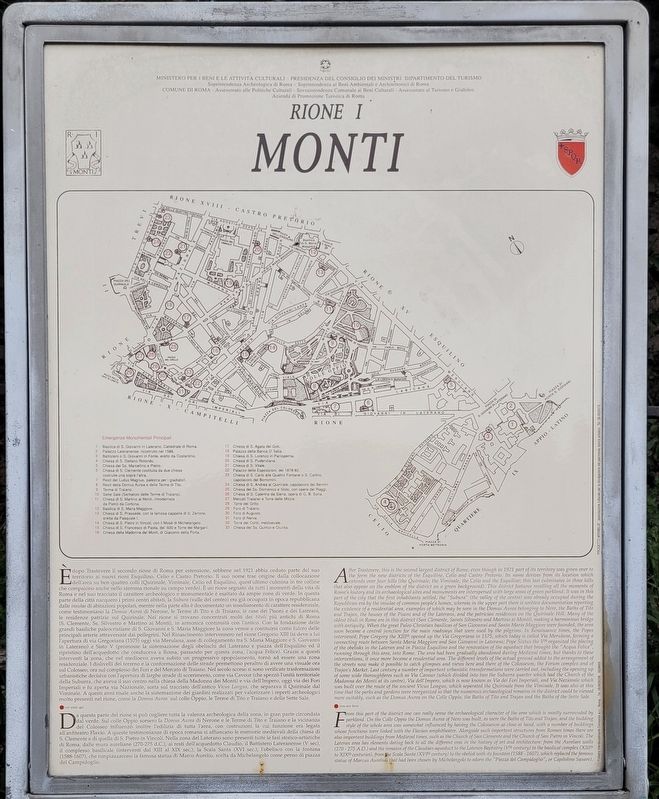
1. Monti Marker

È dopo Trastevere il secondo rione di Roma per estensione, sebbene nel 1921 abbia ceduto parte del suo territorio ai nuovi rioni Esquilino, Celio e Castro Pretorio. Il suo nome trae origine dalla collocazione dell'area su ben quattro colli (Quirinale, Viminale, Celio ed Esquilino, quest'ultimo culmina in tre colline che compaiono anche nello stemma rionale su campo verde). È un rione segnato da tutti i momenti della vita di Roma e nel suo tracciato il carattere archeologico e monumentale è esaltato da ampie zone di verde. In questa parte della città nacquero i primi centri abitati, la Subura (valle del centro) era già occupata in epoca repubblicana dalle insulae di abitazioni popolari, mentre nella parte alta è documentato un insediamento di carattere residenziale, come testimoniano la Domus Aurea di Nerone, le Terme di Tito e di Traiano, le case dei Pisoni e dei Laterani, le residenze patrizie sul Quirinale. Nel rione si trovano concentrati molti dei tituli più antichi di Roma (S. Clemente, Ss. Silvestro e Martino ai Monti), in armonica continuità con l'antico. Con la fondazione delle grandi basiliche paleocristiane di S. Giovanni e S. Maria Maggiore la zona venne a costituirsi come fulcro delle principali arterie attraversate dai pellegrini. Nel Rinascimento intervennero nel rione Gregorio XIII (si deve a lui l'apertura di via Gregoriana (1575) oggi via Merulana, asse di collegamento tra S. Maria Maggiore e S. Giovanni in Laterano) e Sisto V (promosse la sistemazione degli obelischi del Laterano e piazza dell'Esquilino ed il ripristino dell'acquedotto che conduceva a Roma, passando per questa
this page online
Da questa parte del rione si può cogliere tutta la valenza archeologica della zona, in gran parte circondata dal verde. Sul colle Oppio sorsero la Domus Aurea di Nerone e le Terme di Tito e Traiano e la vicinanza del Colosseo influenzò inoltre l'edilizia di tutta l'area, con costruzioni la cui funzione era legata all'anfiteatro Flavio. A queste testimonianze di epoca romana si affiancano le memorie medievali della chiesa di S. Clemente e di quella di S. Pietro in Vincoli. Nella zona del Laterano sono presenti tutte le fasi storico-artistiche di Roma, dalle mura aureliane (270-275 d.C.), ai resti dell'acquedotto Claudio, il Battistero Lateranense (V sec), il complesso basilicale (interventi
Photographed by James Hulse, February 27, 2024
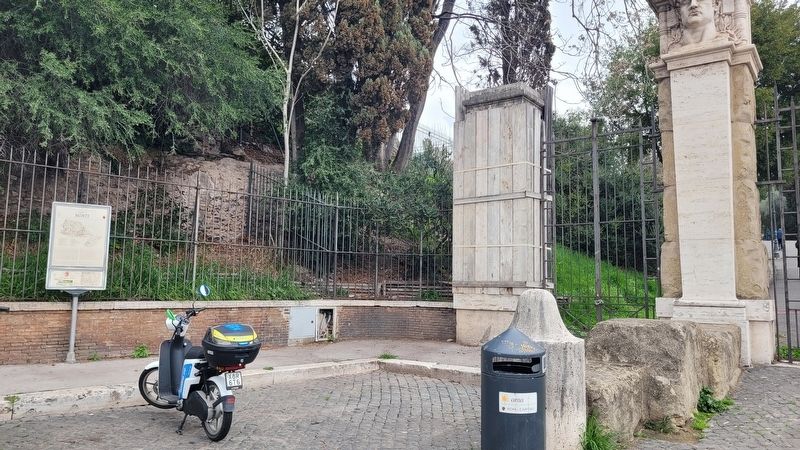
2. The view of the Monti Marker at the gate
After Trastevere, this is the second largest district of Rome, even though in 1921 part of its territory was given over to the form the new districts of the Esquiline, Celio and Castro Pretorio. Its name derives from its location which Lextends over four hills (the Quirinale, the Viminale, the Celio and the Esquiline; this last culminates in three hills that also appear on the emblem of the district on a green background). This district features recalling all the moments of Rome's history and its archaeological sites and monuments are interspersed with large areas of green parkland. It was in this part of the city that the first inhabitants settled, the "Subura" (the valley of the centre) was already occupied during the Republican era by the insulae of common people's homes, whereas in the upper part there is written documentation reporting the existence of a residential area, examples of which may be seen in the Domus Aurea belonging to Nero, the Baths of Tito and Trajan, the houses of the Pisoni and of the Laterans, and the patrician residences on the Quirinale Hill. Many of the oldest tituli in Rome are in this district (San Clemente, Saints Silvestro and Martino ai Monti), making a harmonious bridge with antiquity. When the great Paleo-Christian basilicas of San Giovanni and Santa Maria Maggiore were founded, the area soon became a central junction for the main roadways that were used by the pilgrims. In Renaissance

Photographed by James Hulse, February 27, 2024
3. The view of the Monti Marker from across the street
From this part of the district one can really sense the archaeological character of the area which is mostly surrounded by parkland. On the Colle Oppio the Domus Aurea of Nero was built, as were the Baths of Tito and Trajan, and the building style of the whole area was somewhat influenced by having the Colosseum so close at hand, with a number of buildings whose functions were linked with the Flavian amphitheatre. Alongside such important structures from Roman times there are also important buildings from Medieval times, such as the Church of San Clemente and the Church of San Pietro in Vincoli. The Lateran area has elements dating back to all the different eras in the history of art and architecture: from the Aurelian walls (270-275 A.D.) and the remains of the Claudian aqueduct to the Lateran Baptistry (Vth century) to the basilical complex (XIIIth to XIXth centuries), from the Scala Santa (XVIth century) to the obelisk with its fountain (1588-1607), which replaced the famous statue of Marcus Aurelius that had been chosen by Michelangelo to adorn the "Piazza del Campidoglio", or Capitoline Square).
Erected by Ministry for Cultural Heritage and Activities Presidency of the Council of Ministers Department of Tourism Archaeological Superintendency of Rome Superintendency for Environmental and Architectural Heritage of Rome Municipality of Rome Department of Cultural Policies - Municipal Superintendency for Cultural Heritage - Department of Tourism and Jubilee Tourism Promotion Agency of Rome.
Topics. This historical marker is listed in these topic lists: Anthropology & Archaeology • Religion & Religious Structures. A significant historical year for this entry is 1921.
Location. 41° 53.446′ N, 12° 29.675′ E. Marker is in Roma, Lazio (Latium, Rome), in Città metropolitana di Roma Capitale. It is in Monti. It is at the intersection of Viale della Domus Aurea and Via Nicola Salvi on Viale della Domus Aurea. The marker is located at the gate to the Domus Aurea archaeological site and park. Touch for map. Marker is at or near this postal address: Vle della Domus Aurea 1, Roma, Lazio 00184, Italy. Touch for directions.

Regionally, it is in Europe, the European Union, the Schengen Area, a coastal Mediterranean country, and the Western World. Historically, it finds itself in what was once the Roman Empire.
Other nearby markers. At least 8 other markers are within walking distance of this marker: Ludus Magnus / Great Training Arena (within shouting distance of this marker); I Cippi Perimetrali / The Perimeter Cippi (about 90 meters away, measured in a direct line); Ludus Magnus / Great Training School (about 90 meters away); Hotel Palazzo Manfredi (about 120 meters away); Come Si Entrava Al Colosseo / How People Entered the Colosseum (about 120 meters away); Lo Sperone Stern / The Stern Spur (about 120 meters away); L'Amphitheatrum Flavium / The Flavian Amphitheater (about 120 meters away); Il Colosseo 72-80 D.C. / The Colosseum 72-80 A.D. (about 150 meters away). Touch for a list and map of all markers in Roma.
Regarding Monti. Rione I refers to one of the 22 administrative districts (rioni) in the historic center of Rome. It is also known as "Monti," which is the name of the neighborhood in this rione. Rione I is located near key landmarks like the Colosseum, Roman Forum, and the Quirinal Hill. It is one of the oldest and most vibrant areas in Rome, characterized by its narrow streets, historic buildings, and a mix of ancient and modern elements.
Credits. This page was last revised on February 9, 2025. It was originally submitted on February 6, 2025, by James Hulse of Medina, Texas. This page has been viewed 89 times since then and 11 times this year. Photos: 1, 2, 3. submitted on February 9, 2025, by James Hulse of Medina, Texas.
