Near Milford in Seward County, Nebraska — The American Midwest (Upper Plains)
Farming in Nebraska
Photographed by Cosmos Mariner, August 12, 2021
1. Farming in Nebraska Marker
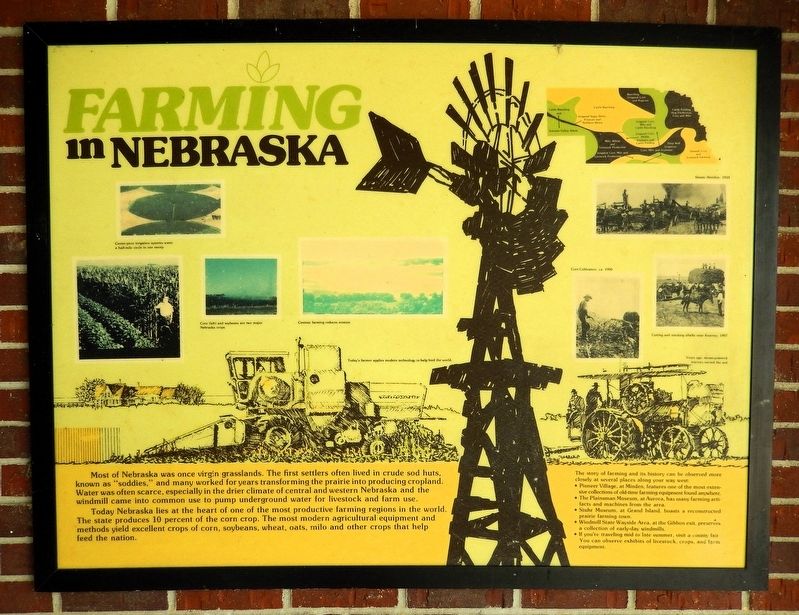
Most of Nebraska was once virgin grasslands. The first settlers often lived in crude sod huts, known as "soddies," and many worked for years transforming the prairie into producing cropland. Water was often scarce, especially in the drier climate of central and western Nebraska and the windmill came into common use to pump underground water for livestock and farm use.
Today Nebraska lies at the heart of one of the most productive farming regions in the world. The state produces 10 percent of the corn crop. The most modern agricultural equipment and methods yield excellent crops of corn, soybeans, wheat, oats, milo and other crops that help feed the nation.
The story of farming and its history can be observed more closely at several places along your way west:
• Pioneer Village at Minden, features one of the most extensive collections of old-time farming equipment found anywhere.
• The Plainsman Museum, at Aurora, has many farming artifacts and machines from the area.
• Stuhr Museum, at Grand Island, boasts a reconstructed prairie farming town.
• Windmill State Wayside Area, at the Gibbon exit, preserves a collection of early-day
this page online
• If you're traveling mid to late summer, visit a county fair. You can observe exhibits of livestock, crops, and farm equipment.
[photo & image captions]
• Center-pivot irrigation systems water a half-mile circle in one sweep.
• Corn and soybeans are two major Nebraska crops.
• Contour farming reduces erosion.
• Today’s farmer applies modern technology to help feed the world.
• Steam thresher, 1910
• Corn cultivation, ca. 1900
• Cutting and stacking alfalfa near Kearney, 1907.
• Years ago, steam-powered tractors turned the sod.
Topics and series. This historical marker is listed in these topic lists: Agriculture • Settlements & Settlers. In addition, it is included in the Windmills series list.
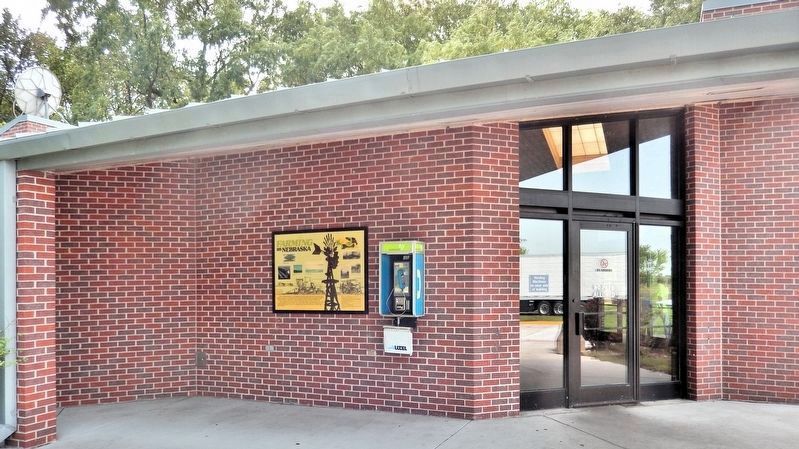
Location. 40° 49.281′ N, 97° 3.658′ W. Marker is near Milford, Nebraska, in Seward County. It can be reached from Interstate 80 at milepost 381, 2 miles east of Exit 379 (State Highway 15), on the right when traveling east. The marker is mounted on the east side of the comfort station in the Interstate 80 East Rest Area. Touch for map. Marker is in this post office area: Milford NE 68405,
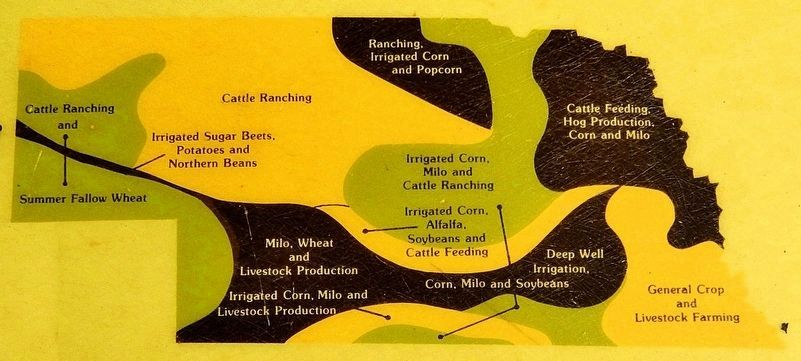
2. Marker detail: Nebraska Agriculture Regions

Regionally, this marker is in Eastern Nebraska and in Greater Lincoln. It is also in the American Midwest, in the Corn Belt, and on the prairies. Globally, it is in North America, the Western Hemisphere, the Western World, and the Anglosphere. Historically, it finds itself in what was once the Louisiana Purchase.
Other nearby markers. At least 8 other markers are within 7 miles of this marker, measured as the crow flies: Purple Heart Trail (a few steps from this marker); The Big Blue River (a few steps from this marker); Tall Grass Prairie (within shouting distance of this marker); Standing Bear and the Ponca Tribe (within shouting distance of this marker); Historic Milford (approx. 3.4 miles away); Big Blue River, Seward (approx. 5.8 miles away); Plum Creek Prairie Historic Site (approx. 5.8 miles away); Seward, 4th of July City (approx. 6.2 miles away). Touch for a list and map of all markers in Milford.
Also see . . . Top Nebraska Agriculture Facts From the 2024 Census of Agriculture.
Excerpt: According to the USDA’s most recent Census of Agriculture,(Submitted on February 8, 2025, by Cosmos Mariner of Cape Canaveral, Florida.)there are 44,479 farms in Nebraska with a market value of agricultural products sold totaling more than $29.4 billion. The number of farms in Nebraska has decreased by 4% since 2017 and by 10% since 2002. However, there are still nearly 44 million acres of farmland in Nebraska, and the state’s average farm size is 989 acres. The market value of crops grown in Nebraska, including nursery and greenhouse crops, totaled more than $14 billion in 2022. The market value of livestock, poultry and their products, including beef, pork, chicken, dairy and eggs, came to $15.4 billion.Photographed by Cosmos Mariner, August 12, 20213. Farming in Nebraska MarkerThe marker is mounted on the east side of the comfort station in the Interstate 80 East Rest Area.
Credits. This page was last revised on February 8, 2025. It was originally submitted on February 6, 2025, by Cosmos Mariner of Cape Canaveral, Florida. This page has been viewed 215 times since then and 46 times this year. Photos: 1, 2, 3. submitted on February 8, 2025, by Cosmos Mariner of Cape Canaveral, Florida.
