South Lake Union in Seattle in King County, Washington — The American West (Northwest)
Tordenskjold
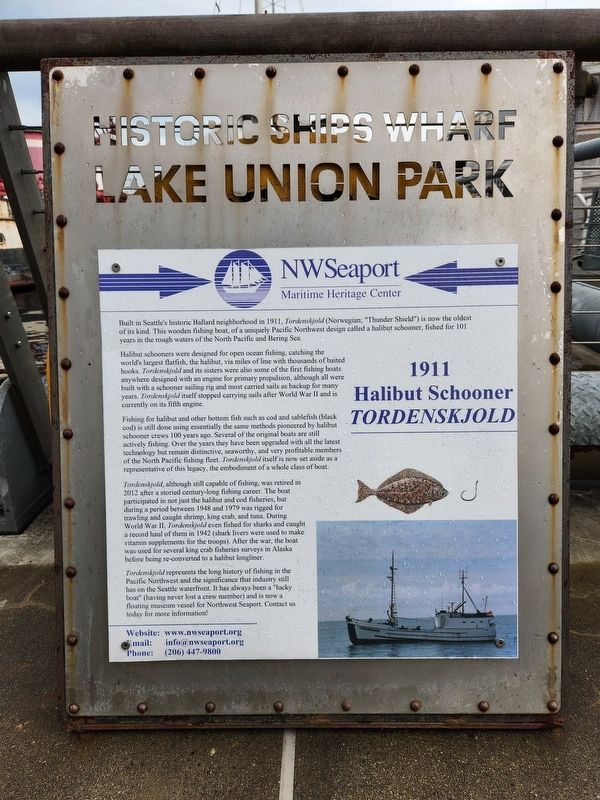
1911 Halibut Schooner
Photographed by Douglass Halvorsen, August 22, 2024
1. Tordenskjold Marker
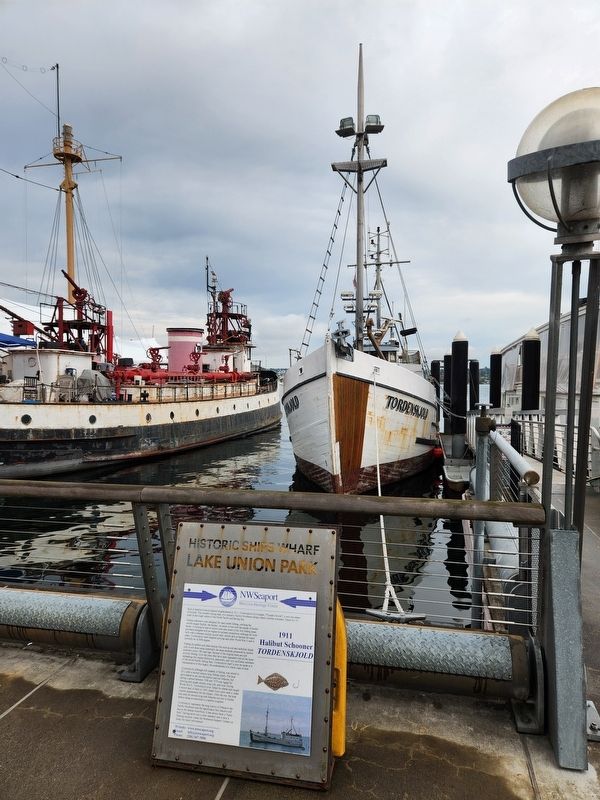
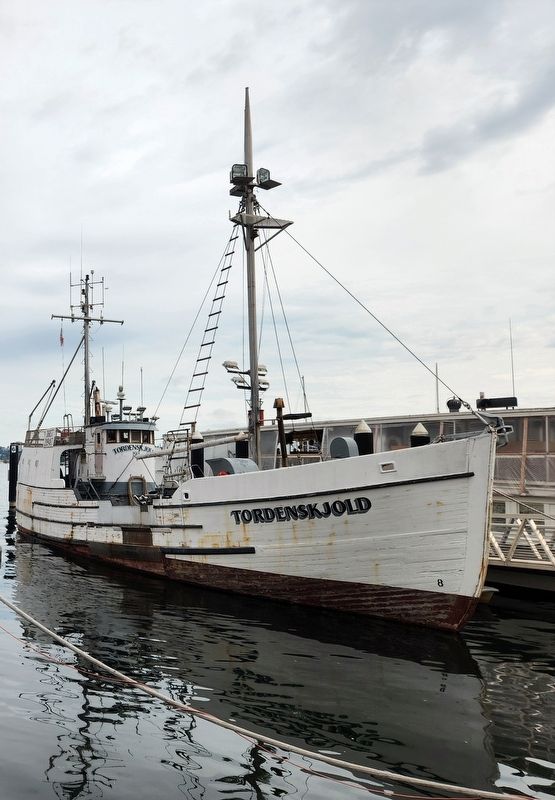
Halibut schooners were designed for open ocean fishing, catching the world’s largest flatfish, the halibut, via miles of line with thousands of baited hooks. Tordenskjold and its sisters were also some of the first fishing boats anywhere designed with an engine for primary propulsion, although all were built with a schooner sailing rig and most carried sails as backup for many years. Tordenskjold itself stopped carrying sails after World War II and is currently on its fifth engine.
Fishing for halibut and other bottom fish such as cod and sablefish (black cod) is still done using essentially the same methods pioneered by halibut schooner crews 100 years ago. Several of the original boats are still actively fishing. Over the years they have been upgraded with all the latest technology but reamin distinctive, seaworthy, and
this page online
Tordenskjold, although still capable of fishing, was retired in 2012 after a storied century-long fishing career. The boat participated in not just the halibut and cod fisheries, but during a period between 1948 and 1979 was rigged for trawling and caught shrimp, king crab, and tuna. During World War II, Tordenskjold even fished for sharks and caught a record haul of them in 1942 (shark livers were used to make vitamin supplements for the troops). After the war, the boat was used for several king crab fisheries surveys in Alaska before being re-converted to a halibut longliner.
Tordenskjold represents the long history of fishing in the Pacific Northwest and the significance that industry still has on the Seattle waterfront. It has always been a "lucky boat" (having never lost a crew member) and is now a floating museum vessel for Northwest Seaport. Contact us today for more information!
Erected by NW Seaport Maritime Heritage Center.
Topics. This historical
Photographed by Douglass Halvorsen, August 22, 2024
2. Tordenskjold Marker
Location. 47° 37.677′ N, 122° 20.18′ W. Marker is in Seattle, Washington, in King County. It is in South Lake Union. It can be reached from Terry Avenue North. Touch for map. Marker is at or near this postal address: 860 Terry Ave N, Seattle WA 98109, United States of America. Touch for directions.

Regionally, this marker is in the Puget Sound Region. It is also on the American Pacific Coast, in the Pacific Northwest, and in the Lewis & Clark Corridor. Globally, it is in North America, in the Cascade Range, in the Inside Passage, on the Ring of Fire, on the Pacific Rim, in the Western Hemisphere, in the Western World, and in the Anglosphere.
Other nearby markers. At least 8 other markers are within walking distance of this marker: Having Fun on the Lake (a few steps from this marker); Swiftsure (a few steps from this marker); Arthur Foss (within shouting distance of this marker); Clock from Carroll’s Fine Jewelry (within shouting distance of this marker); The Steamer Virginia V

Photographed by Douglass Halvorsen, August 22, 2024
3. Tordenskjold
Photographed by Douglass Halvorsen, August 22, 2024
4. Tordenskjold Marker
Credits. This page was last revised on February 8, 2025. It was originally submitted on February 7, 2025, by Douglass Halvorsen of Klamath Falls, Oregon. This page has been viewed 207 times since then and 54 times this year. Photos: 1, 2, 3, 4. submitted on February 7, 2025, by Douglass Halvorsen of Klamath Falls, Oregon. • James Hulse was the editor who published this page.
