South Lake Union in Seattle in King County, Washington — The American West (Northwest)
The Story of Virginia V

Photographed by Douglass Halvorsen, August 22, 2024
1. The Story of Virginia V Marker
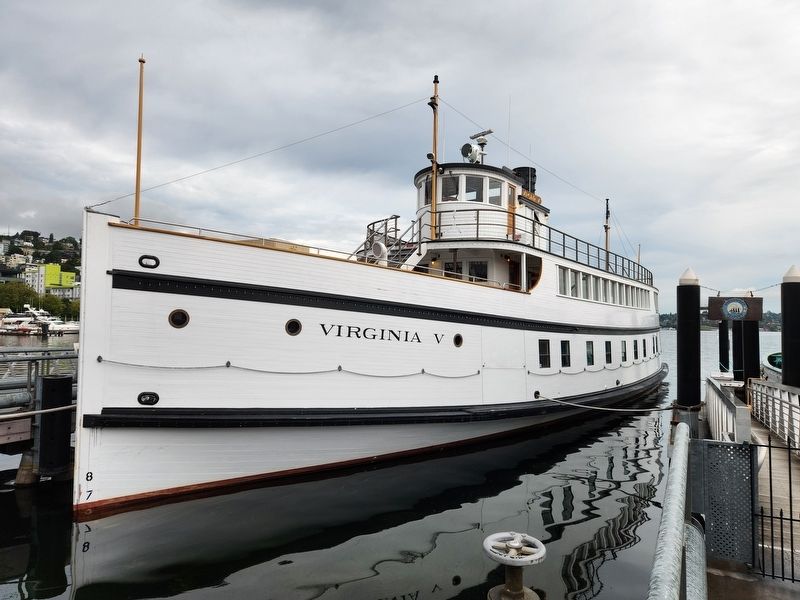
On June 11, 1922, SS Virginia V embarked on her maiden voyage from Elliott Bay. She was built to serve the small communities of Vashon Island and Kitsap Peninsula that faced the waters of Colvos Passage, or West Pass, connecting them to the big cities of Seattle and Tacoma.
Over the years, the ship had many different roles. It serviced US Amry forts at Admiralty Inlet during WWII, worked briefly on the Columbia River in 1942, and provided direct transit between Seattle and Tacoma in the mid-1940s. She entered commercial excursion service after 1946 under the ownership of Puget Sound Excursion Lines and, later, the Northwest Steamship Company.
The ship was placed on the National Register of Historic Places in 1973, then in 1976, The Steamer Virginia V Foundation was formed as a non-profit organization dedicated to preserving, interpreting, and operating Virginia V. From 1995 to 2002, the Foundation undertook a $6.5-million stem-to-stern rebuild of the aging steamer at nearby Lake Union Drydock. Work included rebuilding the original engine, installing a new boiler, and reconstructing the superstructure using traditional
this page online
Erected by NW Seaport Maritime Heritage Center.
Topics and series. This historical marker is listed in these topic lists: Industry & Commerce • War, World II • Waterways & Vessels. In addition, it is included in the National Register of Historic Places (NRHP) series list. A significant historical year for this entry is 1922.
Location. 47° 37.69′ N, 122° 20.227′ W. Marker is in Seattle, Washington, in King County. It is in South Lake Union. It can be reached from Terry Avenue North. Touch for map. Marker is at or near this postal address: 860 Terry Ave N, Seattle WA 98109, United States of America. Touch for directions.

Regionally, this marker is in the Puget Sound Region. It is also on the American Pacific Coast, in the Pacific Northwest, and in the Lewis & Clark Corridor. Globally, it is in North America, in the Cascade Range, in the Inside Passage, on the Ring of Fire, on the Pacific Rim, in the Western Hemisphere, in the Western World, and in the Anglosphere.
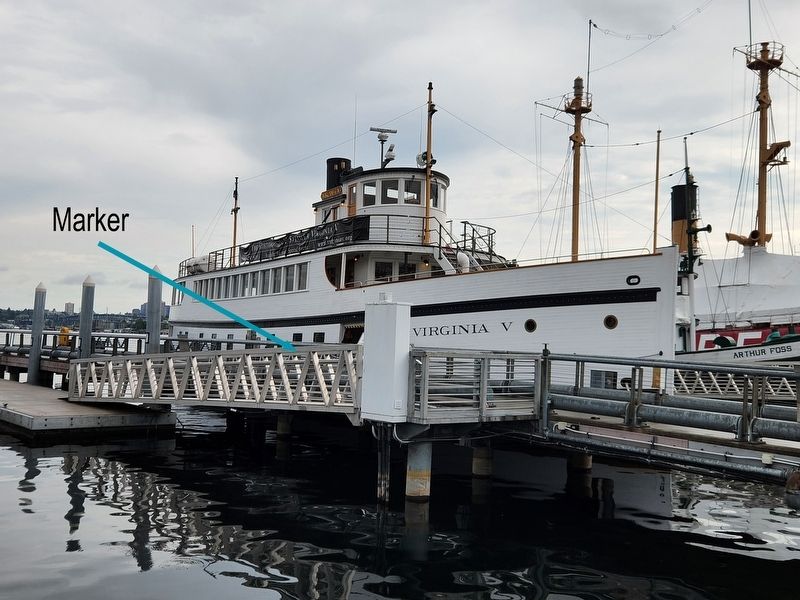
Photographed by Douglass Halvorsen, August 22, 2024
2. Virginia V
Other nearby markers. At least 8 other markers are within walking distance of this marker: Building Boats (here, next to this marker); Fisheries (a few steps from this marker); The Steamer Virginia V (within shouting distance of this marker); Arthur Foss (within shouting distance of this marker); At Work on Lake Union (within shouting distance of this marker); Clock from Carroll’s Fine Jewelry (within shouting distance of this marker); Swiftsure (within shouting distance of this marker); Camas Mill Millstone (within shouting distance of this marker). Touch for a list and map of all markers in Seattle.
Also see . . . National Register of Historic Places Registration Form.
NRHP Statement of Significance: The earliest use of the steamboat in the United States was the adoption of steam for small passenger and cargo carrying vessels. Dating to the first decades of the 19th century, these craft in time dominated the American steam excursion fleet. One of two surviving members of the American "mosquito fleet," the large, unlicensed steamers that flitted around like mosquitoes on the inland waters of the United States, Virginia V(Submitted on February 7, 2025, by Douglass Halvorsen of Klamath Falls, Oregon.)is the only survivor of these small excursion steamers built on the Pacific Coast. The other mosquito fleet vessel, Sabino, is the sole surviving East Coast-built small excursion steamer. These two vessels alone represent a fleet that in June 1932 was documented at an astounding 260,983 vessels. The fact of their survival, and a contributing factor in their significance is the fact that both continue in operation, keeping alive a tradition and a technology now vanished.Photographed by Douglass Halvorsen, August 22, 20243. The Story of Virginia V Marker
Credits. This page was last revised on July 25, 2025. It was originally submitted on February 7, 2025, by Douglass Halvorsen of Klamath Falls, Oregon. This page has been viewed 199 times since then and 30 times this year. Photos: 1, 2, 3. submitted on February 7, 2025, by Douglass Halvorsen of Klamath Falls, Oregon. • James Hulse was the editor who published this page.
