Near Valley Head in Randolph County, West Virginia — The American South (Appalachia)
Fort Marrow
Guarding the Road
| — | The First Campaign | — |
Photographed by Bradley Owen, February 4, 2025
1. Fort Marrow Marker
(Preface)
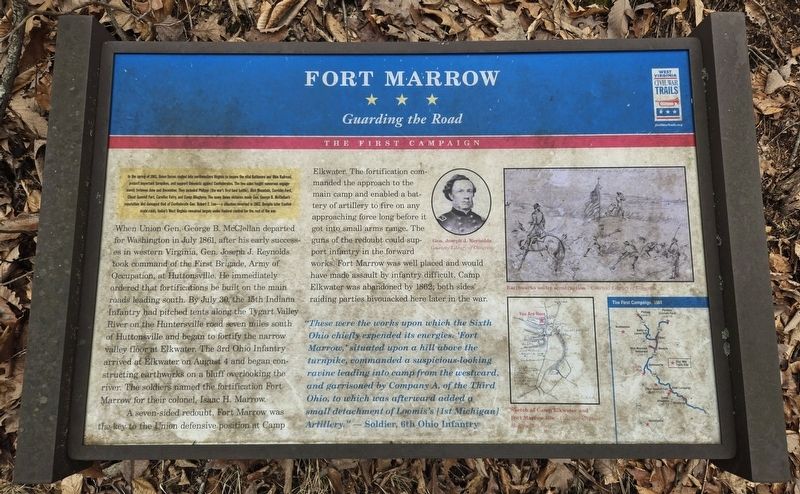
In the spring of 1861, Union forces rushed into northwestern Virginia to secure the vital Baltimore and Ohio Railroad, protect important turnpikes, and support Unionists against Confederates. The two sides fought numerous engagements between June and December. They included Philippi (the war's first land battle), Rich Mountain, Corricks Ford, Cheat Summit Fort, Carnifex Ferry, and Camp Allegheny. The many Union victories made Gen. George B. McClellan's reputation and damaged that of Confederate Gen. Robert E. Lee-a situation reversed in 1862. Despite later Confederate raids, today's West Virginia remained largely under Federal control for the rest of the war.
(Main Text)
When Union Gen. George B. MeClellan departed for Washington in July 1861, after his early successes in western Virginia, Gen. Joseph J. Reynolds took command of the First Brigade, Army of Occupation, at Huttonsville. He immediately ordered that fortifications be built on the main roads leading south. By July 30, the 15th Indiana Infantry had pitched tents along the Tygart Valley River on the Huntersville road seven miles south of Huttonsville
this page online
A seven-sided redoubt, Fort Marrow was the key to the Union defensive position at Camp Elkwater. The fortification commanded the approach to the main camp and enabled a battery of artillery to fire on any approaching force long before it got into small arms range. The guns of the redoubt could support infantry in the forward works. Fort Marrow was well placed and would have made assault by infantry difficult. Camp Elkwater was abandoned by 1862; both sides raiding parties bivouacked here later in the war.
"These were the works upon which the Sixth Ohio chiefly expended its energies. 'Fort Marrow, situated upon a hill above the turnpike, commanded a suspicious-looking ravine leading into camp from the westward, and garrisoned by Company A, of the Third Ohio, to which was afterward added a small detachment of Loomis's [1st Michigan] Artillery." - Soldier, 6th Ohio Infantry
(Captions):
Gen. Joseph J. Reynolds
Courtesy Library of Congress
Earthworks under construction - Courtesy Library of Congress
Sketch of Camp Elkwater and Fort Marrow site - Courtesy Virginia Historical Society
Erected by West
Photographed by Bradley Owen, February 4, 2025
2. Fort Marrow Marker
Topics and series. This historical marker is listed in these topic lists: Forts and Castles • War, US Civil. In addition, it is included in the West Virginia Civil War Trails series list. A significant historical year for this entry is 1861.
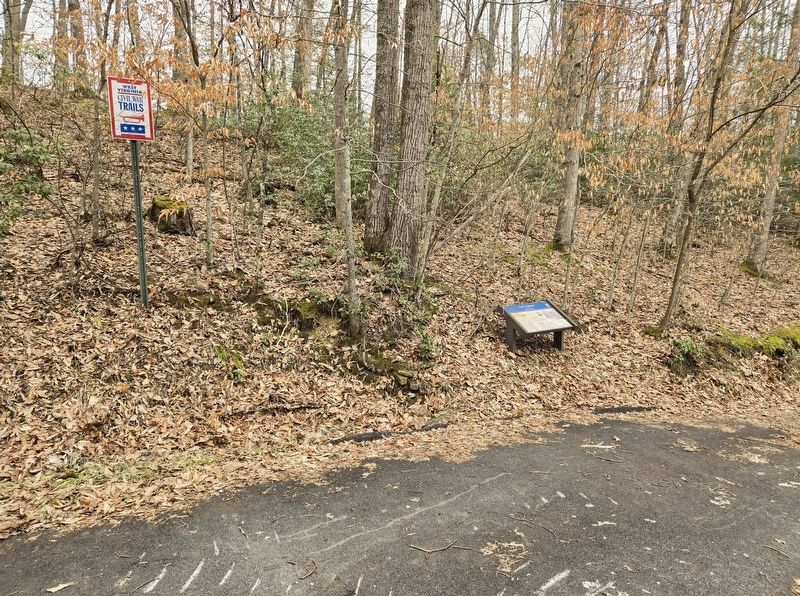
Location. 38° 38.12′ N, 80° 1.398′ W. Marker is near Valley Head, West Virginia, in Randolph County. It is on Kumbrabow Road (County Route 219/16) 0.3 miles west of Seneca Trail (U.S. 219), on the right when traveling west. Marker is located at the second switchback heading west from U.S. 219. Touch for map. Marker is in this post office area: Valley Head WV 26294, United States of America. Touch for directions.

Regionally, this marker is in West Virginia’s Potomac Highlands. It is also in the American South, specifically in the Upper South, in Appalachia, and specifically in Southern Appalachia. Globally, it is in North America, the Western Hemisphere, the Western World, and the Anglosphere. Historically, it finds itself in what was once the territory of the Mississippian Culture.
Other nearby markers. At least 8 other markers are within 7 miles of this marker, measured as the crow flies: Elkwater / Col. J. A. Washington (approx. half a mile away); Camp Elkwater (approx. half a mile away); Camp Good Luck (approx. 0.8 miles away); The Conley Graves (approx. 4.1 miles away); Old Brick Church (approx. 4.9 miles away); Huttonsville (approx. 5.7 miles away); a different marker also named Huttonsville (approx. 5.7 miles away); Valley Head (approx. 6.1 miles away). Touch for a list and map of all markers in Valley Head.
Another marker is no longer nearby. Army Headquarters 1861 / Huttonsville (was approx. 5.7 miles away but has been confirmed missing).
Regarding Fort Marrow. Marker includes a map of the First Campaign, 1861.
Credits. This page was last revised on February 8, 2025. It was originally submitted on February 8, 2025, by Bradley Owen of Morgantown, West Virginia. This page has been viewed 283 times since then and 75 times this year. Photos: 1, 2. submitted on February 8, 2025, by Bradley Owen of Morgantown, West Virginia.
