St. George in Washington County, Utah — The American Mountains (Southwest)
Pioneer Center for the Arts
Photographed by Jeremy Snow, February 6, 2025
1. Pioneer Center for the Arts Marker
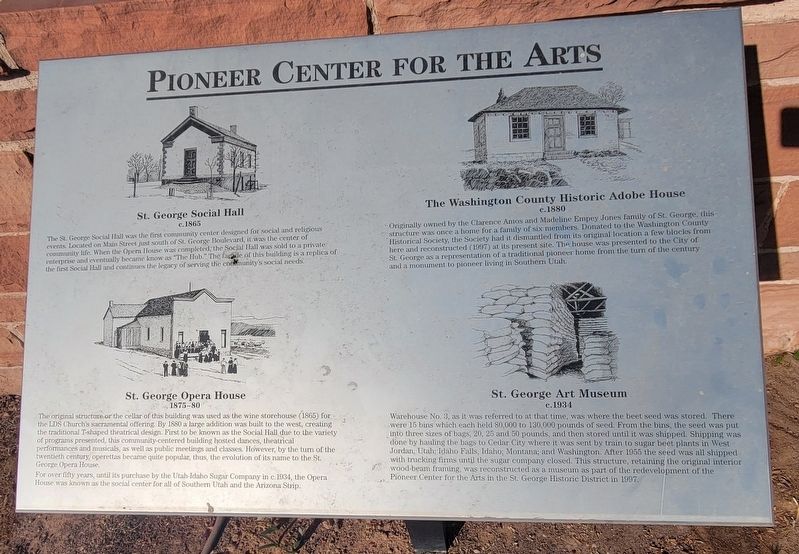
St. George Social Hall c.1865
The St. George Social Hall was the first community center designed for social and religious events Located on Main Street just south of St. George Boulevard, it was the center of community life. When the Opera House was completed, the Social Hall was sold to a private enterprise and eventually became know as "The Hub." The facade of this building is a replica of the first Social Hall and continues the legacy of serving the community's social needs.
St. George Opera House 1875-80
The original structure or the cellar of this building was used as the wine storehouse (1865) for the LDS Church's sacramental offering. By 1880 a large addition was built to the west, creating the traditional T-shaped theatrical design. First to be known as the Social Hall due to the variety of programs presented, this community-centered building hosted dances, theatrical performances and musicals, as well as public meetings and classes. However, by the turn of the twentieth century operettas became quite popular, thus, the evolution of its name to the St. George Opera House.
For over fifty years, until its
this page online
The Washington County Historic Adobe House c.1880
Originally owned by the Clarence Amos and Madeline Empey Jones family of St. George, this structure was once a home for a family of six members. Donated to the Washington County Historical Society, the Society had it dismantled from its original location a few blocks from here and reconstructed (1997) at its present site. The house was presented to the City of St. George as a representation of a traditional pioneer home from the turn of the century and a monument to pioneer living in Southern Utah’
St. George Art Museum c.1934
Warehouse No. 3, as it was referred to at that time, was where the beet seed was stored. There were 15 bins which each held 80,000 to 130,000 pounds of seed. From the bins, the seed was put into three sizes of bags, 20, 25 and 50 pounds, and then stored until it was shipped. Shipping was done by hauling the bags to Cedar City where it was sent by train to sugar beet plants in West Jordan, Utah Idaho Falls, Idaho;
Photographed by Jeremy Snow, February 6, 2025
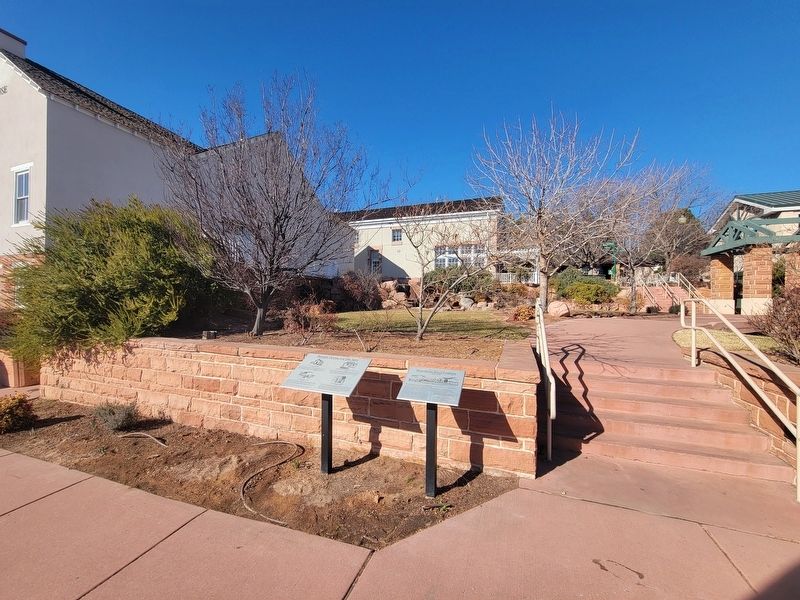
2. Pioneer Center for the Arts Marker
Topics. This historical marker is listed in these topic lists: Agriculture • Arts, Letters, Music • Entertainment • Industry & Commerce. A significant historical year for this entry is 1865.
Location. 37° 6.702′ N, 113° 34.954′ W. Marker is in St. George, Utah, in Washington County. It is on 200 North Street, on the right when traveling west. Touch for map. Marker is at or near this postal address: 47 200 N Street, Saint George UT 84770, United States of America. Touch for directions.

Regionally, this marker is in Utah’s Color Country. It is also in the American Southwest, in the Mountain West, and on the Colorado Plateau. Globally, it is in North America, the Rocky Mountains, the Western Hemisphere, the Western World, and the Anglosphere. Historically, it finds itself in what was once New Spain and also Mexico’s Alta California.
Other nearby markers. At least 8 other markers are within walking distance of this marker: Utah-Idaho Sugar Company (here, next to this marker); St. George Opera House (a few steps from this marker); The Jones Adobe Home (within shouting distance of this marker); Watermaster (within shouting distance of this marker); Albert E. Miller - Dr. Pike Home (about 300 feet away, measured in a direct line); The Gardner House (about 400 feet away); Samuel Miles Jr. Home (about 400 feet away); Julia Graff Home (about 400 feet away). Touch for a list and map of all markers in St. George.
Credits. This page was last revised on February 9, 2025. It was originally submitted on February 8, 2025, by Jeremy Snow of Cedar City, Utah. This page has been viewed 139 times since then and 25 times this year. Photos: 1, 2. submitted on February 8, 2025, by Jeremy Snow of Cedar City, Utah. • Andrew Ruppenstein was the editor who published this page.
