
Near Berry-au-Bac in Aisne, Upper France, France — Western Europe
16 Avril 1917: Le Premier Engagement des Chars
Chemin des Dames
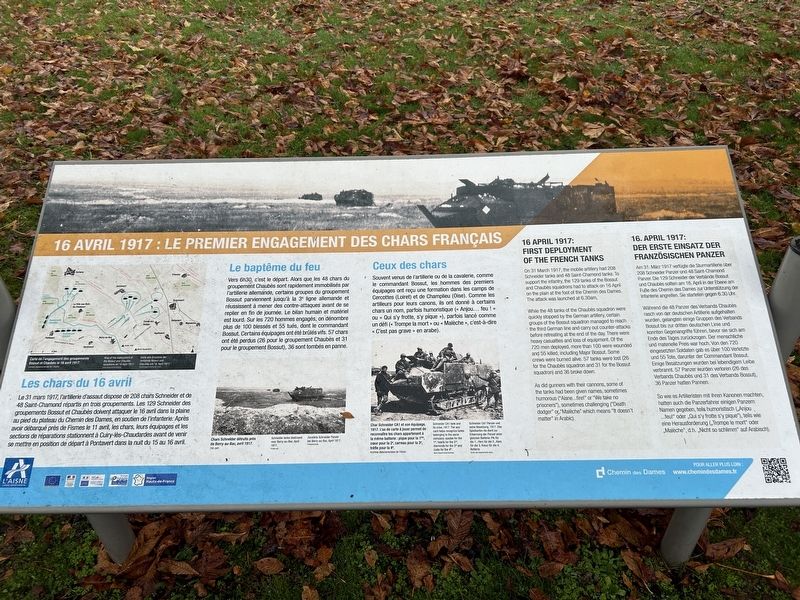
Photographed by Steve Stoessel, November 18, 2024
1. 16 Avril 1917: Le Premier Engagement des Chars Marker

Les chars du 16 avril
Le 31 mars 1917, l'artillerie d'assaut dispose de 208 chars Schneider et de 48 Saint-Chamond répartis en trois groupements. Les 129 Schneider des groupements Bossut et Chaubès doivent attaquer le 16 avril dans la plaine au pied du plateau du Chemin des Dames, en soutien de l'infanterie. Après avoir débarqué près de Fismes le 11 avril, les chars, leurs équipages et les sections de réparations stationnent à Cuiry-lès-Chaudardes avant de venir se mettre en position de départ à Pontavert dans la nuit du 15 au 16 avril.
Le baptême du feu
Vers 6h30, c'est le départ. Alors que les 48 chars du groupement Chaubes sont rapidement immobilisés par l'artillerie allemande, certains groupes du groupement Bossut parviennent jusqu'à la 3e ligne allemande et réussissent à mener des contre-attaques avant de se replier en fin de journée. Le bilan humain et matériel est lourd. Sur les 720 hommes engagés, on dénombre plus de 100 blessés et 55 tués, dont le commandant Bossut. Certains équipages ont été brûlés vifs. 57 chars ont été perdus (26 pour le groupement Chaubès et 31 pour le groupement Bossut), 36 sont
this page online
Souvent venus de l'artillerie ou de la cavalerie, comme le commandant Bossut, les hommes des premiers équipages ont reçu une formation dans les camps de Cercottes (Loiret) et de Champlieu (Oise). Comme les artilleurs pour leurs canons, ils ont donné à certains chars un nom, parfois humoristique (« Anjou... feu ! » ou « Qui s'y frotte, s'y pique »), parfois lancé comme un défi (« Trompe la mort» ou « Malèche », c'est-à-dire « C'est pas grave » en arabe).
On 31 March 1917, the mobile artillery had 208 Schneider tanks and 48 Saint-Chamond tanks. To support the infantry, the 129 tanks of the Bossut and Chaubes squadrons had to attack on 16 April on the plain at the foot of the Chemin des Dames. The attack was launched at 6.30am.
While the 48 tanks of the Chaubes squadron were quickly stopped by the German artillery, certain groups of the Bossut squadron managed to reach the third German line and carry out counter-attacks before retreating at the end of the day. There were heavy casualties and loss of equipment. Of the 720 men deployed, more than
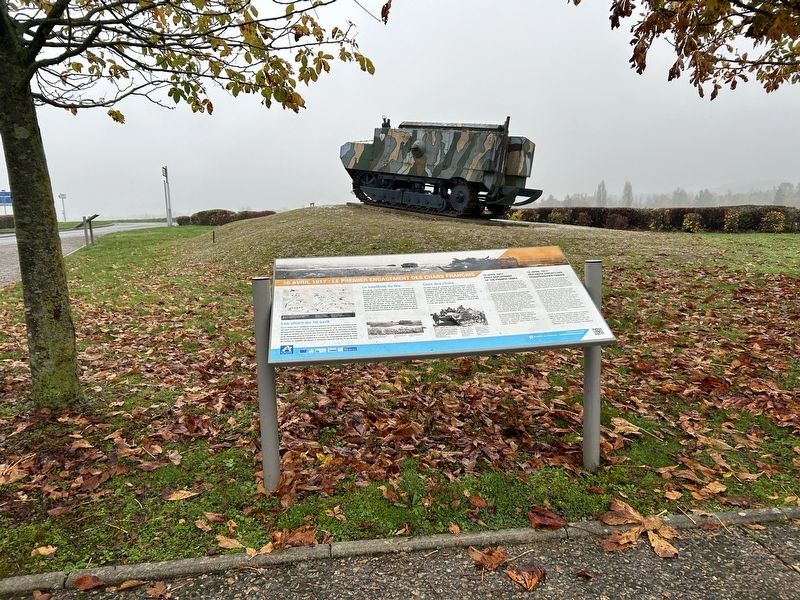
Photographed by Steve Stoessel, November 18, 2024
2. 16 Avril 1917: Le Premier Engagement des Chars Marker
As did gunners with their cannons, some of the tanks had been given names, sometimes humorous ("Aisne...fire!" or "We take no prisoners"), sometimes challenging ("Death dodger" or "Malèche" which means "It doesn't matter" in Arabic).
Am 31. März 1917 verfügte die Sturmartillerie über 208 Schneider Panzer und 48 Saint-Chamond Panzer. Die 129 Schneider der Verbände Bossut und Chaubès sollten am 16. April in der Ebene am Fuße des Chemin des Dames zur Unterstützung der Infanterie angreifen. Sie starteten gegen 6.30 Uhr.
Während die 48 Panzer des Verbands Chaubès rasch von der deutschen Artillerie aufgehalten wurden, gelangten einige Gruppen des Verbands Bossut bis zur dritten deutschen Linie und konnten Gegenangriffe führen, bevor sie sich am Ende des Tages zurückzogen. Der menschliche und materielle Preis war hoch. Von den 720 eingesetzten Soldaten gab es über 100 Verletzte und 55 Tote, darunter der Commandant Bossut. Einige Besatzungen wurden bei lebendigem Leibe verbrannt. 57 Panzer wurden verloren (26 des Verbands Chaubès und 31 des Verbands Bossut), 36 Panzer hatten Pannen.
So wie es Artilleristen mit ihren Kanonen machten, hatten auch die Panzerfahrer einigen Panzern Namen gegeben, teils humoristisch (Anjou, ...eu!" oder „Qui s'y frotte s'y pique"), teils wie eine Herausforderung („Trompe le mort" oder „Malèche", d.h. „Nicht so schlimm" auf Arabisch).
Topics. This historical marker is listed in these topic lists: Roads & Vehicles • War, World I. A significant historical date for this entry is March 31, 1917.
Location. 49° 24.79′ N, 3° 53.231′ E. Marker is near Berry-au-Bac, Hauts-de-France (Upper France), in Aisne. It can be reached from the intersection of Hauts-de-France Route 925 and Route 1044. Touch for map. Marker is in this post office area: Berry-au-Bac, Hauts-de-France 02190, France. Touch for directions.

Regionally, it is in the North Atlantic Region, Europe, the European Union, Atlantic Europe, the Schengen Area, Western Europe, a coastal Mediterranean country, and the Western World. Historically, it finds itself in what was once a French colony and also the Roman Empire.
Other nearby markers. At least 8 other markers are within walking distance of this marker: Berry-au-Bac et la Mémoire de l’Arme Blindée (a few steps from this marker); 1918: La Victoire du Char (a few steps from this marker); The Offensive of April 16, 1917 / L’offensive du 16 Avril 1917 (a few steps from this marker); La Nissance d’une Nouvelle Arme (a few steps from this marker); Le Char Schneider CA-1 (a few steps from this marker); Aux Morts Des Chars d'Assaut (within shouting distance of this marker); Cholera Crossroads (within shouting distance of this marker); Le Chemin des Dames (within shouting distance of this marker). Touch for a list and map of all markers in Berry-au-Bac.
Credits. This page was last revised on February 10, 2025. It was originally submitted on February 9, 2025, by Steve Stoessel of Niskayuna, New York. This page has been viewed 144 times since then and 40 times this year. Photos: 1, 2. submitted on February 9, 2025, by Steve Stoessel of Niskayuna, New York.
