Old Town in Alexandria, Virginia — The American South (Mid-Atlantic)
Lafayette in Alexandria
Alexandria Heritage Trail
| — | City of Alexandria, Est. 1749 | — |
The Farewell Tour
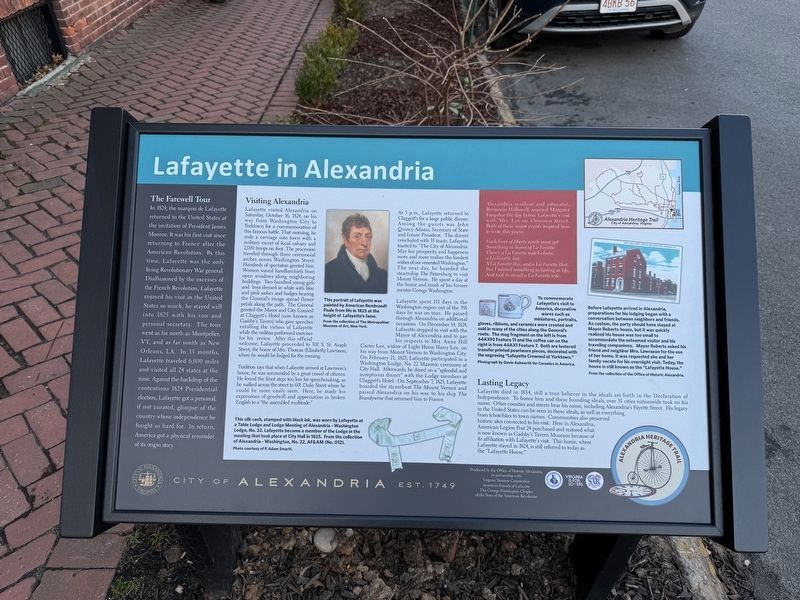
In 1824, the marquis de Lafayette returned to the United States at the invitation of President James Monroe. It was his first visit since returning to France after the American Revolution. By this time, Lafayette was the only living Revolutionary War general. Disillusioned by the excesses of the French Revolution, Lafayette enjoyed his visit in the United States so much, he stayed well into 1825 with his son and personal secretary. The tour went as far north as Montpelier, VT, and as far south as New Orleans, LA. In 13 months, Lafayette traveled 6,000 miles and visited all 24 states at the time. Against the backdrop of the contentious 1824 Presidential election, Lafayette got a personal, if not curated, glimpse of the country whose independence he fought so hard for. In return, America got a physical reminder of its origin story.
Visiting Alexandria
Lafayette visited Alexandria on Saturday, October 16, 1824, on his way from Washington City to Yorktown for a commemoration of his famous battle. That morning, he rode a carriage into town with a military escort of local Calvary and 2,000 troops on foot.
this page online
Tradition says that when Lafayette arrived at Lawrason's house, he was surrounded by a great crowd of citizens. He found the front steps too low for speechmaking, so he walked across the street to 601 Duke Street where he could be more easily seen. Here, he made his expressions of goodwill and appreciation in broken English to a "the assembled multitude."
At 5 p.m., Lafayette returned to Claggett's for a large public dinner. Among
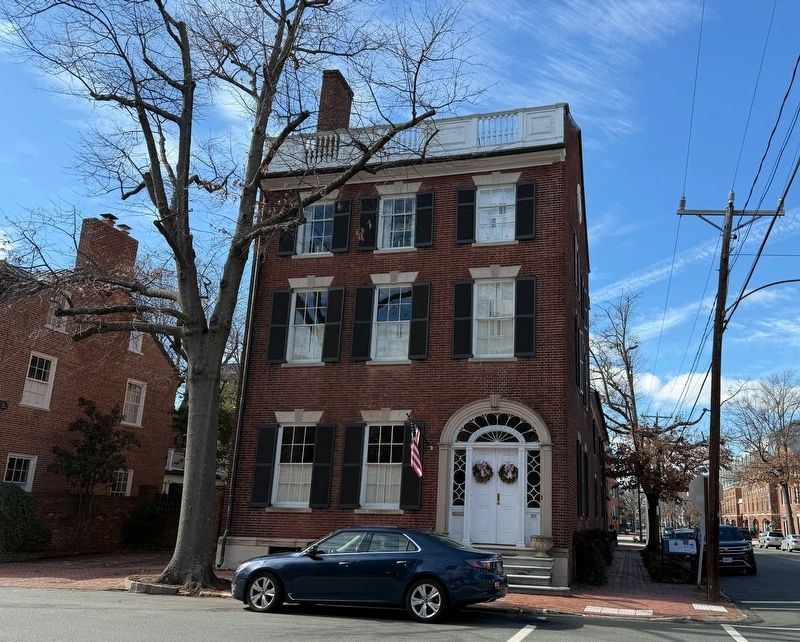
Photographed by Devry Becker Jones (CC0), February 9, 2025
2. Lafayette in Alexandria Marker to the right of the Lafayette House at 301 South St. Asaph Street
Lafayette spent 111 days in the Washington region out of the 391 days he was on tour. He passed through Alexandria on additional occasions. On December 14, 1824, Lafayette stopped to visit with the Mayor of Alexandria and to pay his respects to Mrs. Anne Hill Carter Lee, the widow of Light Horse Harry Lee, on his way from Mount Vernon to Washington City. On February 21, 1825, Lafayette participated in a Washington Lodge, No. 22 Masonic ceremony at City Hall. Afterwards, he dined on a "splendid and sumptuous dinner" with the Lodge members at Claggett's Hotel. On September 7, 1825, Lafayette boarded the steamboat The Mount Vernon and passed Alexandria on his way to his ship The Brandywine that returned him to France.
Lasting Legacy
Lafayette died in 1834, still a true believer in the ideals set forth in the Declaration of Independence. To honor him and these founding ideals, over 35 cities nationwide took on his name. Other counties and streets bear his name, including Alexandria's Fayette Street. His legacy in the United States can be seen in these ideals, as well as everything from tchotchkes to town names. Communities also preserved historic sites connected to his visit. Here in Alexandria, American Legion Post 24 purchased and restored what is now known as Gadsby's Tavern Museum because of its affiliation with Lafayette's visit. This home, where Lafayette stayed in 1824, is still referred to today as the "Lafayette House."
[Sidebar:]
Alexandria resident and educator, Benjamin Hallowell, married Margaret Farquar the day before Lafayette's visit with Mrs. Lee on Oronoco Street. Both of these major events inspired him to write this poem.
Each lover of liberty surely must get
Something in honor of La Fayette.
There's a La Fayette watch-chain,
a La Fayette hat,
A La Fayette this, and a La Fayette that.
But I wanted something as lasting as life,br> And I took to myself a La Fayette wife.
[Captions:]
This portrait of Lafayette was painted by American Rembrandt Peale from life in 1825 at the height of Lafayette's Fame.
This silk sash, stamped with black ink, was worn by Lafayette at a Table Lodge Lodge Meeting of Alexandria - Washington Lodge, No. 22. Lafayette became a member of the Lodge in the meeting that took place at City Hall in 1825. From the collection of Alexandria - Washington, No. 22, AF&AM (No. 012).
To commemorate Lafayette's visit to America, decorative wares such as miniatures, portraits, gloves, ribbons, and ceramics were created and sold in many of the cities along the General's route. the mug fragment on the left is from 44AX93 Feature 11 and the coffee can on the right is from 44AX1 Feature 7. Both are lustered transfer printed pearlware pieces, decorated with the engraving "Lafayette Crowned at Yorktown."
Before Lafayette arrived in Alexandria preparations for his lodging began with a conversation between neighbors and friends. As custom, the party should have stayed at Mayor Roberts house, but it was quickly realized his house was too small to accommodate the esteemed visitor and his traveling companions. Mayor Roberts asked his friend and neighbor Mrs. Lawrason for the use of her home. It was requested she and her family vacate for his overnight visit. Today, the house is still known as the "Lafayette House."
Erected by City of Alexandria Office of Historic Alexandria in partnership with Virginia Tourism Corporation, American Friends of Lafayette and The George Washington Chapter of the Sons of the American Revolution.
Topics and series. This historical marker is listed in these topic lists: Notable Events • Patriots & Patriotism. In addition, it is included in the Lafayette’s Farewell Tour, the Sons of the American Revolution (SAR), and the Virginia, The City of Alexandria series lists. A significant historical date for this entry is February 21, 1825.
Location. 38° 48.157′ N, 77° 2.786′ W. Marker is in Alexandria, Virginia. It is in Old Town. It is at the intersection of South Saint Asaph Street and Duke Street, on the right when traveling south on South Saint Asaph Street. Touch for map. Marker is at or near this postal address: 301 S St Asaph St, Alexandria VA 22314, United States of America. Touch for directions.

Regionally, this marker is in the Washington Metropolitan Area and in Northern Virginia. It is also in the American South, specifically in the Upper South, in the Mid-Atlantic, and on the Eastern Seaboard. Globally, it is in the North Atlantic Region, North America, the Western Hemisphere, the Western World, and the Anglosphere. Historically, it finds itself in what was once the territory of the Mississippian Culture, one of the original Thirteen Colonies, one of the Confederate States of America, and the Antebellum South.
Other nearby markers. At least 8 other markers are within walking distance of this marker: Suffragists and a Courtroom Decision in Alexandria (about 300 feet away, measured in a direct line); Beulah Baptist Church (about 400 feet away); Stabler-Leadbeater House (about 400 feet away); Saint Paul's Episcopal Church (about 400 feet away); The Ticer House (about 400 feet away); Brigadier General Montgomery D. Corse, CSA (about 500 feet away); John Douglass Brown House (about 500 feet away); The Lyceum (about 500 feet away). Touch for a list and map of all markers in Alexandria.
Credits. This page was last revised on February 9, 2025. It was originally submitted on February 9, 2025, by Devry Becker Jones of Washington, District of Columbia. This page has been viewed 230 times since then and 35 times this year. Photos: 1, 2. submitted on February 9, 2025, by Devry Becker Jones of Washington, District of Columbia.
