Near Fleury-devant-Douaumont in Meuse, Alsace, Lorraine, Champagne-Ardenne, France — Western Europe
Les Sentiers du Champ de Bataille
Battlefield Trail
| — | Sentier de Souville | — |

Photographed by Steve Stoessel, November 18, 2024
1. Les Sentiers du Champ de Bataille Marker
 [Side 1]
Die Besichtigungswege Des Schlachtfelds
Battlefield Trails
Sentier De Souville
Autour de Verdun, aux avant-postes de la frontière de l'époque, l'espace rural (villages, terres agricoles et forestières) subit une profonde mutation lors de la construction du camp retranché entre 1873 et 1914. À l'issue des combats de 1916, “300 jours et 300 nuits“ effroyables, près de 700000 hommes sont morts, blessés o disparus. En 1919, en Meuse, l'État français classe en Zone rouge 20000 ha de terrain traumatisé. Autour d'un débat passionné, il confie en 1923 à l'administration forestière la mission de boiser le champ de bataille de Verdun. Tandis que les bois feuillus mutilés se reconstituent naturellement, 36 millions d'arbres sont plantés sur les terres agricole dévastées. Dans cette forêt règnent aujourd'hui les pins et épicéas des premières plantations, les hêtres et autre feuillus des anciens bois et des nouvelles régénérations. Cœur du champ de bataille, exclu de ces reboisements et laisse à l'évolution naturelle, le Plateau de Douaumont
this page online
Cette forêt sanctuaire, dont le sol conserve les restes de 80 000 combattants, est un patrimoine universel de la Grande Guerre. Espace mémoriel, elle accueille des générations de pèlerins et de visiteurs; espace naturel, elle appartient au réseau européen Natura 2000 en raison de sa biodiversité remarquable: trous d'obus devenus mares forestières abritant des amphibiens, bâtis militaires hébergeant une faune cavernicole variée...
Gérée par l'Office National des Forêts, la forêt domaniale de Verdun est labellisée Forêt d'exception: poursuivant l'œuvre entreprise depuis un siècle, gestionnaires, scientifiques et acteurs du territoire s'emploient conjointement à préserver et à valoriser ces lieux. Pour les découvrir autrement, engagez-vous sur ces sentiers en milieu forestier.
Der ländliche Raum um Verdun, an den Vorposten der damaligen Grenze, mit seinen Dörfern, landwirtschaftlichen Flächen und Waldgebieten, erfährt während des Baus des verschanzten Lagers zwischen 1873 und 1914 eine tiefgreifende Veränderung.
Nach den

Photographed by Steve Stoessel, November 18, 2024
2. Sentiers du Souville Marker
Dieses Waldschutzgebiet, in dessen Boden noch die Gebeine von 80.000 Frontsoldaten liegen, ist ein Welterbe des Ersten Weltkriegs. Als Ort des Gedenkens zieht es Generationen von Pilgern und Besuchern an; als Naturraum gehört es aufgrund

Photographed by Steve Stoessel, November 18, 2024
3. Les Sentiers du Champ de Bataille Marker
Der von der zentralen Forstverwaltung ONF verwaltete Staatsforst von Verdun wurde mit dem Qualitätssiegel Forêt d'exception ausgezeichnet. Damit setzen Verwalter, Wissenschaftler und lokale Akteure das vor einem Jahrhundert begonnene Werk fort und setzen sich gemeinsam für den Schutz und die Aufwertung dieser Flächen ein. Unternehmen Sie einen Spaziergang durch den Wald, um dieses Gebiet einmal auf andere Weise zu entdecken.
In the Verdun area, close to what was then the border, the countryside, villages, farmland and forests underwent significant change with the construction of the retrenched camp between 1873 and 1914.
By the end of the battle in 1916, “300 days and 300 nights" of horror, almost 700,000 men were dead, wounded or missing. In 1919, the State classified 20,000 hectares of devastated countryside in Meuse as a "red zone" and in 1923, despite vigorous debate, it handed
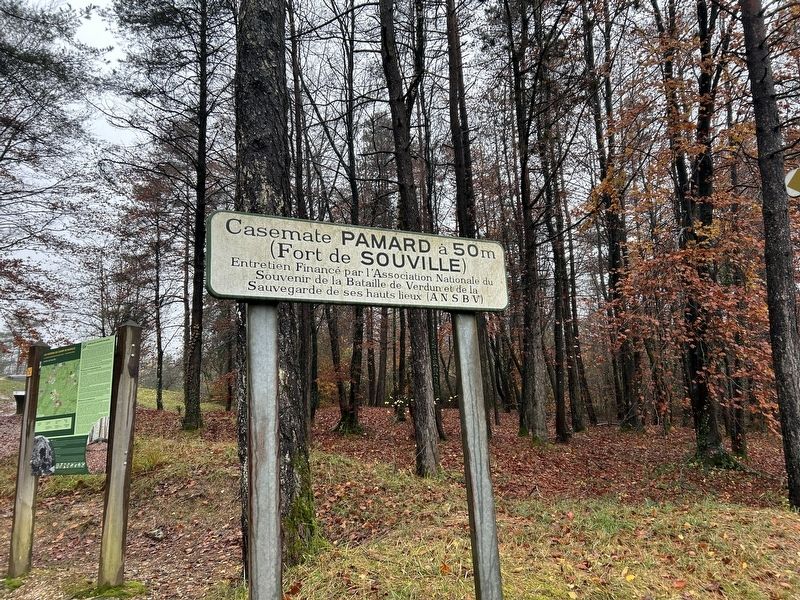
Photographed by Steve Stoessel, November 18, 2024
4. Les Sentiers du Champ de Bataille Marker
The forest has become a sanctuary. Buried in the earth are the remains of 80.000 soldiers, a world heritage dating from the days of the Great War. The battlefield is a memorial, welcoming generations of pilgrims and visitors. It is also an area of unspoiled natural beauty whose outstanding biodiversity has made it part of the European Natura 2000 network. Shell craters have become woodland pools that are home to amphibians. Military constructions now provide a habitat for a range of cave-dwelling creatures.
Managed by the Office National des Forêts, Verdun's State-owned forest has been given Forêt d'exception status. Now, managers, scientists and local stakeholders are continuing the work that has been ongoing for a century to preserve and add value to the location and woodland paths provide a different view.
Chers visiteurs, Vous êtes sur un lieu de mémoire riche d'un patrimoine archéologique et naturel très sensible. La forêt domaniale de Verdun est désignée au réseau européen Natura 2000. Elle bénéficie d'un régime de protection au titre des Codes de l'environnement (loi de 1930) et du Patrimoine (loi de 2004). C'est un bien culturel commun à l'humanité Il est du devoir de chacun de veiller à sa protection et à sa sauvegarde. Tout contrevenant est susceptible de sanctions pénales.
Sie befinden sich an einem Ort der Ennnerung, der über ein vielfältiges archäologisches Erbe und ein sehr empfindliches Naturerbe verfügt. Der Staatsforst von Verdun ist Teil des europäischen Netzwerks Natura 2000. Er genießt einen Schutzstatus gemäß den Gesetzbüchern für Umwelt (Gesetz von 1930) und Kulturerbe (Gesetz von 2004). Dies ist ein gemensames Kulturgut der Menschheit. Es ist die Pflicht jedes Einzelnen, auf seinen Schutz zu achten. Gegen Zuwiderhandelnde können Strafen verhängt werden.
You are in a place of remembrance steeped in archaeological heritage. It is also an environmentally sensitive area. Verdun Forest is part of the European Natura 2000 network and is protected under legislation on the environment (1930 law) and heritage (2004 law). As a cultural asset, it belongs to the whole of humanity so each one of us should ensure that it is protected and kept safe. Anybody committing an offence is liable to criminal prosecution.
Casemate Pamart téte d’elephant
Pamart casemate “elephant head
[Side 2]
Les derniers assauts allemands
Die letzten deutschen Sturmangriffe
The final German assaults
• 1875-1913 : construction puis modernisation du fort
• 21 février 1916: déclenchement de la bataille de Verdun
• 23 juin 1916 : offensive allemande
• 11-12 juillet 1916: échec de l'attaque sur le fort; fin de l'offensive
• Fin juillet 1916: contre-attaques françaises
• 1917: réaménagement du fort: galeries profondes, casemates et sorties
Six repères, une histoire...
1. Près du Mémorial de Fleury, le sentier traverse une pelouse parsemée d'arbustes et arbrisseaux, site aménagé en faveur des insectes. Dans ces milieux semi-ouverts, nombreux sur le site classé du Plateau de Douaumont, cohabitent orchidées, insectes et papillons, dont le rare Azuré du serpolet.
Au carrefour du Lion de Souville, le sentier aborde le glacis nord du fort.
2 Édifié sur des terres agricoles, le fort de Souville contrôle la crête Thiaumont - Fleury. En juillet 1916, il est le dernier verrou devant Verdun. Les dynamiques végétales d'après-guerre, spontanées ou conduites par les forestiers, ont engendré une mosaïque de pelouses, de fourrés, de taillis et de futaies.
Les deux créneaux de mitrailleuses d'une casemate Pamart (nom de son concepteur), construite en 1917 pour renforcer la défense des glacis du fort, sont une image forte du circuit.
3. Une forêt claire masque les ruines du fort, dont l'accès est interdit en raison de la dangerosité et des mesures de protection des chauves-souris, qui en occupent les salles et galeries souterraines. Dans les fossés du saillant sud-ouest, le sentier longe l'escarpe (mur interne) et une caponnière (ouvrage de défense) puis passe devant la porte d'entrée, dite "de paix", du fort. 4. La batterie d'un canon de 155 mm, à tourelle Bussière (nom de son concepteur) fut reliée au fort par une galerie en 1917; sa cloche observatoire est aujourd'hui sous forêt, à proximité, de la troisième casemate Pamart.
5. La section méridionale du sentier passe devant deux accès externes du fort: un abri caverne, dite « entrée de guerre » et un dépôt de munitions (casemate B). La majestueuse forêt de hêtres aux troncs puissants, héritée des bois feuillus d'avant-guerre (le bois des Malades en référence aux Hospices de Verdun, ancien propriétaire), est parcourue d'un lacis de boyaux qui assuraient la logistique de la bataille.
6. Des banquettes d'artillerie prolongent la défense de la crête, dont le sentier parcourt le versant nord jusqu'à la route de Verdun, le long de laquelle s'égrènent des monuments : 7°RI, général Chrétien, André Maginot.
Dans cette zone, les épicéas, fragilisés par des attaques d'insectes et par les coups de vent répétés, ont été récoltés pour laisser la place à des plantations expérimentales.
Pour rejoindre Fleury, le sentier emprunte la plateforme de l'ancienne voie ferrée du Tacot.
• 1875 - 1913: Bau und Modernisierung des Forts
• 21. Februar 1916: Auslösung der Schlacht von Verdun
• 23. Juni 1916: deutsche Offensive
• 11. -12. Juli 1916: Fehlschlag des Angriffs aufs Fort; Ende der Offensive
• Ende Juli 1916: französische Gegenangriffe
• 1917: Neugestaltung des Forts: tiefe Stollen, Kasematten und Ausgänge
Sechs Wegmarken, eine Geschichte...
1. In der Nähe des Memorials von Fleury durchquert der Besichtigungsweg eine mit Büschen und Sträuchern bewachsene Rasenfläche, dieses Gelände wurde als Insektenwiese angelegt. In den zahlreichen, halboffenen Landschaften des Naturschutzgebietes der Hochebene von Douaumont sind Orchideen, Insekten und Schmetterlinge (darunter der seltene Ameisenbläuling) in großer Artenvielfalt anzutreffen.
An der Kreuzung des Verwundeten Löwen von Souville nähert sich der Weg dem nördlichen Glacis des Forts.
2. Das auf landwirtschaftlichen Böden errichtete Fort Souville kontrolliert den Bergkamm Thiaumont - Fleury. Im Juli 1916 ist es die letzte Festung vor Verdun. Die spontanen oder von Förstern gelenkten pflanzlichen Energien der Nachkriegszeit haben ein Mosaik aus Grasflächen, Gestrüpp, Dickicht und Hochwäldern entstehen lassen.
Die beiden Maschinengewehr-Schießscharten einer Pamart-Kasematte (Pamart = Name des Entwicklers), die 1917 gebaut wurden, um die Abwehr der Glacis des Forts zu verstärken, stellen ein aussagekräftiges Bild des Rundweges dar.
3. Lichter Wald verdeckt die Ruinen des Forts, dessen Zugang aufgrund der Gefährlichkeit und zum Schutz der Fledermäuse, die in den Räumen und unterirdischen Stollen Unterschlupf finden, verboten ist. In den Festungsgräben des südwestlichen Vorsprungs führt der Weg an einer langen Escarpemauer (Innenmauer) und einer Kaponniere (Festungswerk) entlang und erreicht dann die „Friedenseingang" genannte Eingangstür.
4.Die 155 mm Kanonenbatterie am Bussière-Turm (Buissière = Name des Entwicklers) wurde 1917 durch einen Stollen mit dem Fort verbunden; ihre Beobachtungsglocke befindet sich heute im Wald in der Nähe der dritten Pamart-Kasematte.
5. Der südliche Teil des Besichtigungswegs führt an zwei externen Zugängen des Forts vorbei: an einem Unterstand (Kaverne), auch „Kriegseingang" genannt und einem Munitionslager (Kasematte B). Der majestätische Buchenwald mit starken Stämmen, ein Erbe der Laubwälder der Vorkriegszeit („bois des Malades* (Krankenwald) Bezug nehmend auf das Pflegeheim von Verdun, dem ehemaligen Besitzer), ist von einem Laufgrabennetz durchzogen, das die Logistik der Schlacht sicherstellte.
6. Artillerie-Banketten verlängern die Verteidigungsanlage des Bergkamms, deren Weg am Nordhang entlang bis zur Straße von Verdun verläuft, an der sich die folgenden Denkmäler aufreihen: IR Nr. 7, General Chrétien, André Maginot
In diesem Bereich wurden die durch Insektenbefall und wiederholte Windstöße geschwächten Fichten abgeholzt, um Platz für experimentelle Pflanzungen zu lassen.
Um nach Fleury zu gelangen, folgt der Besichtigungsweg der Plattform der ehemaligen Tacot-Eisenbahnlinie.
• 21 February 1916: start of the Battle of Verdun
• 23 June 1916: German offensive
• 11-12 July 1916: assault on the fort failed; end of the offensive
• End of July 1916: French counterattacks
• 1917: fort was redeveloped: deep tunnels, bunkers and exits.
Six locations, one history
1. Near the Fleury Memorial, the path crosses an area of grassland dotted with bushes and shrubs, a site created for insects. Orchids, insects and butterflies, including the rare large blue, coexist in these semi-open environments, of which there are many on the classified site of the Douaumont plateau.
At the Lion de Souville crossroads, the path approaches the northern glacis of the fort.
2. Fort Souville, which was built on farmland, stands atop the Thiaumont-Fleury ridge. In July 1916, it was the last line of defence before Verdun. The afterwar plant dynamics, spontaneous or managed by foresters, created a mosaic of grassland, thickets, copses and forests.
The two machine gun emplacements of a Pamart (the name of its inventor) bunker, which was built in 1917 to strengthen the defences of the fort's glacis, are a powerful image of the route.
3. An area of woodland masks the ruins of the fort, to which access is prohibited due the danger and the measures taken to protect bats, which occupy its rooms and underground tunnels. In the ditches of the south-west projection, the path runs alongside the scarp (internal wall) and a caponier (defence fortification) before passing in front of the so-called "peacetime" entrance to the fort.
4 .The battery of a 155 mm gun with a Bussière turret (named after its inventor) was connected to the fort by a passageway in 1917; its observation cloche is now covered by forest close to the third Pamart bunker. 5. The southern section of the path passes in front of two external points of access to the fort: a cavern shelter called the "wartime entrance" and an ammunition dump (bunker B). The majestic forest of beech trees with powerful trunks, which are descendants of the broadleaf woodland that was there before the war (known as the bois des Malades in reference to the Hospices of Verdun, the former owner), is crossed by a maze of passageways which served a logistical purpose during battle.
6. Artillery platforms extend the defences of the ridge, whose northern slope is crossed by the path on its way to the Verdun road, along which there are monuments to the 7th Infantry Regiment, General Chrétien and André Maginot.
In this area, the spruce trees, which were weakened by insect attacks and repeated gusts of wind, were felled to create space for experimental plantations.
On its way back to Fleury, the path runs along the platform on the former Tacot railway line.
[Photo Captions]
Un papilion rare, l'Azuré du serpolet (Maculinea arion) et sa plante préférée, le Thym serpolet (Thymus serpyllum), présents sur le Plateau de Douaumont
Entrée de la batterie à tourelle Bussière, du fort de Souville, en mars 1916.
Dévastation du fort et de ses abords Octobre 1918 (vue aérienne)
Entrée de la batterie à tourelle Bussière à la fin des combats
,br> Entrée du dépôt de munitions fort de Souville en mars 1917.
A rare papilion, the wild thyme (Maculinea arion) and its favourite plant, the wild thyme (Thymus serpyllum), present on the Douaumont
Plateau Entrance of the Bussière turret battery, from the fort of Souville, in March 1916.
Devastation of the fort and its surroundings October 1918 (aerial view)
Entrance of the Bussière turret battery at the end of the fighting
, br> Entrance to the Fort de Souville ammunition depot in March 1917.
Topics. This historical marker is listed in these topic lists: Environment • Horticulture & Forestry • War, World I. A significant historical date for this entry is February 21, 1916.
Location. 49° 11.361′ N, 5° 26.525′ E. Marker is near Fleury-devant-Douaumont, Grand Est (Alsace, Lorraine, Champagne-Ardenne), in Meuse. It is on Grand Est Route 913 half a kilometer south of Route 112, on the right when traveling south. Touch for map. Marker is in this post office area: Fleury-devant-Douaumont, Grand Est 55100, France. Touch for directions.

Regionally, it is in the North Atlantic Region, Europe, the European Union, Atlantic Europe, the Schengen Area, Western Europe, a coastal Mediterranean country, and the Western World. Historically, it finds itself in what was once a French colony, the Roman Empire, and specifically the Holy Roman Empire.
Other nearby markers. At least 8 other markers are within walking distance of this marker: Casements Pamart (within shouting distance of this marker); Monument du Lion de Souville (approx. 0.4 kilometers away); Fort de Souville (approx. 0.4 kilometers away); Command Post 30th Corps (approx. 0.8 kilometers away); André Maginot (approx. 0.8 kilometers away); a different marker also named André Maginot (approx. 0.8 kilometers away); In Memorial (approx. 1.3 kilometers away); The "Ravin des Vignes"! (approx. 1.3 kilometers away). Touch for a list and map of all markers in Fleury-devant-Douaumont.
Credits. This page was last revised on February 10, 2025. It was originally submitted on February 10, 2025, by Steve Stoessel of Niskayuna, New York. This page has been viewed 213 times since then and 35 times this year. Photos: 1, 2, 3, 4. submitted on February 10, 2025, by Steve Stoessel of Niskayuna, New York.
