Pawnee in Pawnee County, Oklahoma — The American South (West South Central)
Earth Lodge
As written by Matt Reed (Pawnee)
| — | Pawnee Bill Ranch & Museum | — |
Photographed by Cosmos Mariner, September 10, 2024
1. Earth Lodge Marker
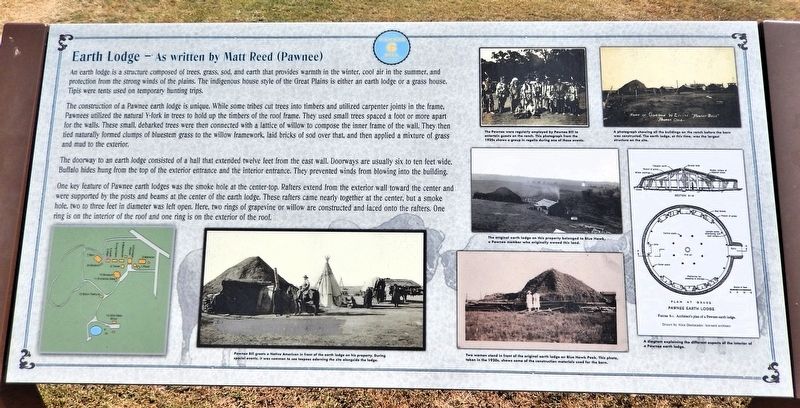
An earth lodge is a structure composed of trees, grass, sod, and earth that provides warmth in the winter, cool air in the summer, and protection from the strong winds of the plains. The indigenous house style of the Great Plains is either an earth lodge or a grass house. Tipis were tents used on temporary hunting trips.
The construction of a Pawnee earth lodge is unique. While some tribes cut trees into timbers and utilized carpenter joints in the frame, Pawnees utilized the natural Y-fork in trees to hold up the timbers of the roof frame. They used small trees spaced a foot or more apart for the walls. These small, debarked trees were then connected with a lattice of willow to compose the inner frame of the wall. They then tied naturally formed clumps of bluestem grass to the willow framework, laid bricks of sod over that, and then applied a mixture of grass and mud to the exterior.
The doorway to an earth lodge consisted of a hall that extended twelve feet from the east wall. Doorways are usually six to ten feet wide. Buffalo hides hung from the top of the exterior entrance and the interior entrance. They prevented winds
this page online
One key feature of Pawnee earth lodges was the smoke hole at the center-top. Rafters extend from the exterior wall toward the center and were supported by the posts and beams at the center of the earth lodge. These rafters came nearly together at the center, but a smoke hole, two to three feet in diameter was left open. Here, two rings of grapevine or willow are constructed and laced onto the rafters. One ring is on the interior of the roof and one ring is on the exterior of the roof.
Erected by Pawnee Bill Ranch & Museum. (Marker Number 6.)
Topics. This historical marker is listed in these topic lists: Architecture • Indigenous Peoples and Communities.
Location. 36° 19.869′ N, 96° 48.989′ W. Marker is in Pawnee, Oklahoma, in Pawnee County. It can be reached from Pawnee Bill Road just east of Harrison Street (U.S. 64), on the right when traveling east. The marker is located on the Pawnee Bill Ranch interpretive trail, overlooking the former earth lodge site. Touch for map. Marker is at or near this postal address: 1141 Pawnee Bill Road, Pawnee

2. Marker detail: Pawnee Bill, Earth Lodge
Pawnee Bill greets a Native American in front of the earth lodge on his property. During special events, it was common to see teepees adorning the site alongside the lodge.

Regionally, this marker is in Northeast Oklahoma—Green Country and in Greater Tulsa. It is also in the American South, specifically on the prairies, and on the Southern Plains. Globally, it is in North America, the Western Hemisphere, the Western World, and the Anglosphere. Historically, it finds itself in what was once the territory of the Mississippian Culture and also the Louisiana Purchase.
Other nearby markers. At least 8 other markers are within walking distance of this marker: The Log Cabin (here, next to this marker); The Blacksmith Shop (within shouting distance of this marker); The Windmill (within shouting distance of this marker); The Observation Tower (within shouting distance of this marker); The Barn (within shouting distance of this marker); Local and Regional Sites (within shouting distance of this marker); Pawnee Bill Ranch and Museum (within shouting distance of this marker); The Old Entrance Gate (within shouting distance of this marker). Touch for a list and map of all markers in Pawnee.
Related markers. Click here for a list of markers

3. Marker detail: Pawnee Entertainment
The Pawnee were regularly employed by Pawnee Bill to entertain guests on the ranch. This photograph from the 1920s shows a group in regalia during one of these events.
Also see . . . Earth Lodges and Tipis (NebraskaStudies.org).
Excerpt: Earth lodges first appeared in the farming tribes on the plains around AD 700. Before Christopher Columbus’ discovery of the "New World," Native Americans lived in villages made up of small numbers of earth lodges, usually square in shape. Large wooden posts were placed upright in the ground and supported a framework of smaller logs. Then this was covered with grass and earth which provided shelter from the weather. Indian tribes such as the Pawnee also lived in earth lodges that were round in shape and made of the same raw materials as earlier earth lodges. As many as thirty people might live in one house. By the late eighteenth and early nineteenth century, the Pawnee were living in circular earth lodges in large villages, which might include 1000 to 2000 people.(Submitted on February 12, 2025, by Cosmos Mariner of Cape Canaveral, Florida.)In some tribes, the earth lodge played a central role in the myths and rituals of the people. The Pawnee, for example, worshiped a host of celestial deities and incorporated astronomical symbolism in their earth lodges and the
layout of their villages. Tirawa was the Pawnee’s supreme deity and creator. His domain was in the vast expanse of the sky above, so his presence in the lodge was visible through the smoke hole and the shaft of light that came through. The door was generally faced east where the morning star pours his beam into the lodge and lights the fire. On the western wall was an altar representing the evening star, the Goddess of Night. Beds were arranged around the outer walls. The fire pit was in the center. 4. Marker detail: Original Earth LodgeThe original earth lodge on this property belonged to Blue Hawk, a Pawnee member who originally owned this land.
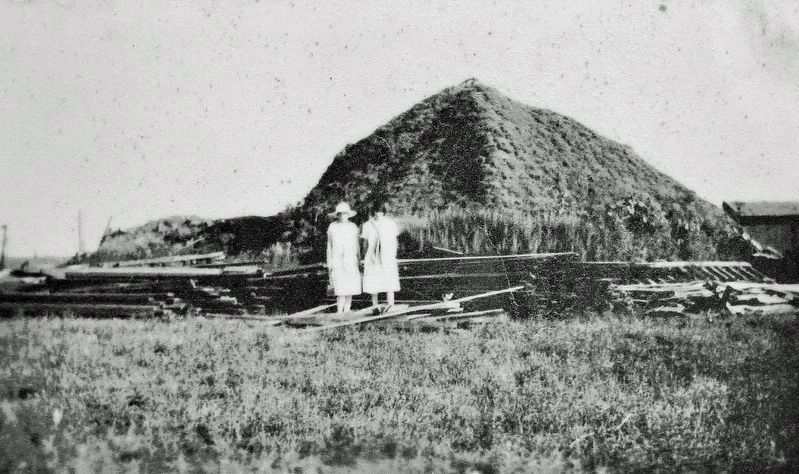
5. Marker detail: Two women stand in front of the original earth lodge on Blue Hawk Peak.
This photo, taken in the 1920s, shows some of the construction materials used for the barn.
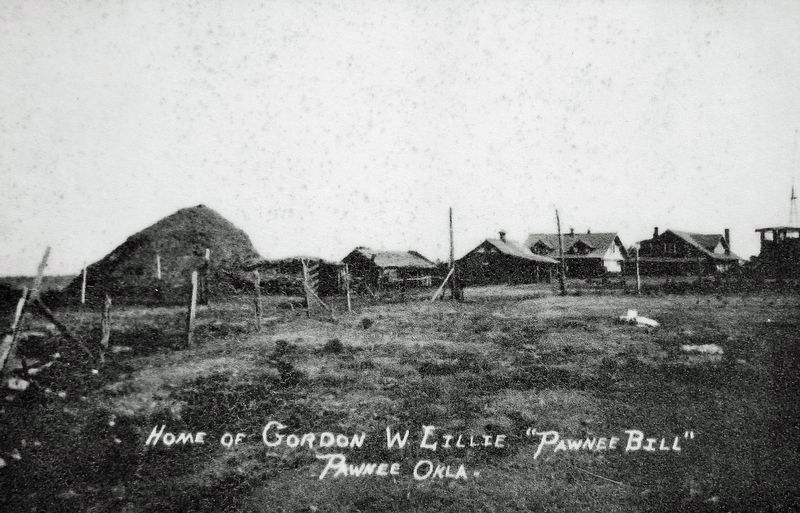
6. Marker detail: Earth Lodge before the barn was constructed.
A photograph showing all the buildings on the ranch before the barn was constructed. The earth lodge, at this time, was the largest structure on the site.

7. Marker detail: Pawnee Earth Lodge Diagram

Photographed by Cosmos Mariner, September 10, 2024
8. Earth Lodge Marker
Looking south across the former earth lodge site; the present-day barn is in the background.
Credits. This page was last revised on February 14, 2025. It was originally submitted on February 11, 2025, by Cosmos Mariner of Cape Canaveral, Florida. This page has been viewed 483 times since then and 205 times this year. Photos: 1, 2, 3, 4, 5, 6, 7, 8. submitted on February 12, 2025, by Cosmos Mariner of Cape Canaveral, Florida.
