Near Romagne in Meuse, Alsace, Lorraine, Champagne-Ardenne, France — Western Europe
Romagne-Sous-Montfaucon
German War Cemetery
Photographed by Steve Stoessel, November 18, 2024
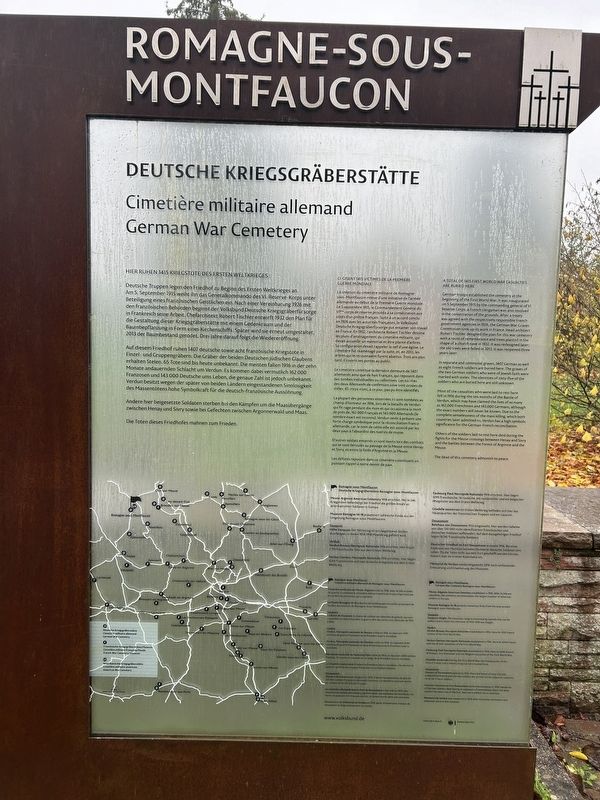
1. Romagne-Sous- Montfaucon Marker

Cimetière militaire allemand
German War Cemetery
Deutsche Truppen legen den Friedhof zu Beginn des Ersten Weltkrieges an. Am 5. September 1915 weiht ihn das Generalkommando des VI. Reserve-Korps unter Beteiligung eines französischen Geistlichen ein. Nach einer Vereinbarung 1926 mit den französischen Behörden beginnt der Volksbund Deutsche Kriegsgräberfürsorge in Frankreich seine Arbeit. Chefarchitekt Robert Tischler entwirft 1932 den Plan für die Gestaltung dieser Kriegsgräberstätte mit einem Gedenkraum und der Baumbepflanzung in Form eines Kirchenschiffs, Später wird sie erneut umgestaltet, 2013 der Baumbestand gerodet. Drei Jahre darauf folgt die Wiedereröffnung.
Auf diesem Friedhof ruhen 1407 deutsche sowie acht französische Kriegstote in Einzel- und Gruppengräbern. Die Gräber der beiden Deutschen jüdischen Glaubens erhalten Stelen. 65 Tote sind bis heute unbekannt. Die meisten fallen 1916 in der zehn Monate andauernden Schlacht um Verdun. Es kommen dabei vermutlich 162 000 Franzosen und 143 000 Deutsche ums Leben, die
this page online
Andere hier beigesetzte Soldaten sterben bei den Kämpfen um die Maasübergänge zwischen Henay und Sivry sowie bei Gefechten zwischen Argonnerwald und Maas.
Die Toten dieses Friedhofes mahnen zum Frieden.
La création du cimetière militaire de Romagne-sous-Montfaucon relève d'une initiative de l'armée allemande au début de la Première Guerre mondiale. Le 5 septembre 1915, le Commandement Général du VIeme corps de réserve procéda à sa consécration aux côtés d'un prêtre français. Suite à un accord conclu en 1926 avec les autorités françaises, le Volksbund Deutsche Kriegsgräberfürsorge put entamer son travail en France. En 1932, l'architecte Robert Tischler dessina les plans d'aménagement du cimetière militaire, qui devait accueillir un mémorial et être planté d'arbres. Sa configuration devait rappeler la nef d'une église. Le cimetière fut réaménagé par la suite, et, en 2013, les arbres qui
Photographed by Steve Stoessel, November 18, 2024
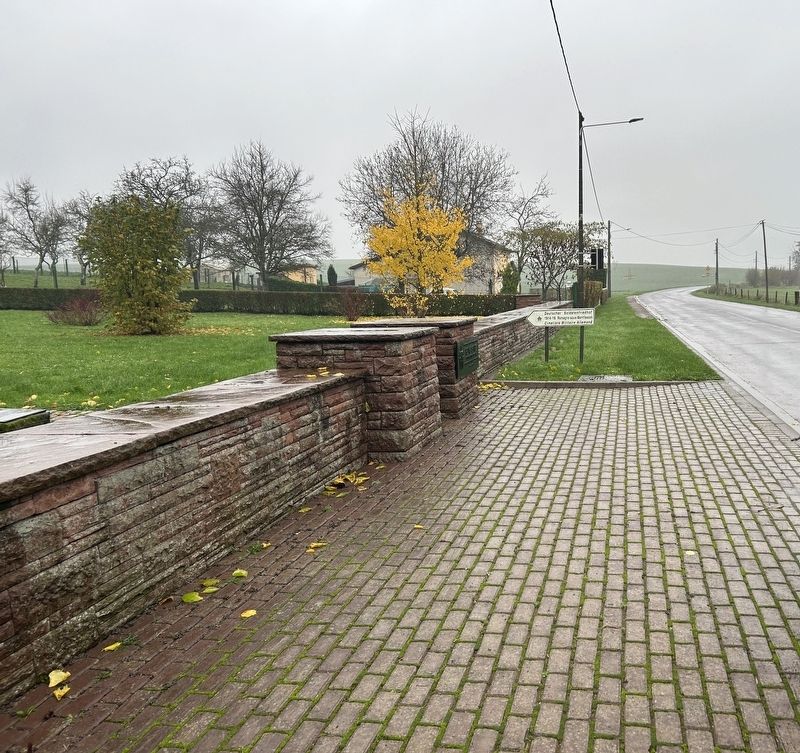
2. Romagne-Sous- Montfaucon Marker
Ce cimetière constitue la dernière demeure de 1407 allemands ainsi que de huit Français, qui reposent dans des tombes individuelles ou collectives. Les tombes des deux Allemands de confession juive sont ornées de stèles. 65 corps n'ont, à ce jour, pas pu être identifiés.
La plupart des personnes enterrées ici sont tombées au champ d'honneur en 1916, lors de la bataille de Verdun qui fit rage pendant dix mois et qui occasionna la mort de près de, 162 000 Français et 143 000 Allemands (le nombre exact est inconnu). Verdun revêt à présent une forte charge symbolique pour la réconciliation franco-allemande, car le nom de cette ville est associé par les deux pays à l'absurdité des tueries de masse.
D'autres soldats enterrés ici sont morts lors des combats qui se sont déroulés au passage de la Meuse entre Henay et Sivry, et entre la forêt d'Argonne et la Meuse.
Les défunts reposant dans ce cimetière constituent un puissant rappel à notre devoir de paix.
German troops established the cemetery
Photographed by Steve Stoessel, November 18, 2024
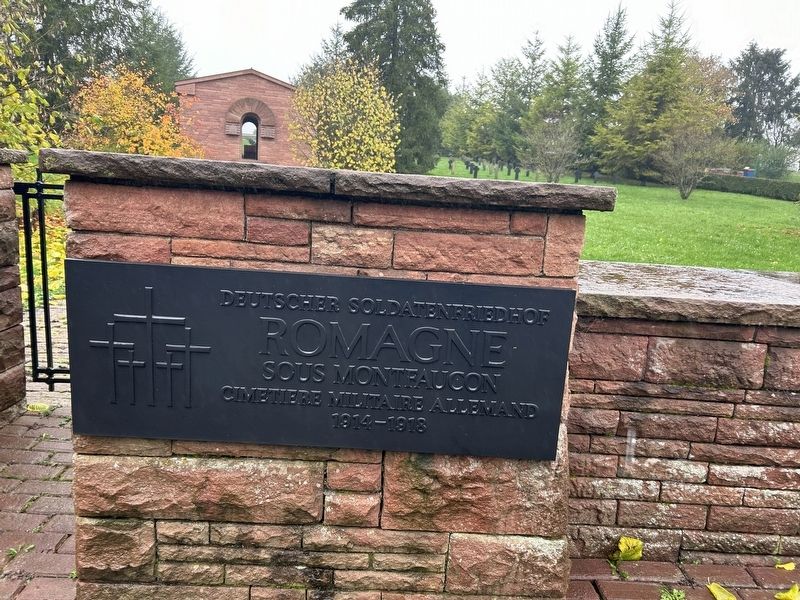
3. Romagne-Sous- Montfaucon Marker
In separate and communal graves, 1407 German as well as eight French soldiers are buried here. The graves of the two German soldiers who were of Jewish faith were marked with steles. The identities of sixty-five of the soldiers who are buried here are still unknown.
Most of the casualties who were laid to rest here fell in 1916 during the ten months of the Battle of Verdun, which may have claimed the lives of as many as 162,000 Frenchmen and 143,000 Germans, although the exact numbers will never be known. Due to the complete senselessness
Photographed by Steve Stoessel, November 18, 2024
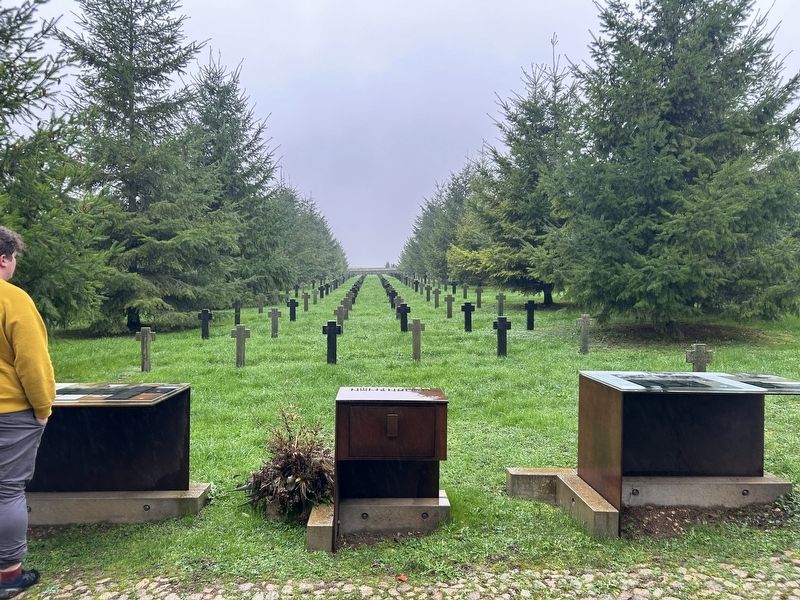
4. Romagne-Sous-Montfaucon Cemetery
The markers relate some individual stories of those buried here, and how the cemetery was restored for 2014.
Others of the soldiers laid to rest here died during the fights for the Meuse crossings between Henay and Sivry and the battles between the Forest of Argonne and the Meuse.
The dead of this cemetery admonish to peace.
[Map legend not transcribed]
Topics. This historical marker is listed in these topic lists: Cemeteries & Burial Sites • War, World I. A significant historical date for this entry is September 5, 1915.
Location. 49° 20.045′ N, 5° 4.946′ E. Marker is near Romagne, Grand Est (Alsace, Lorraine, Champagne-Ardenne), in Meuse. It is on Rue de l'Europe (Grand Est Route 998) 0.4 kilometers north of Route 123, on the left when traveling north. Touch for map. Marker is in this post office area: Romagne, Grand Est 55110, France. Touch for directions.

Regionally, it is in the North Atlantic Region, Europe, the European Union, Atlantic Europe, the Schengen Area, Western Europe, a coastal Mediterranean country, and the Western World. Historically, it finds itself in what was once a French colony, the Roman Empire, and specifically the Holy Roman Empire.
Other nearby markers. At least 8 other markers are within 13 kilometers of this marker, measured as the crow flies: Meuse-Argonne American Cemetery (approx. 0.8 kilometers away); Bois Des Rappes (approx. 2.4 kilometers away); Val Dunois Sector / Secteur du Val Dunois (approx. 2.5 kilometers away); La nécropole nationale de Brieulles-sur-Meuse (approx. 6.4 kilometers away); Montfaucon American Monument (approx. 8.1 kilometers away); 5th U.S. Division (approx. 8.9 kilometers away); U.S. First Division Monument (approx. 9.1 kilometers away); Pennsylvania Memorial at Varennes en Argonne (approx. 12.6 kilometers away).
Credits. This page was last revised on February 12, 2025. It was originally submitted on February 12, 2025, by Steve Stoessel of Niskayuna, New York. This page has been viewed 150 times since then and 26 times this year. Photos: 1, 2, 3, 4. submitted on February 12, 2025, by Steve Stoessel of Niskayuna, New York.
