
Pawnee in Pawnee County, Oklahoma — The American South (West South Central)
The Windmill
| — | Pawnee Bill Ranch & Museum | — |
Photographed by Cosmos Mariner, September 10, 2024
1. The Windmill Marker
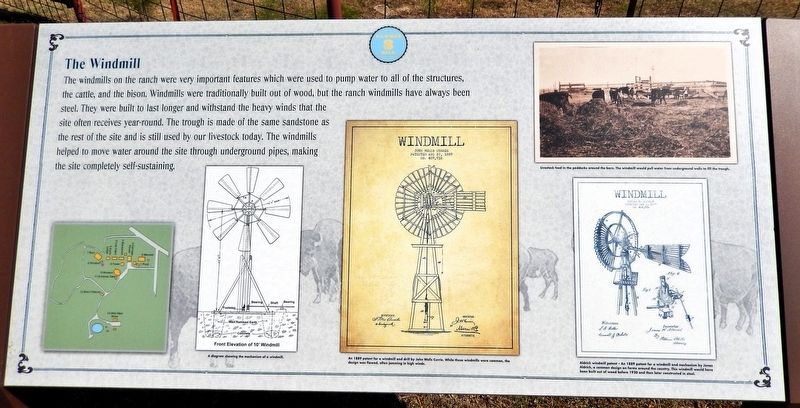
The windmills on the ranch were very important features which were used to pump water to all of the structures, the cattle, and the bison. Windmills were traditionally built out of wood, but the ranch windmills have always been steel. They were built to last longer and withstand the heavy winds that the site often receives year-round. The trough is made of the same sandstone as the rest of the site and is still used by our livestock today. The windmills helped to move water around the site through underground pipes, making the site completely self-sustaining.
Erected by Pawnee Bill Ranch & Museum. (Marker Number 8.)
Topics and series. This historical marker is listed in these topic lists: Agriculture • Animals. In addition, it is included in the Windmills series list.
Location. 36° 19.843′ N, 96° 48.979′ W. Marker is in Pawnee, Oklahoma, in Pawnee County. It can be reached from Pawnee Bill Road just east of Harrison Street (U.S. 64), on the right when traveling east. The marker is located on the Pawnee Bill Ranch interpretive trail, near the northeast corner
this page online

Regionally, this marker is in Greater Tulsa. It is also in the American South, specifically on the prairies, and on the Southern Plains. Globally, it is in North America, the Western Hemisphere, the Western World, and the Anglosphere. Historically, it finds itself in what was once the territory of the Mississippian Culture and also the Louisiana Purchase.
Other nearby markers. At least 8 other markers are within walking distance of this marker: The Barn (a few steps from this marker); Earth Lodge (within shouting distance of this marker); The Log Cabin (within shouting distance of this marker); The Old Entrance Gate (about 300 feet away, measured in a direct line); Local and Regional Sites (about 300 feet away); The Blacksmith Shop (about 300 feet away); The Observation Tower (about 300 feet away); Pawnee Bill Ranch and Museum (about 400 feet away). Touch for a list and map of all markers in Pawnee.
Related markers. Click here for a list of markers that are

2. Marker detail: Currie Windmill Patent
An 1889 patent for a windmill and drill by John Wells Currie. While these windmills were common, the design was flawed, often jamming in high winds.
Also see . . .
1. Windmills (Encyclopedia of the Great Plains).
Excerpt: Windmills started to appear in considerable numbers in the Great Plains during the 1870s, but the heyday for their use spanned the decades from the 1880s to the 1920s. Dozens of companies produced them. In time, tens of thousands of these wind machines came into use, principally for pumping water from drilled wells.(Submitted on February 13, 2025, by Cosmos Mariner of Cape Canaveral, Florida.)
The initial windmills in the Great Plains employed wheels and vanes made from wood, combined with cast iron and steel mechanical components. All-metal windmills began appearing in the 1870s, but it was not until the 1890s that they came into widespread use. Production of steel windmills gradually supplanted that of "wooden" mills, although the latter remained available commercially into the 1940s.
2. Currie Windmill (Kansapedia).
Excerpt: Organized in the 1880s as the Currie Windmill and Pump Company, the company first moved to Manhattan and next to Topeka where it manufactured mills at 7th(Submitted on February 13, 2025, by Cosmos Mariner of Cape Canaveral, Florida.)and Adams from around 1900 until the late 1940s. Currie windmills gained a reputation as sturdy, reliable machines. Distinctive features included hardwood bearings and the steel band encircling the vanes of the wheel. Currie wheels came in 6, 8, and 10-foot diameters. 3. Marker detail: Aldrich Windmill PatentAn 1889 patent for a windmill and mechanism by Jonas Aldrich, a common design on farms around the country. This windmill would have been built out of wood before 1920 and then later constructed in steel.
Currie prices were especially economical, and its machines were called "the poor man's windmill." In the 1930s the average price was $28. As late as 1950 one model was offered for $39. Its reasonable price and durable construction made the Currie windmill a common feature on prairie farms and ranches.

4. Marker detail: Livestock feed in paddocks near the barn.
The windmill would pull water from underground wells to fill the trough.
Photographed by Cosmos Mariner, September 10, 2024
5. The Windmill Marker
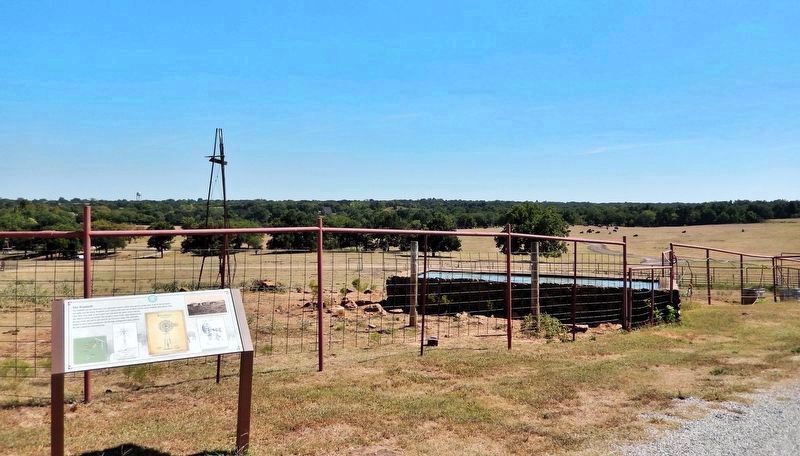
Looking southeast across the ranch from near the barn. The windmill ruins and trough are in the background, beyond the livestock fence.

Photographed by Cosmos Mariner, September 10, 2024
6. Windmill Ruins and Trough
Looking southeast across the ranch from near the marker.
Credits. This page was last revised on February 14, 2025. It was originally submitted on February 12, 2025, by Cosmos Mariner of Cape Canaveral, Florida. This page has been viewed 146 times since then and 15 times this year. Photos: 1, 2, 3, 4, 5, 6. submitted on February 13, 2025, by Cosmos Mariner of Cape Canaveral, Florida.
