Monroe Ward in Richmond, Virginia — The American South (Mid-Atlantic)
The AS Smith House
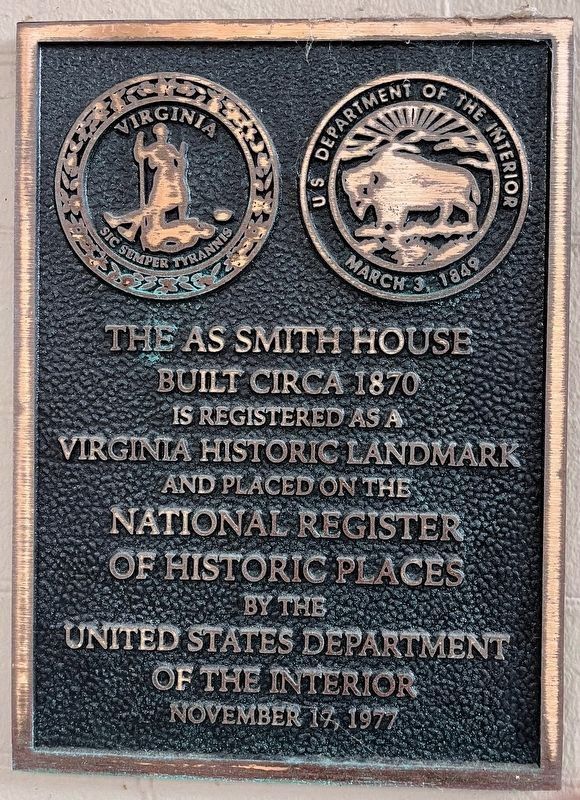
Built circa 1870
is registered as a
Virginia Historic Landmark
and placed on the
National Register
of Historic Places
by the
United States Department
of the Interior
November 19, 1977
Erected 1977 by United States Department of the Interior.
Topics. This historical marker is listed in this topic list: Architecture. A significant historical year for this entry is 1870.
Location. 37° 32.718′ N, 77° 26.735′ W. Marker is in Richmond, Virginia. It is in the Monroe Ward. It is on West Franklin Street just west of North Jefferson Street, on the left when traveling east. Touch for map. Marker is at or near this postal address: 206 West Franklin Street, Richmond VA 23220, United States of America. Touch for directions.

Regionally, this marker is in Central Virginia. It is also in the American South and specifically in the Upper South. Globally, it is in North America, the Western Hemisphere, the Western World, and the Anglosphere. Historically, it finds itself in what was once the territory of the Mississippian Culture, one of the original Thirteen Colonies, one of the Confederate States
this page online
Other nearby markers. At least 8 other markers are within walking distance of this marker: Site of J. E. B. Stuart's Death (about 400 feet away, measured in a direct line); “I must save the women of Richmond!” (about 400 feet away); Samuel Preston Moore (about 400 feet away); Maggie Lena Walker Memorial (approx. 0.2 miles away); Patrick H. Starke Residence (approx. 0.2 miles away); Mathew F. Pleasant Residence (approx. 0.2 miles away); Officer Vernon L. Jarrelle (approx. 0.2 miles away); Mary Wingfield Scott (approx. ¼ mile away). Touch for a list and map of all markers in Richmond.
Also see . . . National Register Nomaination Form.
This form was prepared in 1977. It includes a description of this house on page 8:
Set between the Diggs House and the Price House, and connected with them internally, this house forms an architectural link between the two. As a result of changes introduced to make a continuous structure of the three houses, the original plan has been confused by later additions, but its main partitions are intact.(Submitted on November 11, 2023, by Devry Becker Jones of Washington, District of Columbia.)
The plan is a typical side-hall plan with pairsof rooms on the right on each floor. The house is built of brick and is three stories high and three bays wide. Segmental heads are used on all of the window openings. A tall, modillion-and-dentil cornice and projecting eaves hide the low hipped roof with its and chimneys. A one-story porch with three sets of coupled Ionic columns shelters the two ground-story windows and the east-bay doorway. The porch is apparently an early alteration.
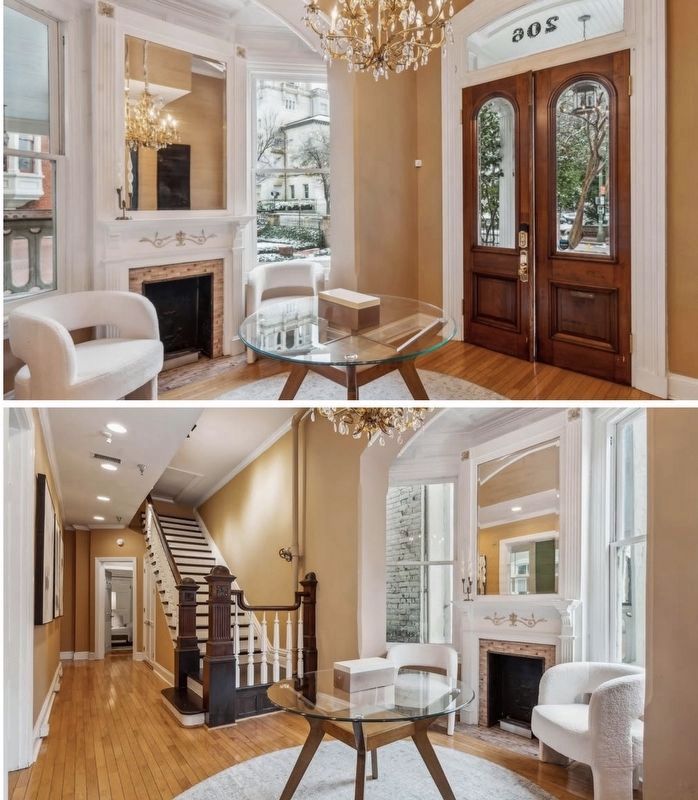
Surviving interior features of interest include the open-string, square-newel-baluster, straight-run chair. At the bottom of the stair is a bay window containing a fireplace. The fireplace is an early but not original feature. Most of the house's original door and window frames survive and there are two Italianate mantels on the second floor.
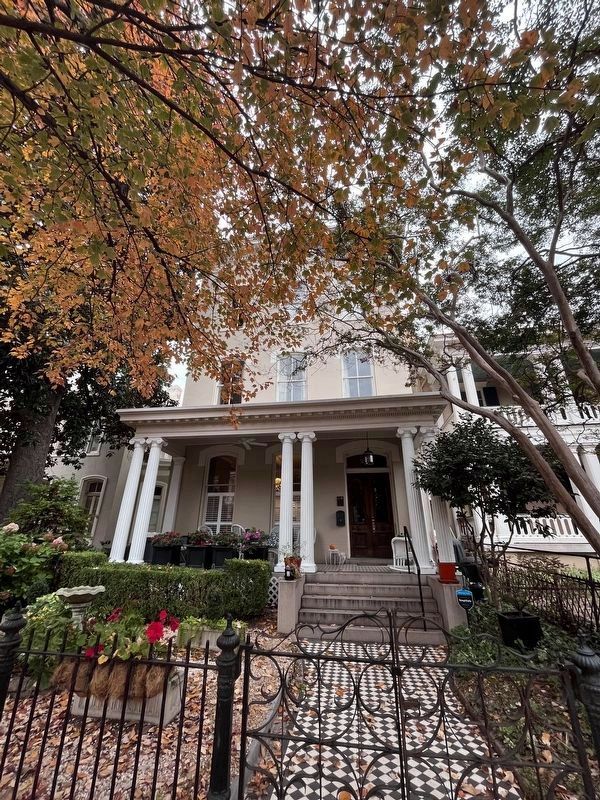
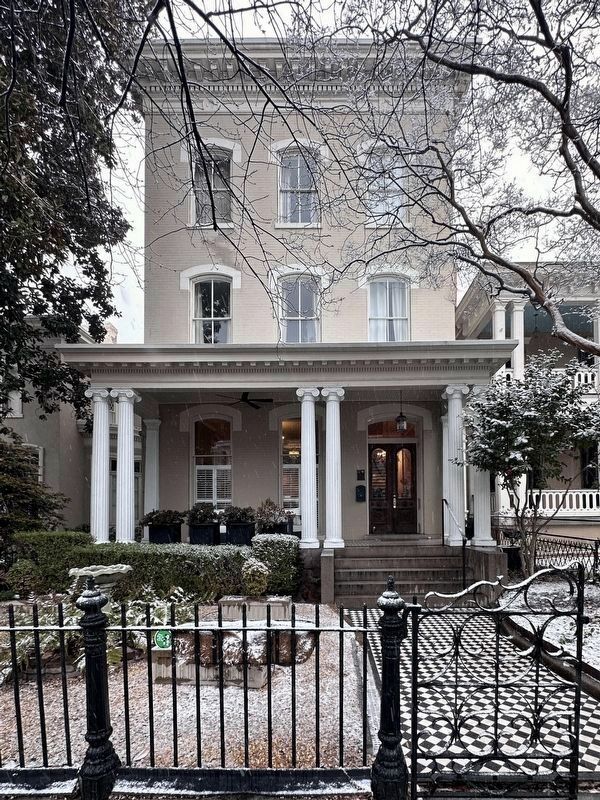
Photographed by Johnathan Miller, February 11, 2025
3. The AS Smith House Front Garden View
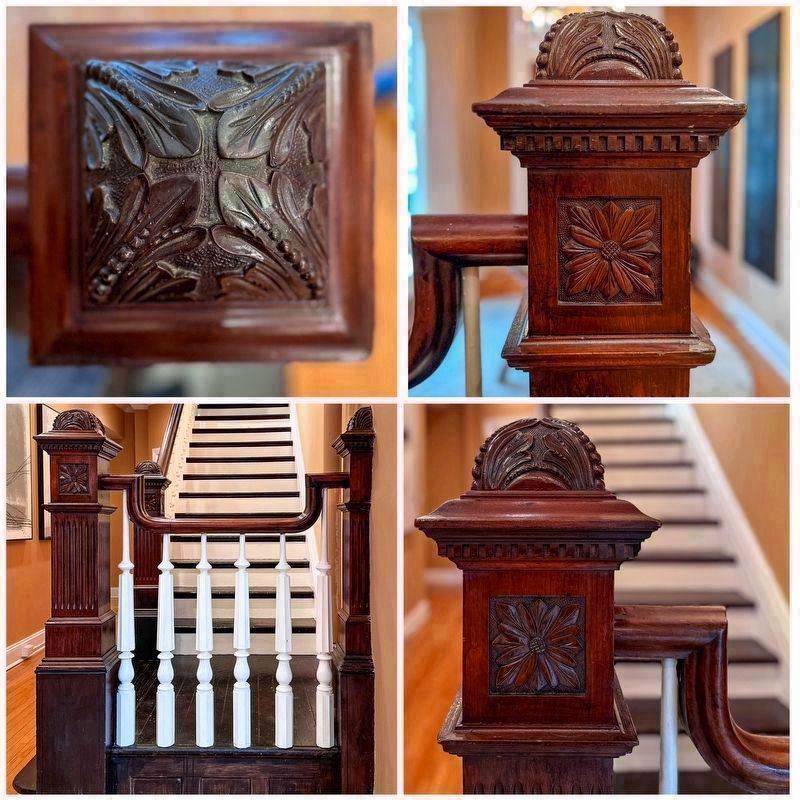
Photographed by Johnathan Miller
4. Architectural Features of the Historic Staircase
This staircase exemplifies fine craftsmanship and design, blending structural integrity with aesthetic refinement. Each element showcases the rich architectural traditions of its time.
1. Newel Posts & Decorative Carvings
Newel posts anchor the staircase at its base and turns, serving both a structural and decorative function. These focal points are adorned with intricate hand-carved details, reflecting classical influences:
• Acanthus Leaf Motif – A finely carved design atop the newel post, inspired by Greco-Roman architecture and later popularized in Victorian and Beaux-Arts styles.
• Beaded Border – Adds texture and depth to the post, enhancing its visual appeal.
• Floral Rosette Panel – A symmetrical design on the side panels, symbolizing craftsmanship and nature-inspired ornamentation.
2. Egg-and-Dart & Dentil Molding Details
The upper molding of the newel post incorporates classical motifs:
• Dentil Molding – A repeating rectangular pattern, emphasizing proportion and balance, commonly found in classical architecture.
• Egg-and-Dart Motif – A decorative design alternating between oval (egg) and pointed (dart) shapes, widely used in historic interiors, from grand mansions to civic buildings.
3. Balustrade & Spindles
The staircase features a striking contrast between its dark wood handrail and newel posts and the bright white balusters (spindles):
• Turned Wooden Balusters – Evenly spaced, creating a rhythmic visual effect while maintaining an open, airy aesthetic.
• Curved Handrail & Scrollwork – Smoothly transitions between levels, incorporating graceful curves for a fluid, cohesive design.
• Crisp White Balusters – A period technique used to enhance contrast and maximize light in historic interiors.
4. Handrail & Scrollwork
The handrail’s smooth, flowing transitions exemplify fine woodworking:
• Elegant Curves – The sweeping turn of the handrail is both functional and sculptural, guiding movement with ease.
• Scrollwork at the Base – A testament to skilled craftsmanship, featuring smooth contours that seamlessly integrate into the overall design.
5. Rich Wood Tones & Historic Character
The staircase’s deep, rich wood finish speaks to its historical significance:
• Mahogany or Oak Construction – Common in high-end period homes for durability and a luxurious appearance.
• Aged Patina – The natural aging of the wood highlights its authentic craftsmanship and historical charm.
Historical Significance
Staircases like this were not just functional elements but expressions of architectural artistry, often serving as grand statements in entryways and halls. The intricate carvings, classical motifs, and fine woodworking reflect a time when artisans prioritized decorative excellence and material quality. These features align with Victorian and early 20th-century craftsmanship, when intricate woodwork defined fine homes and prestigious buildings. The classical influences in the carvings suggest an appreciation for historical architectural styles, blending ornamental detail with structural sophistication. This beautifully preserved staircase remains a remarkable example of historic woodwork, showcasing the elegance and craftsmanship of a bygone era. Its carved details, classical motifs, and refined balustrade design pay tribute to a rich architectural heritage.
1. Newel Posts & Decorative Carvings
Newel posts anchor the staircase at its base and turns, serving both a structural and decorative function. These focal points are adorned with intricate hand-carved details, reflecting classical influences:
• Acanthus Leaf Motif – A finely carved design atop the newel post, inspired by Greco-Roman architecture and later popularized in Victorian and Beaux-Arts styles.
• Beaded Border – Adds texture and depth to the post, enhancing its visual appeal.
• Floral Rosette Panel – A symmetrical design on the side panels, symbolizing craftsmanship and nature-inspired ornamentation.
2. Egg-and-Dart & Dentil Molding Details
The upper molding of the newel post incorporates classical motifs:
• Dentil Molding – A repeating rectangular pattern, emphasizing proportion and balance, commonly found in classical architecture.
• Egg-and-Dart Motif – A decorative design alternating between oval (egg) and pointed (dart) shapes, widely used in historic interiors, from grand mansions to civic buildings.
3. Balustrade & Spindles
The staircase features a striking contrast between its dark wood handrail and newel posts and the bright white balusters (spindles):
• Turned Wooden Balusters – Evenly spaced, creating a rhythmic visual effect while maintaining an open, airy aesthetic.
• Curved Handrail & Scrollwork – Smoothly transitions between levels, incorporating graceful curves for a fluid, cohesive design.
• Crisp White Balusters – A period technique used to enhance contrast and maximize light in historic interiors.
4. Handrail & Scrollwork
The handrail’s smooth, flowing transitions exemplify fine woodworking:
• Elegant Curves – The sweeping turn of the handrail is both functional and sculptural, guiding movement with ease.
• Scrollwork at the Base – A testament to skilled craftsmanship, featuring smooth contours that seamlessly integrate into the overall design.
5. Rich Wood Tones & Historic Character
The staircase’s deep, rich wood finish speaks to its historical significance:
• Mahogany or Oak Construction – Common in high-end period homes for durability and a luxurious appearance.
• Aged Patina – The natural aging of the wood highlights its authentic craftsmanship and historical charm.
Historical Significance
Staircases like this were not just functional elements but expressions of architectural artistry, often serving as grand statements in entryways and halls. The intricate carvings, classical motifs, and fine woodworking reflect a time when artisans prioritized decorative excellence and material quality. These features align with Victorian and early 20th-century craftsmanship, when intricate woodwork defined fine homes and prestigious buildings. The classical influences in the carvings suggest an appreciation for historical architectural styles, blending ornamental detail with structural sophistication. This beautifully preserved staircase remains a remarkable example of historic woodwork, showcasing the elegance and craftsmanship of a bygone era. Its carved details, classical motifs, and refined balustrade design pay tribute to a rich architectural heritage.
Photographed by 2
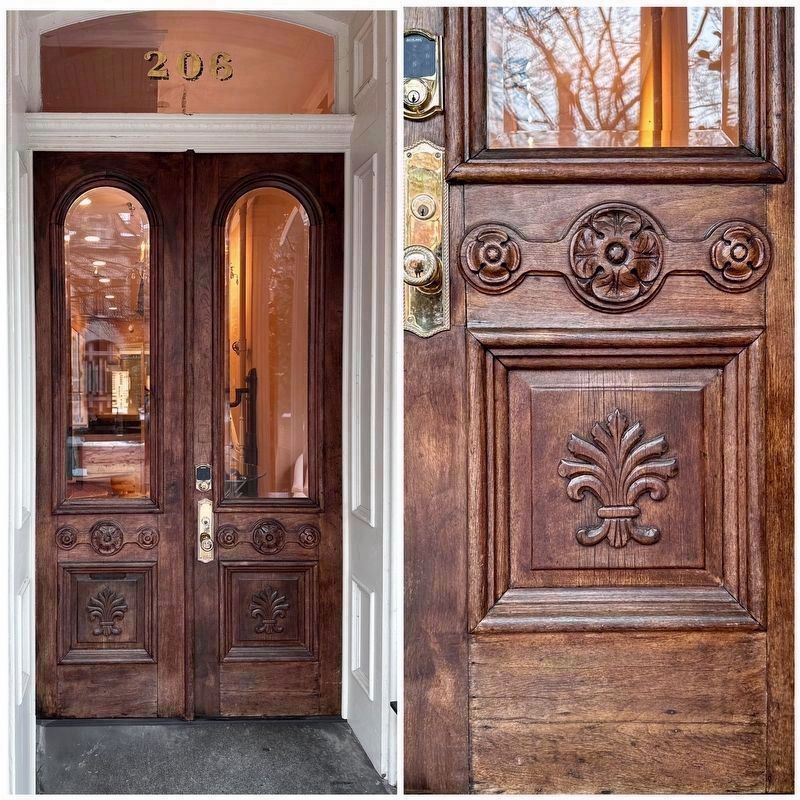
5. Architectural Features of the Historic Entrance Door
The carved woodwork, of the ornate double doors including decorative motifs, and glass paneling reflect the period’s emphasis on elegance, symbolism, and structural sophistication.
1. Double-Door Design & Grand Entryway
The tall double doors serve as an impressive focal point, inviting visitors while establishing a sense of grandeur and symmetry. This design was commonly used in Victorian, Italianate, and Beaux-Arts architecture, allowing for a wide entryway to accommodate larger gatherings and improve airflow during warmer months.
•Arched Glass Panels – The curved glass inserts soften the structure’s appearance, allowing natural light to filter into the entry while maintaining privacy. The arch motif is a hallmark of classical design, often seen in Italianate and Second Empire styles.
•Transom Window with Gold Leaf Address (“206”) – Positioned above the doors, the transom enhances light and ventilation. The gold numbering adds a distinguished, timeless touch, reinforcing the entryway’s prominence.
2. Ornate Carved Wood Details
The door panels feature a richly detailed arrangement of carved motifs, highlighting period craftsmanship and symbolic artistry.
•Floral Rosettes and Circular Carvings – The midsection of each door displays a symmetrical floral rosette, flanked by two smaller circular floral elements. These details are deeply rooted in Victorian and Neoclassical design, symbolizing nature, renewal, and harmony.
•Fleur-de-Lis Motif – The bottom panels feature an elaborate fleur-de-lis carving, a stylized lily historically associated with French influence, nobility, and purity. This motif was widely used in Gothic Revival and Victorian architecture, symbolizing elegance and prestige.
•Raised Panel Framing – The door panels are bordered by deeply beveled moldings, adding depth, structure, and a sense of formality. Raised panels were a signature element of handcrafted doors in the late 19th and early 20th centuries.
3. Hardware & Modern Replacements
While the door retains its historic charm, the original hardware has been replaced with modern brass locks and handles.
•Modern Brass Lock & Handle – The contemporary replacements maintain a traditional warm brass finish, blending with the historic aesthetic while providing updated functionality.
•Keyhole Escutcheon Plate – Though the original locking mechanisms have been replaced, the presence of the historic keyhole plate suggests the door once featured a period-appropriate mortise lock, commonly found in 19th-century homes.
4. Wood Finish & Natural Aging
The solid wood construction highlights the enduring quality of materials used in historic architecture. The aged patina and natural grain patterns showcase the passage of time, emphasizing the door’s authenticity and historic significance.
•The rich brown finish enhances the natural depth of the wood, with variations in tone adding to its charm.
•Subtle weathering along the lower panels and edges indicates decades of use, reinforcing the door’s historical integrity.
Historical Significance & Period Influence
This entrance reflects Victorian-era craftsmanship, incorporating elements of Italianate, Second Empire, and Gothic Revival styles. The combination of arched glass, intricate woodwork, and floral symbolism speaks to the 19th-century emphasis on both function and ornamentation. Doors like this were often handcrafted by skilled artisans, custom-designed for grand homes and buildings that prioritized architectural beauty. The floral carvings, moldings, and decorative motifs demonstrate a commitment to detail and artistic expression, making this a prime example of historic entrance design. Although the locks and handles have been updated, the overall integrity of the door’s historic design remains intact, continuing to serve as a remarkable example of 19th-century architectural elegance.
1. Double-Door Design & Grand Entryway
The tall double doors serve as an impressive focal point, inviting visitors while establishing a sense of grandeur and symmetry. This design was commonly used in Victorian, Italianate, and Beaux-Arts architecture, allowing for a wide entryway to accommodate larger gatherings and improve airflow during warmer months.
•Arched Glass Panels – The curved glass inserts soften the structure’s appearance, allowing natural light to filter into the entry while maintaining privacy. The arch motif is a hallmark of classical design, often seen in Italianate and Second Empire styles.
•Transom Window with Gold Leaf Address (“206”) – Positioned above the doors, the transom enhances light and ventilation. The gold numbering adds a distinguished, timeless touch, reinforcing the entryway’s prominence.
2. Ornate Carved Wood Details
The door panels feature a richly detailed arrangement of carved motifs, highlighting period craftsmanship and symbolic artistry.
•Floral Rosettes and Circular Carvings – The midsection of each door displays a symmetrical floral rosette, flanked by two smaller circular floral elements. These details are deeply rooted in Victorian and Neoclassical design, symbolizing nature, renewal, and harmony.
•Fleur-de-Lis Motif – The bottom panels feature an elaborate fleur-de-lis carving, a stylized lily historically associated with French influence, nobility, and purity. This motif was widely used in Gothic Revival and Victorian architecture, symbolizing elegance and prestige.
•Raised Panel Framing – The door panels are bordered by deeply beveled moldings, adding depth, structure, and a sense of formality. Raised panels were a signature element of handcrafted doors in the late 19th and early 20th centuries.
3. Hardware & Modern Replacements
While the door retains its historic charm, the original hardware has been replaced with modern brass locks and handles.
•Modern Brass Lock & Handle – The contemporary replacements maintain a traditional warm brass finish, blending with the historic aesthetic while providing updated functionality.
•Keyhole Escutcheon Plate – Though the original locking mechanisms have been replaced, the presence of the historic keyhole plate suggests the door once featured a period-appropriate mortise lock, commonly found in 19th-century homes.
4. Wood Finish & Natural Aging
The solid wood construction highlights the enduring quality of materials used in historic architecture. The aged patina and natural grain patterns showcase the passage of time, emphasizing the door’s authenticity and historic significance.
•The rich brown finish enhances the natural depth of the wood, with variations in tone adding to its charm.
•Subtle weathering along the lower panels and edges indicates decades of use, reinforcing the door’s historical integrity.
Historical Significance & Period Influence
This entrance reflects Victorian-era craftsmanship, incorporating elements of Italianate, Second Empire, and Gothic Revival styles. The combination of arched glass, intricate woodwork, and floral symbolism speaks to the 19th-century emphasis on both function and ornamentation. Doors like this were often handcrafted by skilled artisans, custom-designed for grand homes and buildings that prioritized architectural beauty. The floral carvings, moldings, and decorative motifs demonstrate a commitment to detail and artistic expression, making this a prime example of historic entrance design. Although the locks and handles have been updated, the overall integrity of the door’s historic design remains intact, continuing to serve as a remarkable example of 19th-century architectural elegance.
Photographed by Johnathan H. Miller
6. Entry Foyer Fireplace and Staircase
Credits. This page was last revised on February 16, 2025. It was originally submitted on November 11, 2023, by Devry Becker Jones of Washington, District of Columbia. This page has been viewed 308 times since then and 31 times this year. Last updated on February 12, 2025, by Johnathan H. Miller of Richmond, Virginia. Photos: 1, 2. submitted on November 11, 2023, by Devry Becker Jones of Washington, District of Columbia. 3, 4, 5. submitted on February 12, 2025, by Johnathan H. Miller of Richmond, Virginia. 6. submitted on February 14, 2025, by Johnathan H. Miller of Richmond, Virginia. • Bernard Fisher was the editor who published this page.
