Rheintor/Grafenstraße in Darmstadt, Hesse, Germany — Central Europe
Gedenken an die Opfer von Zwangssterilisierung
⎯⎯⎯
Victims of Forced Sterilization Memorial
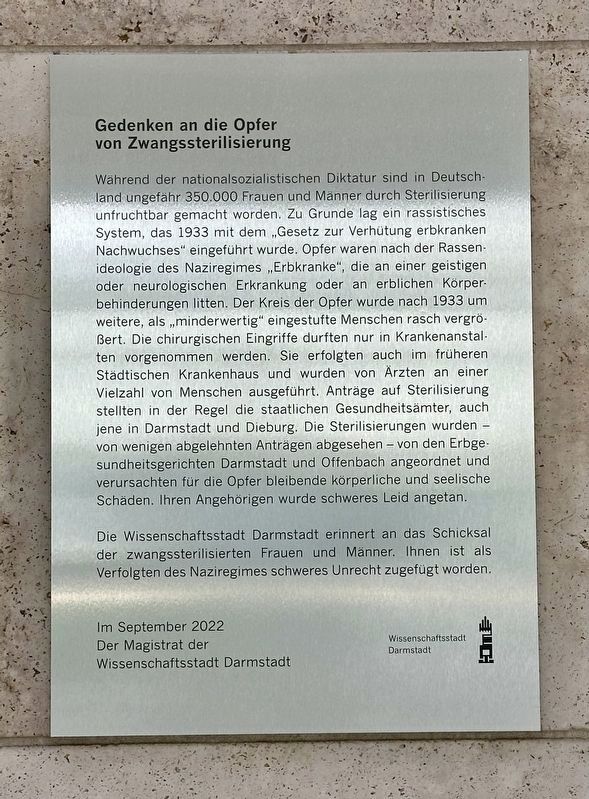
Photographed by Andrew Ruppenstein, January 30, 2025
1. Victims of Forced Sterilization Memorial Marker

Während der nationalsozialistischen Diktatur sind in Deutschland ungefähr 350.000 Frauen und Männer durch Sterilisierung unfruchtbar gemacht worden. Zu Grunde lag ein rassistisches System, das 1933 mit dem „Gesetz zur Verhütung erbkranken Nachwuchses“ eingeführt wurde. Opfer waren nach der Rassenideologie des Naziregimes „Erbkranke“, die an einer geistigen oder neurologischen Erkrankung oder an erblichen Körperbehinderungen litten. Der Kreis der Opfer wurde nach 1933 um weitere, als „minderwertig“ eingestufte Menschen rasch vergrößert. Die chirurgischen Eingriffe durften nur in Krankenanstalten vorgenommen werden. Sie erfolgten auch im früheren Städtischen Krankenhaus und wurden von Ärzten an einer Vielzahl von Menschen ausgeführt. Anträge auf Sterilisierung stellten in der Regel die staatlichen Gesundheitsämter, auch jene in Darmstadt und Dieburg. Die Sterilisierungen wurden von wenigen abgelehnten Anträgen abgesehen von den Erbgesundheitsgerichten Darmstadt und Offenbach angeordnet und verursachten für die Opfer bleibende körperliche und seelische Schäden.
this page online
Die Wissenschaftsstadt Darmstadt erinnert an das Schicksal der zwangssterilisierten Frauen und Männer. Ihnen ist als Verfolgten des Naziregimes schweres Unrecht zugefügt worden.
Victims of Forced Sterilization Memorial
Commemoration of the victims of forced sterilization During the National Socialist dictatorship, approximately 350,000 women and men in Germany were rendered infertile through sterilization. The basis was a racist system that was introduced in 1933 with the "Law for the Prevention of Genetically Diseased Offspring". According to the racial ideology of the Nazi regime, victims were "hereditarily ill" people who suffered from a mental or neurological disease or hereditary physical disabilities. After 1933, the circle of victims was quickly expanded to include other people classified as "inferior". The surgical interventions could only be carried out in hospitals. They also took place in the former municipal hospital and were carried out by doctors on a large number of people. Applications for sterilization were usually made by the state health

Photographed by Andrew Ruppenstein, January 30, 2025
2. Victims of Forced Sterilization Memorial - wide view
The science city of Darmstadt commemorates the fate of the women and men who were forcibly sterilized. They suffered severe injustice as victims of the Nazi regime.
Erected 2022 by Magistrat der Wissenschaftstadt Darmstadt.
Topics. This historical marker and memorial is listed in this topic list: Science & Medicine. A significant historical date for this entry is July 14, 1933.
Location. 49° 52.43′ N, 8° 38.761′ E. Marker is in Darmstadt, Hessen (Hesse). It is in Rheintor/Grafenstraße. It can be reached from Bleichstraße. The marker is on the grounds of Klinkum Darmstadt hospital complex. From the north side of Bleichstrasse there is a walkway (roughly opposite Gagnerstrasse) that leads north. About 12-15 meters into the complex the marker will be visible at the entrance of the building to the right. Touch for map. Marker is at or near this postal address:

Photographed by Andrew Ruppenstein, January 30, 2025
3. Victims of Forced Sterilization Memorial - wider view

Regionally, this marker and memorial is on the German Upper Rhine. Globally, it is in Europe, the European Union, Atlantic Europe, Central Europe, the Schengen Area, Western Europe, and the Western World. Historically, it finds itself in what was once the Roman Empire, the Holy Roman Empire, and the former West Germany.
Other nearby markers. At least 8 other markers are within walking distance of this marker: Darmstadt Sister City Occupation and Holocaust Memorial (here, next to this marker); Erinnerungsort Liberale Synagoge / Liberal Synagogue Memorial Site (a few steps from this marker); Virtuelle Rekonstruktion der Synagoge / Virtual Reconstruction of the Synagogue (about 180 meters away, measured in a direct line); Die Synagoge der Orthodoxen Jüdischen Gemeinde / Orthodox Jewish Synagogue (about 180 meters away); Christoph Graupner (approx. 0.4 kilometers away); Weißer Turm / White Tower (approx. 0.6 kilometers away); Ehemaliges Kaufhaus Rothschild / Former Rothschild Department Store (approx. 0.6 kilometers away); Parkanlage im Schlossgraben / The Park in the Castle Moat (approx. 0.7 kilometers away). Touch for a list and map of all markers in Darmstadt.
Also see . . . German Law Authorizes Sterilization for Prevention of Hereditary Diseases (USHMM).
Soon after Hitler took power, the Nazis fulfilled long-held aspirations of eugenics proponents. Eugenicists believed the human race could be improved by controlled breeding. In an effort to further the Nazi vision of a biologically "pure" population and to create an "Aryan master race," on July 14, 1933, the German government promulgated the “Law for the Prevention of Progeny with Hereditary Diseases” (Gesetz zur Verhütung erbkranken Nachwuchses). This law mandated the forced sterilization of certain individuals with physical and mental disabilities or mental illness. Individuals who were subject to the law were those men and women who “suffered” from any of nine conditions: hereditary feeblemindedness, schizophrenia, manic-depressive (or bi-polar) disorder, hereditary epilepsy, Huntington’s chorea (a fatal form of dementia), genetic blindness, deafness, severe hereditary physical deformity, and chronic alcoholism. The law also allowed public health officials to apply the law to those, like Roma (Gypsies) and “asocial elements” who were seen to reject German social values.(Submitted on February 13, 2025.)
Special hereditary health courts lent an aura of due process to the sterilization measure, but the decision to sterilize was generally routine. Nearly all better-known geneticists, psychiatrists, and anthropologists sat on such courts at one time or another, mandating the sterilizations of an estimated 400,000 Germans. Vasectomy was the usual sterilization method for men, and for women, tubal ligation, an invasive procedure that resulted in the deaths of hundreds of women.
Additional keywords. eugenics
Credits. This page was last revised on February 13, 2025. It was originally submitted on February 13, 2025, by Andrew Ruppenstein of Lamorinda, California. This page has been viewed 140 times since then and 15 times this year. Photos: 1, 2, 3. submitted on February 13, 2025, by Andrew Ruppenstein of Lamorinda, California.
