Verdun in Meuse, Alsace, Lorraine, Champagne-Ardenne, France — Western Europe
La nécropole nationale de Verdun Faubourg-Pavé
Verdun Faubourg-Pavé National Cemetery
| — | Meuse | — |
Photographed by Steve Stoessel, November 18, 2024
1. La nécropole nationale de Verdun Faubourg-Pavé Marker

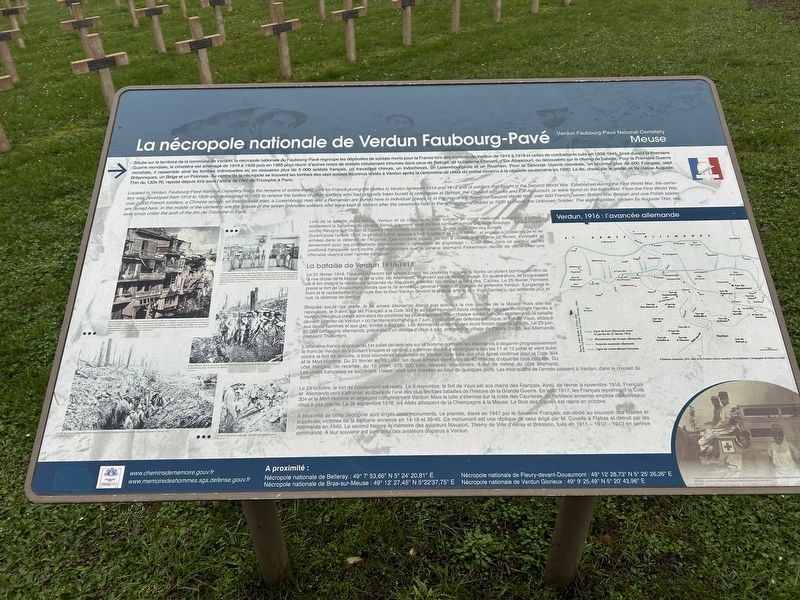
Lors de la bataille de la Marne,
this page online
Durant toute l'année 1915, le général Joffre, attaque à l'est le saillant de Saint-Mihiel, et engage à l'ouest les 3e et 4e armées dans la défense de l'Argonne. Ces combats locaux, où l'on a recourt à la guerre de mines, s'enlisent et deviennent pour les combattants d'éprouvantes « opérations de grignotage ». C'est donc dans ce secteur où les positions françaises sont moins bien organisées que le général allemand Falkenhayn décide de déclencher une offensive visant à user l'armée française.
Le 21 février 1916, l'opération Gericht est lancée contre les positions françaises. Après un violent bombardement de la rive droite de la Meuse et de la ville, les Allemands, avancent sur un terrain ravagé. En quatre jours, ils progressent de 6 km malgré la résistance acharnée du 30e corps d'armée, qui défend le bois des Caures.
Photographed by Steve Stoessel, November 18, 2024
2. La nécropole nationale de Verdun Faubourg-Pavé Marker
Bloquée sur la rive droite, la 5e armée allemande élargit son action à la rive gauche de la Meuse mais elle est repoussée, le 9 avril, par les Français à la Cote 304 et au Mort-Homme. Seuls obstacles naturels contrôlant l'accès à Verdun, ces deux crêtes sont alors les positions les plus disputées. Pour chaque soldat français et allemand, la bataille devient « l'enfer de Verdun » où l'artillerie triomphe. Le 7 juin, en dépit d'une défense héroïque, le fort de Vaux, attaqué aux lance-flammes et aux gaz, tombe à son tour. Les Allemands jettent toutes leurs forces dans la bataille. Le 23 juin, 80.000 fantassins allemands, précédés d'un déluge d'obus à gaz, prennent le village de Fleury. Le 26, les Allemands prennent Thiaumont.
L'offensive franco-anglaise du 1er juillet déclenchée sur la Somme contraint les Allemands à dégarnir progressivement le front de Verdun en y puisant troupes et canons. Le dernier assaut d'envergure a lieu les 11 et 12 juillet et vient buter contre le fort de Souville, à trois kilomètres seulement de Verdun. Une lutte des plus âpres continue pour la Cote 304 et le Mort-Homme. Du 21 février au 15 juillet, les deux armées tirent plus de 40 millions d'obus de tous calibres. Du côté français, on recense, au 15 juillet, 275 000 tués, blessés, prisonniers. Il est de même du côté allemand. Les unités françaises se succèdent. Usées, elles sont relevées au bout de quelques jours. Les trois quarts de l'armée passent à Verdun, dans le creuset du front.
Le 24 octobre, le fort de Douaumont est repris. Le 2 novembre, le fort de Vaux est aux mains des Français. Ainsi, de février à novembre 1916, Français et Allemands vont s'affronter au cours de l'une des plus terribles batailles de l'histoire de la Grande Guerre, En août 1917, les Français reprennent la Cote 304 et le Mort-Homme et dégagent complètement Verdun. Mais la lutte s'éternise sur la crête des Caurières où l'artillerie ennemie emploie de nouveaux obus à gaz ypérite. Le 26 septembre 1918, les Alliés attaquent de la Champagne à la Meuse. Le Bois des Caures est repris en octobre.
>br> A proximité de cette nécropole sont érigés deux monuments. Le premier, élevé en 1947 par le Souvenir Français, est dédié au souvenir des fusillés et suppliciés, victimes de la barbarie ennemie en 14-18 et 39-45. Ce monument est une réplique de celui érigé par M. Cuvelle à Flabas et détruit par les Allemands en 1940. Le second honore la mémoire des aviateurs Nieuport, Thierry de Ville d'Avray et Bression, tués en 1911 - 1912 - 1913 en service commandé. A leur souvenir est joint celui des aviateurs disparus à Verdun.
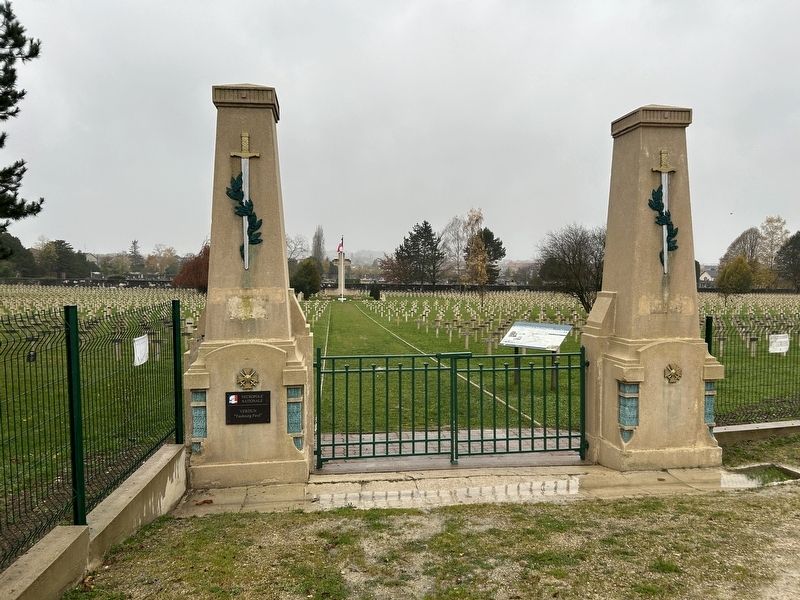
Located in Verdun, Faubourg-Pavé National Cemetery holds the remains of soldiers who died for France during the battles in Verdun between 1914 and 1918 and of soldiers that fought in the Second World War. Established during the First World War, the cemetery was developed from 1919 to 1926 and redesigned in 1965 to receive the bodies of other soldiers who had originally been buried in cemeteries at Belrupt, the Chevert barracks and Eix-Abaucourt, or were found on the battlefield. From the First World War over 5,000 French soldiers, a Chinese worker, an Indochinese man, a Luxembourg man and a Romanian are buried here in individual graves or in the ossuaries. From the Second World War, over 600 French, seven British, one Belgian and one Polish soldier are buried here. In the middle of the cemetery are the graves of the seven unknown soldiers who were kept in Verdun after the ceremony held in the underground citadel in 1920 to choose the Unknown Soldier. The eighth soldier, chosen by Auguste Thin, lies ever since under the arch of the Arc de Triomphe in Paris.
During the Battle of the Marne, Verdun and its belt of forts formed an entrenched camp on which General Sarrail's 3rd Army firmly rested. The enemy tried to take down this fort with two attacks: one to the west against Revigny-sur-Ornain and the other to the east against the fort of Troyon. Both were failures.
Throughout 1915, General Joffre attacked the Saint-Mihiel salient to the east, and engaged the 3rd and 4th armies in the west in the defense of the Argonne. These local battles, where mine warfare was used, got bogged down and became grueling "nibbling operations" for the combatants. It was in this sector where the French positions were less well organized that the German general Falkenhayn decided to launch an offensive aimed at wearing down the French army.
On February 21, 1916, Operation Gericht was launched against the French positions. After a violent bombardment of the right bank of the Meuse and the city, the Germans advanced on ravaged terrain. In four days, they advanced 6 km despite the fierce resistance of the 30th Army Corps, which defended the Bois des Caures. On February 25, the enemy took Fort Douaumont, while General Pétain's 2nd Army was tasked with defending Verdun. He organized the front and the supply. The Bar-le-Duc-Verdun road becomes the great artery, the "Voie Sacrée", which supplies the defense of Verdun day and night.
Blocked on the right bank, the 5th German army extends its action to the left bank of the Meuse but is pushed back, on April 9, by the French at Hill 304 and Mort-Homme. The only natural obstacles controlling access to Verdun, these two ridges are then the most contested positions. For each French and German soldier, the battle becomes "the hell of Verdun" where artillery triumphs. On June 7, despite a heroic defense, the fort of Vaux, attacked with flamethrowers and gas, falls in turn. The Germans throw all their forces into the battle. On June 23, 80,000 German infantrymen, preceded by a deluge of gas shells, take the village of Fleury. On the 26th, the Germans took Thiaumont.
The Franco-British offensive of July 1st launched on the Somme forced the Germans to gradually thin the Verdun front by drawing troops and cannons from there. The last major assault took place on July 11th and 12th and came up against the Souville fort, only three kilometers from Verdun. A very bitter struggle continued for Hill 304 and Mort-Homme. From February 21st to July 15th, the two armies fired more than 40 million shells of all calibers. On the French side, there were 275,000 killed, wounded, and prisoners as of July 15th. The same was true on the German side. French units followed one another. Worn out, they were relieved after a few days. Three-quarters of the army went to Verdun, in the crucible of the front.
On October 24th, Fort Douaumont was retaken. On November 2, Fort Vaux was in French hands. Thus, from February to November 1916, the French and Germans would clash during one of the most terrible battles in the history of the Great War. In August 1917, the French recaptured Hill 304 and Mort-Homme and completely liberated Verdun. But the fight dragged on at the Caurières Ridge, where enemy artillery used new mustard gas shells. On September 26, 1918, the Allies attacked from Champagne to the Meuse. The Bois des Caures was recaptured in October.
Two monuments were erected near this necropolis. The first, erected in 1947 by the Souvenir Français, is dedicated to the memory of those shot and tortured, victims of enemy barbarity in 14-18 and 39-45. This monument is a replica of the one erected by Mr. Cuvelle in Flabas and destroyed by the Germans in 1940. The second honors the memory of the aviators Nieuport, Thierry de Ville d'Avray and Bression, killed in 1911 - 1912 - 1913 in active service. Their memory is joined by that of the aviators who disappeared at Verdun.
Topics. This historical marker is listed in these topic lists: Cemeteries & Burial Sites • War, World I. A significant historical year for this entry is 1914.
Location. 49° 9.957′ N, 5° 24.354′ E. Marker is in Verdun, Grand Est (Alsace, Lorraine, Champagne-Ardenne), in Meuse. It can be reached from Avenue du 30E Corps (Grand Est Route 609) west of Rue de Fleury ( Route 112). Touch for map. Marker is in this post office area: Verdun, Grand Est 55100, France. Touch for directions.

Regionally, it is in the North Atlantic Region, Europe, the European Union, Atlantic Europe, the Schengen Area, Western Europe, a coastal Mediterranean country, and the Western World. Historically, it finds itself in what was once a French colony, the Roman Empire, and specifically the Holy Roman Empire.
Other nearby markers. At least 8 other markers are within walking distance of this marker: Unknown French Soldiers (within shouting distance of this marker); Les soldats inconnus de la nécropole nationale du Faubourg-Pavé (within shouting distance of this marker); Verdun War Memorial (approx. 1.4 kilometers away); Le 166eme Régiment d'Infanterie (approx. 1.4 kilometers away); « Honneur et Reconnaissance aux Femmes des Territoires » (approx. 1.4 kilometers away); The Defense (approx. 1.4 kilometers away); Porte Saint-Paul (approx. 1.6 kilometers away); Verdun (approx. 1.6 kilometers away). Touch for a list and map of all markers in Verdun.
Credits. This page was last revised on February 16, 2025. It was originally submitted on February 14, 2025, by Steve Stoessel of Niskayuna, New York. This page has been viewed 180 times since then and 38 times this year. Photos: 1, 2. submitted on February 14, 2025, by Steve Stoessel of Niskayuna, New York.
