Verdun in Meuse, Alsace, Lorraine, Champagne-Ardenne, France — Western Europe
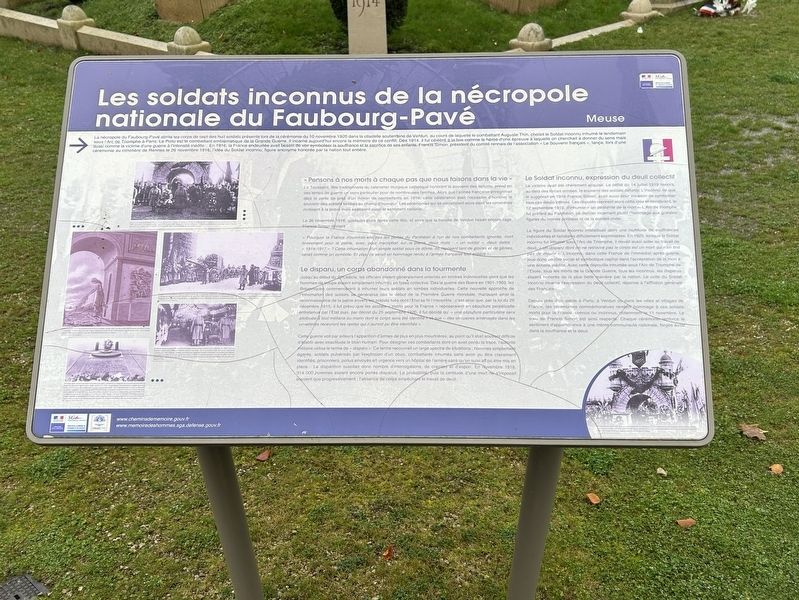
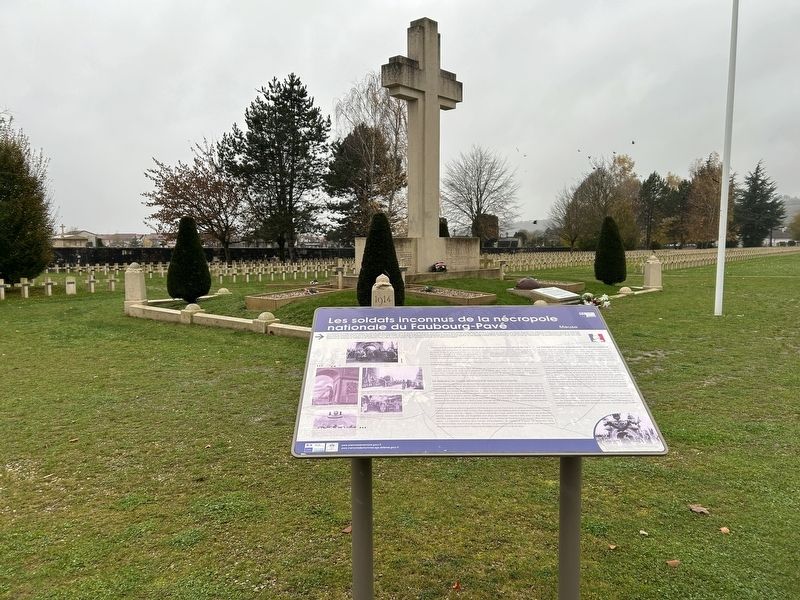
Les soldats inconnus de la nécropole nationale du Faubourg-Pavé
The Unknown Soldiers of the Faubourg-Pavé National Cemetery
Photographed by Steve Stoessel, November 18, 2024
1. Les soldats inconnus de la nécropole nationale du Faubourg-Pavé Marker

La nécropole du Faubourg-Pavé abrite les corps de sept des huit soldats présents lors de la cérémonie du 10 novembre 1920 dans la citadelle souterraine de Verdun, au cours de laquelle le combattant Auguste Thin, choisit le Soldat inconnu inhumé le lendemain sous l'Arc de Triomphe à Paris. Le Poilu est le combattant emblématique de la Grande Guerre. Il incarne aujourd'hui encore la mémoire de ce conflit. Dès 1914, il fut célébré à la fois comme le héros d'une épreuve à laquelle on cherchait à donner du sens mal aussi comme la victime d'une guerre à l'intensité inédite... En 1916, la France endeuillée avait besoin de voir symboliser la souffrance et le sacrifice de ses enfants, Francis Simon, président du comité rennais de l'association - Le Souvenir français », lança, lors d'une cérémonie au cimetière de Rennes le 26 novembre 1916, l'idée du Soldat inconnu, figure anonyme honorée par la nation tout entière.
« Pensons à nos morts à chaque pas que nous faisons dans la vie »
La Toussaint, fête traditionnelle du calendrier liturgique catholique honorant le souvenir des défunts, prend en ces temps de guerre un sens
this page online
Le 26 novembre 1916, quelques jours après cette fête, et alors que la bataille de Verdun faisait encore rage, Francis Simon déclara :
« Pourquoi la France n'ouvrirait-elle pas les portes du Panthéon à l'un de nos combattants Ignorés, mort bravement pour la patrie, avec, pour inscription sur la pierre, deux mots : « un soldat » , deux dates : « 1914-1917 » ? Cette inhumation d'un simple soldat sous ce dôme, ou reposent tant de gloires et de génies, serait comme un symbole. Et plus ce serait un hommage rendu à l'armée française tout-entière »
Le disparu, un corps abandonné dans la tourmente
Jusqu'au début du 200 siècle, les officiers étaient généralement enterrés en tombes individuelles alors que les hommes de troupe étaient simplement inhumés en fosse collective. Das la guerre
Photographed by Steve Stoessel, November 18, 2024
2. Les soldats inconnus de la nécropole nationale du Faubourg-Pavé Marker
Cette guerre voit par ailleurs l'apparition d'armes de plus en plus meurtrières, au point qu'il était souvent difficile d'établir avec exactitude le bilan humain. Pour désigner ces combattants dont on avait perdu la trace, l'autorité militaire utilisa le terme de « disparu » Ce terme recouvrait un large spectre de situations : hommes simplement égarés, soldats pulvérisés par l'explosion d'un obus, combattants inhumés sans avoir pu être clairement identifiés, prisonniers, poilus envoyés en urgence vers un hôpital de l'arrière sans qu'un suivi ait pu être mis en place... La disparition suscitait donc nombre d'interrogations, de craintes et d'espoir. En novembre 1918, 314 000 hommes étaient encore portés disparus, La probabilité, puis la certitude d'une mort ne-s'imposait souvent que progressivement : l'absence de corps empêchant le travail de deuil.
Le Soldat inconnu, expression du deuil collectif
La victoire avait été chèrement acquise. Le défilé du 14 juillet 1919 honora au-delà des forces armées, le souvenir des soldats défunts. L'inconnu, tel que le suggérait en 1916 Francis Simon, avait aussi pour vocation de symboliser tous cos deuils intimes. Les députés reprirent alors cette idée et décidèrent, le 12 septembre 1918, d'inhumer « un déshérité de la mort » L'Arc de triomphe fut préféré au Panthéon, ce dernier incarnant plutôt l'hommage aux grandes figures du monde politique et de la société civile.
La figure du Soldat inconnu cristallisait alors une multitude de souffrances individuelles et familiales difficilement exprimables. En 1920, lorsque le Soldat inconnu fut inhumé sous l'Arc de Triomphe, Il devait aussi aider au travail de deuil, un disparu dont da ne retrouve pas le corps est un mort qui n'en finit pas de mourir . L'inconnu, dans cette France de l’immédiat après-guerre. joue donc un rôle social et symbolique capital dans l'acceptation de la mort à une échelle inédite, Avec cette dépouille Inhumée sous l'Arc de Triomphe de l'Étoile, tous les morts de la Grande Guerre, tous les inconnus, les disparus étaient honorés de la plus belle manière par la nation. Le culte du Soldat inconnu incarne l'expression du deuil collectif, réponse à l'affliction générale des Français.
Depuis près d'un siècle à Paris, à Verdun ou dans les villes et villages de France, les cérémonies commémoratives rendent hommage à ces soldats morts pour la France, connus ou inconnus, notamment 11 novembre. Le vœu de Francis Simon est ainsi respecté. Chaque cérémonie renforce le - sentiment d'appartenance à une mème communauté nationale, forgée aussi dans la souffrance et le deuil.
The Faubourg-Pavé cemetery houses the bodies of seven of the eight soldiers present at the ceremony of November 10, 1920 in the underground citadel of Verdun, during which the veteran Auguste Thin chose the Unknown Soldier to be buried the next day under the Arc de Triomphe in Paris. “The Poilu” is the emblematic fighter of the Great War. He still embodies the memory of this conflict today. From 1914, he was celebrated both as the hero of an ordeal to which people were trying to give meaning and as the victim of a war of unprecedented intensity... In 1916, grieving France needed to see the suffering and sacrifice of its children symbolized. Francis Simon, president of the Rennes committee of the association “Le Souvenir français", launched, during a ceremony at the Rennes cemetery on November 26, 1916, the idea of the Unknown Soldier, an anonymous figure honored by the entire nation.
"Let us think of our dead at every step we take in life"
All Saints' Day, a traditional feast of the Catholic liturgical calendar honoring the memory of the deceased, takes on a special meaning for many families in these times of war. While the French army had already recorded the loss of nearly a million combatants in 1916, this celebration was an opportunity to honor the memory of the soldiers who had fallen on the field of honor. The ceremonies that took place in the cemeteries invited prayer but also exalted national sentiment.
On November 26, 1916, a few days after this celebration, and while the Battle of Verdun was still raging, Francis Simon declared:
"Why wouldn't France open the doors of the Pantheon to one of our Ignored fighters, who died bravely for his country, with two words written on the stone: "a soldier", two dates: "1914-1917"? This burial of a simple soldier under this dome, where so many glories and geniuses rest, would be like a symbol. And it would be a tribute to the entire French army"
The missing person, a body abandoned in the turmoil
Until the beginning of the 20th century, officers were generally buried in individual graves while enlisted men were simply buried in a collective grave. During the Boer War in 1901-1903, the British began to bury their soldiers in individual graves. This new approach to the burial of soldiers became widespread from the beginning of the First World War, thus marking the recognition of the homeland towards your dead soldiers whose interpretation was made by the State. Thus, by the law of December 29, 1915, it was provided that the soldiers "who died for France" would rest in a perpetual burial maintained by the State, then, by decree of September 25, 1920, it was decided that "a special burial will be attributed to any soldier or sailor whose body has been identified" and that "ossuaries set up in the cemeteries will receive the remains that could not be identified".
This war also saw the emergence of increasingly deadly weapons, to the point that it was often difficult to establish the exact human toll. To designate these combatants whose trace had been lost, the military authorities used the term "disappeared". This term covered a wide range of situations: men who had simply gone astray, soldiers pulverized by the explosion of a shell, combatants buried without having been clearly identified, prisoners, soldiers sent urgently to a rear hospital without any follow-up being able to be set up... The disappearance therefore raised many questions, fears and hopes. In November 1918, 314,000 men were still missing. The probability, then the certainty of death, often imposed itself only gradually: the absence of a body prevented the work of mourning.
The Unknown Soldier, expression of collective mourning
Victory had been dearly won. The parade of July 14, 1919 honored beyond the armed forces, the memory of the deceased soldiers. The unknown, as suggested in 1916 by Francis Simon, also had the vocation to symbolize all these intimate mournings. The deputies then took up this idea and decided, on September 12, 1918, to bury "one disinherited by death" The Arc de Triomphe was preferred to the Pantheon, the latter rather embodying the homage to the great figures of the political world and civil society.
The figure of the Unknown Soldier then crystallized a multitude of individual and family sufferings that were difficult to express. In 1920, when the Unknown Soldier was buried under the Arc de Triomphe, It was also intended to help with the work of mourning, a missing person whose body is never found is a dead person who never stops dying. The unknown, in this France of the immediate post-war period. plays a vital social and symbolic role in the acceptance of death on an unprecedented scale. With this body Buried under the Arc de Triomphe de l'Étoile, all the dead of the Great War, all the unknown, the missing were honored in the most beautiful way by the nation. The cult of the Unknown Soldier embodies the expression of collective mourning, a response to the general affliction of the French.
For nearly a century in Paris, Verdun or in the cities and villages of France, commemorative ceremonies have paid tribute to these soldiers who died for France, known or unknown, notably on November 11. Francis Simon's wish is thus respected. Each ceremony reinforces the feeling of belonging to the same national community, also forged in suffering and mourning
Topics. This historical marker is listed in these topic lists: Cemeteries & Burial Sites • War, World I. A significant historical year for this entry is 1920.
Location. 49° 9.938′ N, 5° 24.304′ E. Marker is in Verdun, Grand Est (Alsace, Lorraine, Champagne-Ardenne), in Meuse. It can be reached from Avenue du 30E Corps (Grand Est Route 609) north of Rue de Fleury ( Route 112). Touch for map. Marker is in this post office area: Verdun, Grand Est 55100, France. Touch for directions.

Regionally, it is in the North Atlantic Region, Europe, the European Union, Atlantic Europe, the Schengen Area, Western Europe, a coastal Mediterranean country, and the Western World. Historically, it finds itself in what was once a French colony, the Roman Empire, and specifically the Holy Roman Empire.
Other nearby markers. At least 8 other markers are within walking distance of this marker: Unknown French Soldiers (a few steps from this marker); La nécropole nationale de Verdun Faubourg-Pavé (within shouting distance of this marker); Verdun War Memorial (approx. 1.3 kilometers away); Le 166eme Régiment d'Infanterie (approx. 1.3 kilometers away); « Honneur et Reconnaissance aux Femmes des Territoires » (approx. 1.4 kilometers away); The Defense (approx. 1.4 kilometers away); Porte Saint-Paul (approx. 1.5 kilometers away); Verdun (approx. 1.5 kilometers away). Touch for a list and map of all markers in Verdun.
Credits. This page was last revised on August 24, 2026. It was originally submitted on February 14, 2025, by Steve Stoessel of Niskayuna, New York. This page has been viewed 98 times since then and 16 times this year. Photos: 1, 2. submitted on February 14, 2025, by Steve Stoessel of Niskayuna, New York.
