Mount Pleasant in Charleston County, South Carolina — The American South (South Atlantic)
The Christ Church Lines
Oyster Point
| — | Fort Palmetto Park Trail | — |
Photographed by South Carolina Battleground Trust
1. The Christ Church Lines Marker
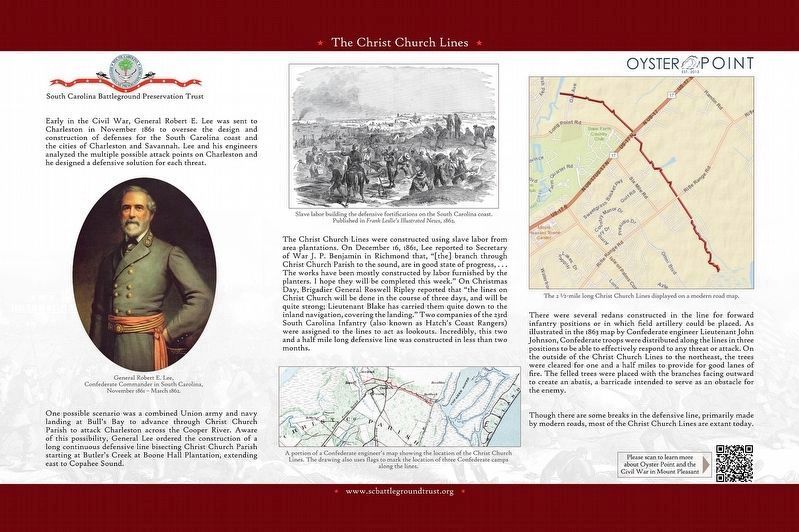
Early in the Civil War, General Robert E. Lee was sent to Charleston in November 1861 to oversee the design and construction of defenses for the South Carolina coast and the cities of Charleston and Savannah. Lee and his engineers analyzed the multiple possible attack points on Charleston and he designed a defensive solution for each threat.
One possible scenario was a combined Union army and navy landing at Bull's Bay to advance across the Cooper River. Aware of this possibility, General Lee ordered the construction of a long continuous defensive line bisecting Christ Church Parish starting at Butler's Creek at Boone Hall Plantation, extending east to Copahee Sound.
The Christ Church Lines were constructed using slave labor from area plantations. On December 16, 1861, Lee reported to Secretary of War J.P. Benjamin in Richmond that, “[the] branch through Christ Church Parish to the sound, are in good state of progress,... The works have been mostly constructed by labor furnished by the planters. I hope they will be completed this week.” On Christmas Day, Brigadier General Roswell Ripley reported that “the lines
this page online
There were several redans constructed in the line for forward infantry positions or in which field field artillery could be placed. As illustrated in the 1863 map by Confederate engineer Lieutenant John Johnson, Confederate troops were distributed along the lines in three positions to be able to effectively respond to any threat or attack. On the outside of the Christ Church Lines to the northeast, the trees were cleared for one and a half miles to provide for good lanes of fire. The felled trees were placed with the branches facing outward to create an abatis, a barricade intended to serve as an obstacle for the enemy.
Though there are some breaks in the defensive line, primarily made by modern roads, most of the Christ
Photographed by Thomas Moore, February 8, 2025
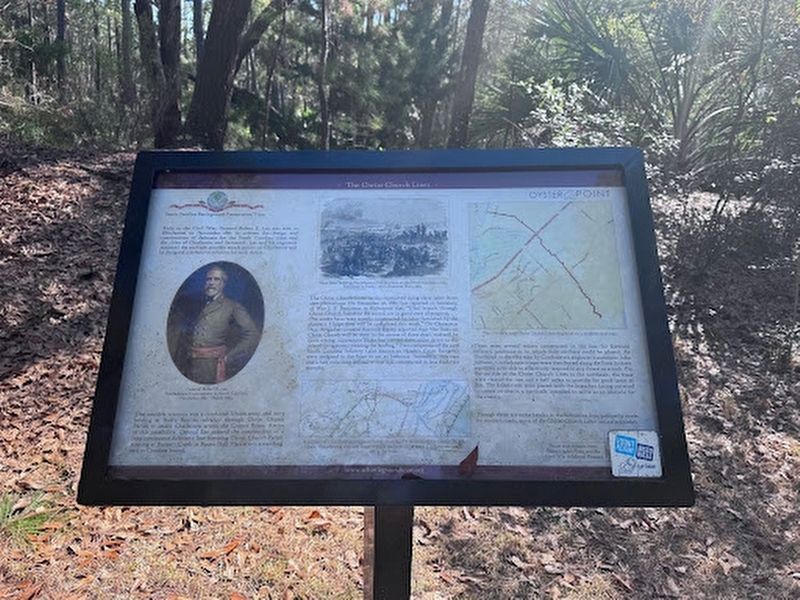
2. The Christ Church Lines Marker
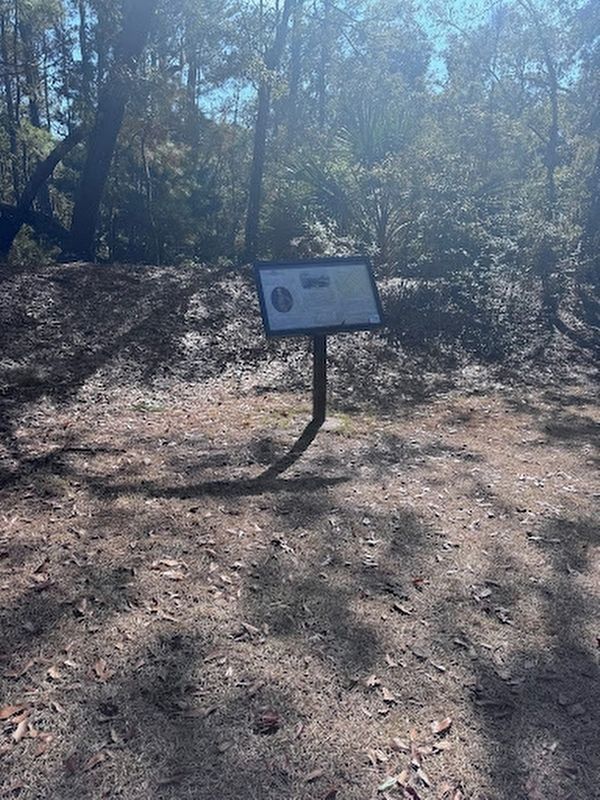
Marker on the Fort Palmetto Park Trail.
(captions)
General Robert E. Lee, Confederate Commander in South Carolina, November 1861 - March 1862.
Slave labor building the defensive fortifications on the South Carolina coast. Published in Frank Leslie's Illustrated News, 1862.
A portion of a Confederate engineer's map showing the location of the Christ Church Lines. The drawing also uses flags to mark the location of three Confederate camps along the lines.
The 2½-mile long Christ Church Lines displayed on a modern road map.
Erected by South Carolina Battleground Preservation Trust.
Topics. This historical marker is listed in this topic list: War, US Civil. A significant historical month for this entry is November 1861.
Location. 32° 49.484′ N, 79° 47.932′ W. Marker is in Mount Pleasant, South Carolina, in Charleston County. It can be reached from Fort Palmetto Circle south of Midden Drive, on the right when traveling north. Touch for map. Marker is in this post office area: Mount Pleasant SC 29466, United States of America. Touch for directions.

Regionally, this marker is in the Lowcountry. It is also in the American South, specifically
Photographed by Thomas Moore, February 8, 2025
3. The Christ Church Lines Marker
Other nearby markers. At least 8 other markers are within 2 miles of this marker, measured as the crow flies: Fort Palmetto (about 500 feet away, measured in a direct line); Defending the Inland Waterways (approx. 0.2 miles away); Christ Church Parish Line (approx. ¼ mile away); Early Site History (approx. 0.3 miles away); Seaside (approx. 1.1 miles away); Christ Church (approx. 1.6 miles away); Confederate Lines (approx. 1.6 miles away); a different marker also named Christ Church (approx. 1.6 miles away). Touch for a list and map of all markers in Mount Pleasant.
Another marker is no longer nearby. Cook's Old Field Cemetery / Copahee Plantation and Hamlin Beach (was approx. 1.2 miles away but has been confirmed missing).
Also see . . .
1. South Carolina Battleground Trust. (Submitted on February 14, 2025, by Thomas Moore of Charleston, South Carolina.)
2. Robert E. Lee.
Robert Edward Lee (January 19, 1807 – October 12, 1870) was a Confederate general during the American Civil War, who was appointed the overall commander of the Confederate States Army toward the end of the war.(Submitted on February 14, 2025, by Thomas Moore of Charleston, South Carolina.)
Credits. This page was last revised on July 20, 2025. It was originally submitted on February 14, 2025, by Thomas Moore of Charleston, South Carolina. This page has been viewed 258 times since then and 43 times this year. Photos: 1. submitted on February 21, 2025. 2, 3. submitted on February 14, 2025, by Thomas Moore of Charleston, South Carolina. • Bernard Fisher was the editor who published this page.
