Old Bend in Deschutes County, Oregon — The American West (Northwest)
Horses and High Wheels

Photographed by Douglass Halvorsen, May 27, 2024
1. Horses and High Wheels Marker
Photo caption 1
Use your imagination for a moment and step back in time. From 1916 to 1929, the nearby forest was bustling with more than 200 “high wheel” log skidders. Each was pulled by four draft horses - big, heavy animals well-trained in logging. Over rough ground and logging slash, these gentle giants hauled their heavy loads year round.
Photo caption 2
Moving big logs over rugged terrain made early logging difficult and challenging. Trees had to be felled, moved by high wheels about a quarter mile to landings, and loaded into railroad cars headed for the mill.
Trees were felled and cut into 16’ lengths with crosscut saws. Each team of horses hauled one to three logs, whatever could fit underneath the wheels.
Photo caption 3
Using one or two horses, a “buncherman” would pile the logs into tight stacks. Then, using a small shovel, it was the job of the “gopherman” to dig a tunnel underneath the logs for the chain that was wrapped around the logs and attached to the high wheel.
Photo caption 4
The cleverness
this page online
Photo caption 5
In 1929, diesel replaced hay. Able to pull twice as much weight, diesel tractors usurped the horses and an era passed. The photo above shows how the wheels were reinforced with steel to brace them for heavier loads
These 11-foot high wheels weigh 1,500 pounds each and are constructed of white oak spokes and eucalyptus axles. Eucalyptus is naturally oily and lubricates the wheels.
Photo caption 6
Listen to them now, as they squeak and groan under the weight of their heavy loads. Smell the fresh cut ponderosa pine; the scent of sagebrush mixed with dust. Hear the horses as they snort and blow and their huge, steel shod hooves clink against the lava, while strong, sweating men chip away at bark and heartwood with axe and crosscut saw until
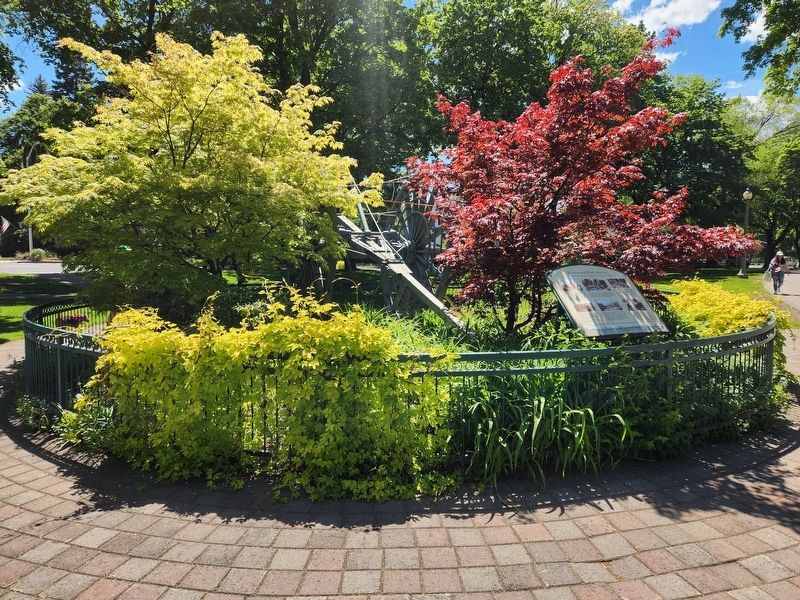
Photographed by Douglass Halvorsen, May 27, 2024
2. Horses and High Wheels Marker
The horse drawn high wheel before you can was witness to these sights and sounds of early logging near Bend.
Erected by Cascade Heritage Foundation and the Samuel S. Johnson Foundation.
Topics. This historical marker is listed in these topic lists: Horticulture & Forestry • Industry & Commerce • Roads & Vehicles.
Location. 44° 3.542′ N, 121° 19.092′ W. Marker is in Bend, Oregon, in Deschutes County. It is in Old Bend. It can be reached from Northwest Riverside Boulevard. Touch for map. Marker is at or near this postal address: 888 NW Riverside Blvd, Bend OR 97703, United States of America. Touch for directions.

Regionally, this marker is in Oregon’s High Desert. It is also in the American Mountain West and in the Lewis & Clark Corridor. Globally, it is in North America, in the Cascade Range, on the Ring of Fire, in the Pacific Rim, in the Western Hemisphere, in the Western World, and in the Anglosphere.
Other nearby markers. At least 8 other markers are within walking distance of this marker: Bend School Landmark (here, next to this marker); Frank T. Johns (within shouting distance of this marker); Klondike Kate (within shouting distance of this marker); Frank T. Johns Landmark (within shouting distance of this marker); Pioneer Homesite (about 400 feet away, measured in a direct line); Clyde McKay Landmark (about 400 feet away); Founding of Bend (about 700 feet away); A.M. Drake Homesite (about 800 feet away). Touch for a list and map of all markers in Bend.
Credits. This page was last revised on February 18, 2025. It was originally submitted on February 17, 2025, by Douglass Halvorsen of Klamath Falls, Oregon. This page has been viewed 192 times since then and 46 times this year. Photos: 1, 2. submitted on February 17, 2025, by Douglass Halvorsen of Klamath Falls, Oregon. • James Hulse was the editor who published this page.
