Downtown in Jacksonville in Duval County, Florida — The American South (South Atlantic)
Jacksonville's Favorite Oak (Quercus virginiana)
Jesse Ball Dupont Park

Photographed by Tracy Andersen Roberts
1. Jacksonville's Favorite Oak Marker
This beloved tree is a field specimen Southern Live Oak, best known for its size, age and legendary past. Over 70 feet tall, with a 25-foot trunk circumference, the so-called Treaty Oak is at least two centuries old.
In the early 1900s, Giant Oak, as it was called then, was often festooned with electric lights. As the main attraction of Dixieland Amusement Park, where Babe Ruth once played baseball and John Phillip Sousa gave a concert, it provided shady picnic grounds for families and a backdrop for the silent films that were produced nearby in 1910.
Although the bright lights, the music, and the glamour of the movies faded away at the end of World War I, the tree and this site remained dear to the people of Jacksonville.
Treaty Oak was given its popular name by a journalist who was intent on saving it from developers. Even though it was not true, the reporter wrote a newspaper story that claimed a treaty had been signed by Indians and early settlers beneath the tree's bountiful limbs.
The fate of Jacksonville's favorite oak was secured not by fiction but by dedication and generosity. "Treaty Oak" still
this page online
In 1964 at the request of the Garden Club, Jessie Ball duPont, a longtime member of the Garden Club's Early Settler's Circle, bought the remaining seven lots surrounding Treaty Oak. She gave this land to the City for the use only as a public park, preventing construction of future buildings or other development.
Originally called Treaty Oak Park, this site was renamed Jessie Ball duPont Park in recognition of her generous spirit and abiding love of nature.
That spirit and love will be kept alive here through the deep appreciation of all who enjoy the natural beauty she helped preserve for generations to come.
Topics and series. This historical marker is listed in these topic lists: Entertainment • Horticulture & Forestry • Parks & Recreational Areas. In addition, it is included in the Historic Trees series list. A significant historical year for this entry is 1910.
Location. 30° 19.013′ N, 81° 39.489′ W. Marker is in

Photographed by Tracy Andersen Roberts
2. Jacksonville's Favorite Oak Marker
Marker is located just to the left of the tree as shown.

Regionally, this marker is in Florida’s First Coast. It is also in the American South and on the Eastern Seaboard. Globally, it is in the North Atlantic Region, North America, a Gulf of Mexico state, the Western Hemisphere, the Western World, and the Anglosphere. Historically, it finds itself in what was once New Spain, the territory of the Mississippian Culture, one of the Confederate States of America, and the Antebellum South.
Other nearby markers. At least 8 other markers are within walking distance of this marker: Jessie Ball DuPont Park (a few steps from this marker); Treaty Oak Conservation Project Dedication (within shouting distance of this marker); Soldiers of the American Revolution Associated with Jacksonville’s History (approx. ¼ mile away); Historic King's Road British East Florida
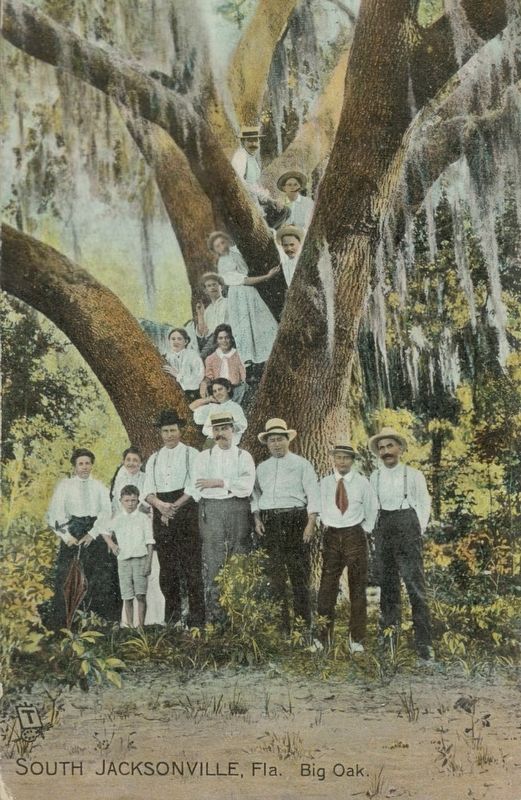
Raphael Tuck & Sons (courtesy of the Jacksonville (Fla.) Public Library), circa 1907
3. Big Oak
Written on the back: “Located about two blocks from the river on land belonging to the Dixieland Park Company, stands this famous old oak. Fastened to the tree is a tablet bearing these words: "The oldest and largest tree in Florida, 160 feet across under the braches. At noon it shades a space 190 feet in diameter. Students of forestry say it is over 400 years old. Body of the tree is over 9 feet in circumference. It was Osceola's favorite camp ground, and was generally used for Indian councils of war."
Other markers no longer nearby. The St. Johns (was approx. ¼ mile away but has been confirmed missing); Duval County Vietnam Memorial and Veterans Eternal Flame (was approx. 0.6 miles away but has been permanently removed); The Beginning (was approx. 0.6 miles away but has been permanently removed).
Also see . . . Treaty Oak (Jacksonville) - Wikipedia entry. Includes many hyperlinks, references, and external links.
The Treaty Oak is an octopus-like Southern live oak (Quercus virginiana) in Jacksonville, Florida. The tree is estimated to be 250 years old and may be the single oldest living thing in Jacksonville, predating the founding of the city by Isaiah Hart during the 1820s. It is located in Treaty Oak Park in the Southbank area of Downtown Jacksonville.(Submitted on February 17, 2025, by Tracy Andersen Roberts of Atlanta, Georgia.)
Credits. This page was last revised on June 30, 2025. It was originally submitted on February 17, 2025, by Tracy Andersen Roberts of Atlanta, Georgia. This page has been viewed 339 times since then and 83 times this year. Photos: 1, 2. submitted on February 17, 2025, by Tracy Andersen Roberts of Atlanta, Georgia. 3. submitted on February 19, 2025. • Andrew Ruppenstein was the editor who published this page.
