
Rione IX Pigna in Roma in Città metropolitana di Roma Capitale, Latium, Rome, Italy — Central Italy (Tyrrhenian Coast)
Il Campo Marzio
⎯⎯⎯
Campus Martius

Photographed by James Hulse, February 28, 2024
1. Il Campo Marzio / Campus Martius Marker (left side of the marker)

L'area su cui insistono i templi di largo Argentina si trova nella zona centrale del Campo Marzio, una vasta pianura posta subito al di fuori delle Mura Serviane e del pomerium (limite sacro della città antica), compresa tra il Tevere e le pendici del Quirinale e del Campidoglio. Appartenuta ai Tarquini e poi divenuta pubblica dopo la loro cacciata, era tradizionalmente destinata alle esercitazioni militari.
Questo utilizzo, certamente connesso alla sua posizione marginale rispetto al centro della città, è sostenuto anche dal mito che identificava il Campo Marzio con il luogo in cui Romolo, proprio durante un'esercitazione militare, fu chiamato a far parte del consesso degli dei come Quirino. Qui viene inoltre ricordata la presenza di un antico santuario di Marte, dio della guerra, da cui deriva il nome.
Nel corso dell'età repubblicana divenne il luogo deputato alle operazioni di voto per le magistrature. Per questo scopo furono edificati i Saepta, un'enorme piazza destinata alle assemblee, collegata con portici e altri edifici a formare un enorme complesso il cui orientamento Nord-Sud ha condizionato lo sviluppo successivo dell'area.
Le più importanti famiglie dell'aristocrazia senatoria favorirono l'espansione urbanistica del Campo Marzio, promuovendo la costruzione di numerosi edifici pubblici e di culto, tra cui i templi A, B, C e D dell'area sacra.
Un momento cruciale nello sviluppo della zona è rappresentato dalla costruzione da parte di Pompeo del gigantesco impianto del teatro, che da lui prenderà il nome, e del monumentale portico quadrangolare, il cui muro di recinzione costituiva il limite occidentale dell'area sacra di largo Argentina.
L'ultima realizzazione di un membro dell'aristocrazia estraneo alla famiglia imperiale è rappresentata dal teatro di Balbo, inaugurato nel 13 a.C.
Il processo di urbanizzazione si intensificò nei primi anni dell'impero, soprattutto per volontà di Augusto: i suoi numerosi interventi monumentali - l'edificazione del teatro di Marcello e del Pantheon, solo per citare i monumenti più noti - ridisegnarono completamente l'assetto del Campo Marzio culminando con la costruzione del mausoleo, il maestoso sepolcro destinato ai membri della gens Giulia.
Didascalie
(Foto #1) II Campo Marzio nella suddivisione augustea dell'Urbe in quattordici regioni (rielaborazione da Le chiavi di Roma. La città di Augusto, catalogo della mostra, Roma 2014)
(Foto #2) Il Campo Marzio centrale in età imperiale (rielaborazione da Atlante di Roma Antica 2012. Disegno Inklink)
(Foto #3) Il Campo Marzio. Nel riquadro è evidenziata l'area sacra di Largo Argentina (rielaborazione da Augusto, catalogo della mostra, Roma 2013)
The temples of Largo Argentina are located in the centre of Campus Martius, a vast plain situated just outside the Servian Walls and the pomerium (the ancient city's sacred boundary), between the Tiber and the slopes of the Quirinal and Capitoline hills. The area originally belonged to the Tarquinii and then became public after their expulsion. It was usually destined for military exercises, undoubtedly because it was on the outskirts of the city, a fact supported by the myth that identified Campus Martius with the place where Romulus, precisely during a military exercise, was called on to join the assembly of gods as Quirinus. There is also the ancient temple of Mars, God of war, in the area, after whom it was named.
During the Roman Republic it was where the elections for the magistrates were held. They built a large square for the voters, called the Saepta, which was connected to arcades and other buildings, forming a huge complex whose North-South orientation conditioned the subsequent development of the area. The most important families of the senatorial aristocracy favoured the urban expansion of Campus Martius, promoting the construction of numerous public buildings and places of worship, including temples A, B, C and D in the sacred area.
A crucial moment in the area's development was the construction of the monumental quadrangular portico, whose surrounding wall formed the western boundary of the sacred area of Largo Argentina, and a huge theatre complex, both built by Pompey and the latter of which took his name. The last building to be built by a member of the aristocracy outside the imperial family, was the Theatre of Balbus, inaugurated in 13 BC. Urbanization intensified in the early years of the Roman Empire, particularly under Augustus: his numerous monumental interventions - the Theatre of Marcellus and the Pantheon, just to mention two of the most well-known monuments - completely changed the layout of Campus Martius, culminating in the construction of the mausoleum, the majestic tomb intended for members of the gens Giulia.
Captions
(Photo #1) Campus Martius in the Augustan subdivision of the city into fourteen regions (reworking from Le chiavi di Roma. La città di Augusto, exhibition catalogue, Rome 2014)
(Photo #2) Central Campus Martius during the Imperial age (reworking from Atlante di Roma Antica 2012. Illustration Inklink)
(Photo #3) Campus Martius. The Sacred Area of Largo Argentina is highlighted in the box (reworking from Augusto, exhibition catalogue, Rome 2013)
Erected by City
this page online
Topics. This historical marker is listed in this topic list: Anthropology & Archaeology. A significant historical year for this entry is 2012.
Location. 41° 53.725′ N, 12° 28.626′ E. Marker is in Roma, Lazio (Latium, Rome), in Città metropolitana di Roma Capitale. It is in Rione IX Pigna. It is at the intersection of Via di San Nicola de' Cesarini and Largo di Torre Argentina, on the left when traveling north on Via di San Nicola de' Cesarini. The marker is located in the Largo di Torre Argentina archeological site. Touch for map. Marker is at or near this postal address: Via di S Nicola de' Cesarini 8, Roma, Lazio 00186, Italy. Touch for directions.

Regionally, it is in Europe, the European Union, the Schengen Area, a coastal Mediterranean country, and the Western World. Historically, it finds itself in what was once the Byzantine Empire and specifically also the Roman Empire.
Other nearby markers. At least 8 other markers are within walking distance of this marker: Il Tempio B / Temple B (here, next to this marker); Inquadramento Topografico / Topographical Overview (here, next to this marker);

Photographed by James Hulse, February 28, 2024
2. Il Campo Marzio / Campus Martius Marker (right side of the marker)
More about this marker. There is a small entry fee to visit the Largo di Torre Argentina archeological site.
Also see . . . Capitoline Superintendency for Cultural Heritage. (Submitted on February 20, 2025, by James Hulse of Medina, Texas.)
Photographed by James Hulse, February 28, 2024
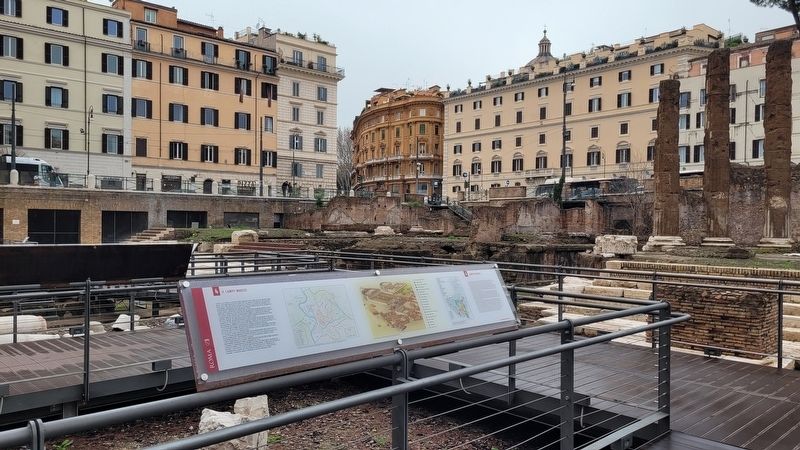
3. The view of the Campus Martius Marker in the Largo Argentina

Photographed by James Hulse, February 26, 2024
4. The view of the Largo Argentina from the street level
The marker is located at the far left side of the photo.
Credits. This page was last revised on February 20, 2025. It was originally submitted on February 19, 2025, by James Hulse of Medina, Texas. This page has been viewed 116 times since then and 18 times this year. Photos: 1, 2, 3, 4. submitted on February 20, 2025, by James Hulse of Medina, Texas.
