
Rione IX Pigna in Roma in Città metropolitana di Roma Capitale, Latium, Rome, Italy — Central Italy (Tyrrhenian Coast)
Inquadramento Topografico
⎯⎯⎯
Topographical Overview
Photographed by James Hulse, February 28, 2024
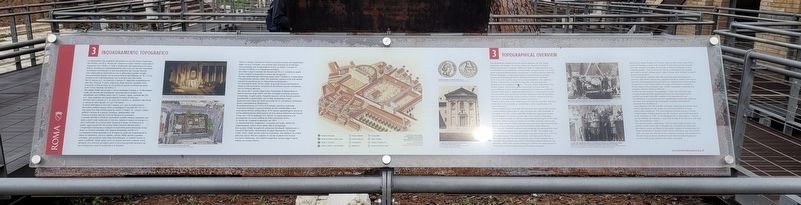
1. Inquadramento Topografico / Topographical Overview Marker

Le demolizioni del quartiere compreso tra via del Teatro Argentina, via Florida, via di S. Nicola de' Cesarini e corso Vittorio Emanuele II, compiute tra il 1926 e il 1929 e finalizzate alla costruzione di nuovi edifici, riportarono inaspettatamente alla luce uno dei più importanti complessi archeologici di età repubblicana del Campo Marzio: una vasta piazza lastricata su cui si affacciano quattro templi comunemente distinti con le prime lettere dell'alfabeto (A, B, C e D), poiché la loro identificazione non è ancora del tutto certa.
Nel III secolo a.C. fu costruito il tempio C, dedicato probabilmente alla dea Feronia. Il culto, originario della Sabina, sarebbe stato introdotto a Roma dopo la conquista di questo territorio da parte di M. Curio Dentato nel 290 a.C.
Allo stesso livello del tempio C venne innalzato il tempio A. Di dimensioni molto più piccole del precedente, secondo alcuni studiosi è da identificare con l'edificio sacro che C. Lutazio Catulo, console del 242 a.C., fece costruire nel Campo Marzio in onore di Giuturna.
All'inizio del II secolo a. C. fu costruito il tempio D, dedicato alle Ninfe o, secondo altre ipotesi, ai Lari Permarini. Si deve attendere la fine del II secolo a.C. per la realizzazione dell'ultimo edificio sacro: dopo la battaglia di Vercelli del 101 a.C., che pose fine alla terribile guerra contro i Cimbri, Q. Lutazio Catulo edificò il tempio B a pianta circolare, dedicandolo alla Fortuna huiusce diei (la Fortuna del giorno presente).
A questa divinità si riferisce il grandioso acrolito (statua colossale con testa e parti nude realizzate in marmo, mentre il resto è in bronzo on altro materiale) di cui sono stati rinvenuti la testa, un braccio e un piede, oggi conservati nel museo della Centrale Montemartini. L'imperatore Domiziano restaurò e trasformò profondamente l'area dopo un furioso incendio che l'aveva devastata nell'80 d.C. Le macerie furono spianate e al di sopra fu costruito il pavimento in lastre di travertino, ancora visibile. Venne rifatto anche il portico orientale, già presente nella fase repubblicana, e i templi furono in parte modificati. Negli spazi vuoti tra questi vennero costruiti nuovi ambienti che unirono gli edifici sacri in un'unica grande struttura da cui emergevano solo le scalinate e le facciate.
Dietro il tempio rotondo di Fortuna si conserva parte del basamento della Curia di Pompeo, una grande sala annessa al complesso monumentale che comprendeva anche un teatro, il tempio di Venere Vincitrice e un maestoso porticato. Qui ebbe luogo la seduta del Senato del 44 a.C. durante la quale Giulio Cesare fu pugnalato a morte dai congiurati.
Sul lato settentrionale dell'area sacra, oltre il tempio A, si estendeva l'Hecatostylon (portico delle 100 colonne), mentre a Est una strada coperta la separava da un imponente quadriportico. Un frammento della Forma Urbis, la grande pianta marmorea di Roma di età severiana, consente di identificare questo complesso con la Porticus Minucia.
Nel corso del V secolo ebbe inizio il processo di abbandono e trasformazione degli edifici che fino a questo momento avevano conservato, in gran parte, l'aspetto assunto con la ristrutturazione domizianea. In particolare, per la fase tardoantica si può ipotizzare che l'area sia stata occupata da un complesso monastico, forse il monasterium Boetianum.
Successivamente, tra I'VIII e il IX secolo, vennero realizzate imponenti strutture in grandi blocchi di tufo riconducibili a una importante dimora aristocratica. Al IX secolo appartengono anche le prime testimonianze dell'impianto di una chiesa all'interno del tempio A che nel 1132 fu dedicata a S. Nicola. In epoca barocca vi si sovrappose un nuovo edificio di culto conosciuto come S. Nicola de' Cesarini e demolito nel 1927.
La denominazione "Argentina", acquisita dal luogo, deriva da Argentoratum, antico nome della città di Strasburgo. Era questa, infatti, la patria di Johannes Burckardt, italianizzato in Giovanni Burcardo, cerimoniere di papa Alessandro VI Borgia (1492-1503), detto anche vescovo Argentino, che abitava nei pressi dell'area sacra. Nel suo palazzo in via del Sudario era inclusa una torre medievale, che chiamò Argentina, ancora oggi in parte visibile nel cortile interno.
Didascalie
(Foto #1) Jean-Léon Gérôme, La morte di Cesare, Baltimora, The Walters Art Museum
(Foto #2) Foto aerea dell'area sacra di largo Argentina, ©DAI Berlin
(Foto #3) Ritrovamento della testa colossale di Fortuna, 1929, ©Sovrintendenza Capitolina
(Foto #4) 21 aprile 1929: inaugurazione dell'area archeologica alla presenza di B. Mussolini con A. Muñoz, direttore della X Ripartizione del Governatorato, ©Archivio Storico Istituto Luce Cinecittà
The demolitions carried out in the district between Via del Teatro Argentina, Via Florida, Via di San Nicola de' Cesarini and Corso Vittorio Emanuele II, between 1926 and 1929, to make space for the construction of new buildings, unexpectedly brought to light one of the most important archaeological complexes in Campus Martius from the Roman Republic: a large paved square overlooking four temples, commonly distinguished by the first four letters of the alphabet (A, B, C and D), as they have not yet been identified with certainty. Temple C was built in the 3rd century BC, and was probably dedicated to the goddess Feronia. The cult, which originated in the Sabina region, would have been introduced to Rome after the consul Manius Curius Dentatus conquered the Sabines in 290 BC. Temple A was built in alignment with temple C. It was much smaller than the latter and, according to some scholars, it can be identified with the sacred building Gaius Lutatius Catulus, consul in 242 BC, had built in Campus Martius in honour of Juturna. Temple D was built at the beginning of the 2nd century BC, and was dedicated to the Nymphs or, according to other hypotheses, the Lares Permarini.
The last temple wasn't built until the end of the 2nd century BC: Quintus Lutatius Catulus built temple B, with a circular plan, after the Battle of Vercellae in 101 BC, which ended the terrible war against the Cimbri, and dedicated it to Fortuna huiusce diei (The Fortune of This Day). The grandiose acrolith (a colossal statue with the bare parts of the body in marble, while the rest is in bronze or another material) refers to the female deity: only the head, one arm and a foot have been found of this statue, today on display in the Centrale Montemartini Museum. The emperor Domitian restored and drastically transformed the area after it was destroyed by a raging fire in AD 80. The rubble was levelled and a floor in travertine slabs was laid on top of it, which is still visible today. The eastern portico, built during the Roman Republic, was also rebuilt, and some parts of the temples were modified. New rooms were built in the empty spaces between the temples, uniting the sacred buildings to create one large structure, from which only the staircases and facades emerged.
Behind the round Temple of Fortuna, there is part of the base of the Curia of Pompey, a large hall annexed to the monumental complex that also housed a theatre, the temple of Venus Victorious, and a majestic portico. This is where the famous meeting of the Senate was held in 44 BC, during which Julius Caesar was stabbed to death by the conspirators.
The Hecatostylon (portico with 100 columns) extended along the northem side of the sacred area, beyond temple A, while to the east a covered road separated the area from an imposing four-sided portico. A fragment of the Forma Urbis, the huge marble plan of Ancient Rome made in the Severian age, makes it possible to identify this complex with the Porticus Minucia.
During the 5th century, the buildings - which up until then had mostly preserved their appearance from the renovation works carried out under Domitian, started to be abandoned and transformed. In particular, we can hypothesize that in late antiquity the area was occupied by a monastic complex, perhaps the monasterium Boetianum.
Later, between the 8th and 9th centuries, imposing structures were built in big blocks of tuff, which can be traced back to a large aristocratic residence. The first evidence of there being a church inside temple A dates back to the 9th century, and it was dedicated to St. Nicholas in 1132. In the Baroque era, a new church - known as San Nicola de' Cesarini - was built on top of the old one, and was then demolished in 1927.
The place's name, "Argentina", derives from Argentoratum, the ancient name of the city of Strasbourg, homeland of Johannes Burckardt, known as Giovanni Burcardo, master of ceremonies for Pope Alexander VI Borgia (1492-1503), who lived near the sacred area. He was also known as the Argentine bishop. His residence in Via del Sudario had a medieval tower that he called Argentina, which is still partly visible in the inner courtyard.
Captions
(Photo #1) Jean-Léon Gérôme, The death of Caesar, Baltimore, The Walters Art Museum
(Photo #2) Aerial photo of the Sacred Area in Largo Argentina, ©DAI Berlin
(Photo #3) Finding of the colossal Fortuna's head, 1929, ©Sovrintendenza Capitolina
(Photo #4) April, 21st, 1929: inauguration of the archaeological site in the presence of B. Mussolini with A. Muñoz, director of the Governorate's X Division, ©Archivio Storico Istituto Luce Cinecittà
Erected by City
this page online
Topics. This historical marker is listed in this topic list: Anthropology & Archaeology. A significant historical year for this entry is 1926.
Location. 41° 53.722′ N, 12° 28.626′ E. Marker is in Roma, Lazio (Latium, Rome), in Città metropolitana di Roma Capitale. It is in Rione IX Pigna. It is at the intersection of Via di San Nicola de' Cesarini and Largo di Torre Argentina on Via di San Nicola de' Cesarini. The marker is located in the Largo di Torre Argentina archeological site. Touch for map. Marker is at or near this postal address: Via di S Nicola de' Cesarini 11, Roma, Lazio 00186, Italy. Touch for directions.

Regionally, it is in Europe, the European Union, the Schengen Area, a coastal Mediterranean country, and the Western World. Historically, it finds itself in what was once the Byzantine Empire and specifically also the Roman Empire.
Other nearby markers. At least 8 other markers are within walking distance of this marker: Il Campo Marzio / Campus Martius (here, next to this marker); Il Tempio B / Temple B (a few steps from this marker); La Curia Di Pompeo / The Curia of Pompey (a few
Photographed by James Hulse, February 28, 2024
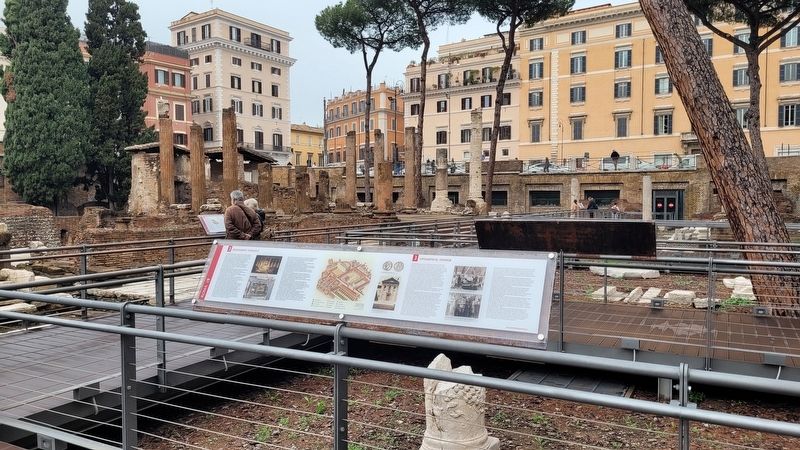
2. The view of the Topographical Overview Marker in the Largo Argentina
More about this marker. There is a small entry fee to visit the Largo di Torre Argentina archeological site.
Also see . . . Capitoline Superintendency for Cultural Heritage. (Submitted on February 20, 2025, by James Hulse of Medina, Texas.)

Photographed by James Hulse, February 28, 2024
3. The view of the marker is the archeological site

Photographed by James Hulse, February 28, 2024
4. The view of Temple B in the Largo Argentina
Credits. This page was last revised on February 20, 2025. It was originally submitted on February 19, 2025, by James Hulse of Medina, Texas. This page has been viewed 100 times since then and 5 times this year. Photos: 1, 2, 3, 4. submitted on February 20, 2025, by James Hulse of Medina, Texas.
