
Rione IX Pigna in Roma in Città metropolitana di Roma Capitale, Latium, Rome, Italy — Central Italy (Tyrrhenian Coast)
Il Tempio B
⎯⎯⎯
Temple B
Photographed by James Hulse, February 28, 2024
1. Il Tempio B / Temple B Marker

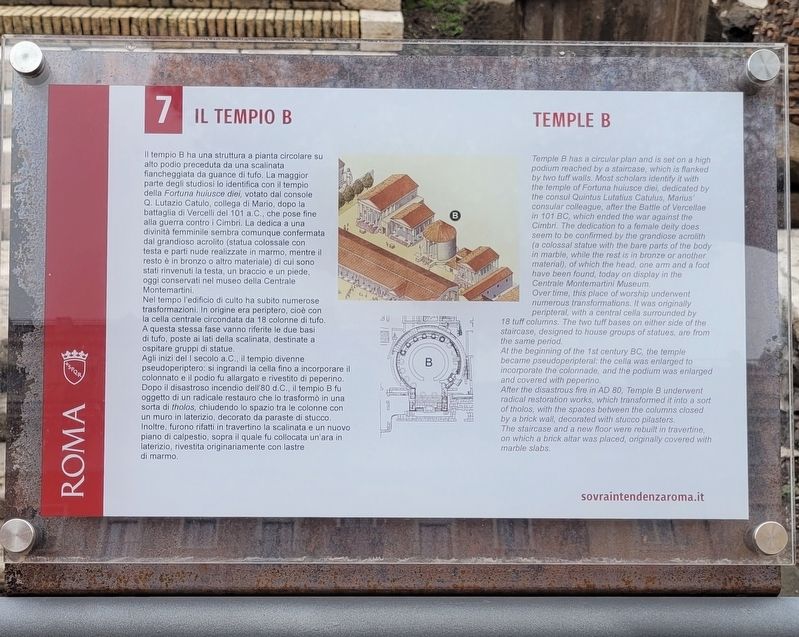
Il tempio B ha una struttura a pianta circolare su alto podio preceduta da una scalinata fiancheggiata da guance di tufo. La maggior parte degli studiosi lo identifica con il tempio della Fortuna huiusce diei, votato dal console Q. Lutazio Catulo, collega di Mario, dopo la battaglia di Vercelli del 101 a.C., che pose fine alla guerra contro i Cimbri. La dedica a una divinità femminile sembra comunque confermata dal grandioso acrolito (statua colossale con testa e parti nude realizzate in marmo, mentre il resto è in bronzo o altro materiale) di cui sono stati rinvenuti la testa, un braccio e un piede, oggi conservati nel museo della Centrale Montemartini.
Nel tempo l'edificio di culto ha subito numerose trasformazioni. In origine era periptero, cioè con la cella centrale circondata da 18 colonne di tufo. A questa stessa fase vanno riferite le due basi di tufo, poste ai lati della scalinata, destinate a ospitare gruppi di statue.
Agli inizi del I secolo a.C., il tempio divenne pseudoperiptero: si ingrandi la cella fino a incorporare il colonnato e il podio fu allargato e rivestito di peperino. Dopo
this page online
Temple B has a circular plan and is set on a high podium reached by a staircase, which is flanked by two tuff walls. Most scholars identify it with the temple of Fortuna huiusce diei, dedicated by the consul Quintus Lutatius Catulus, Marius' consular colleague, after the Battle of Vercellae in 101 BC, which ended the war against the Cimbri. The dedication to a female deity does seem to be confirmed by the grandiose acrolith (a colossal statue with the bare parts of the body in marble, while the rest is in bronze or another material), of which the head, one arm and a foot have been found, today on display in the Centrale Montemartini Museum.
Over time, this place of worship underwent numerous transformations. It was originally
Photographed by James Hulse, February 28, 2024
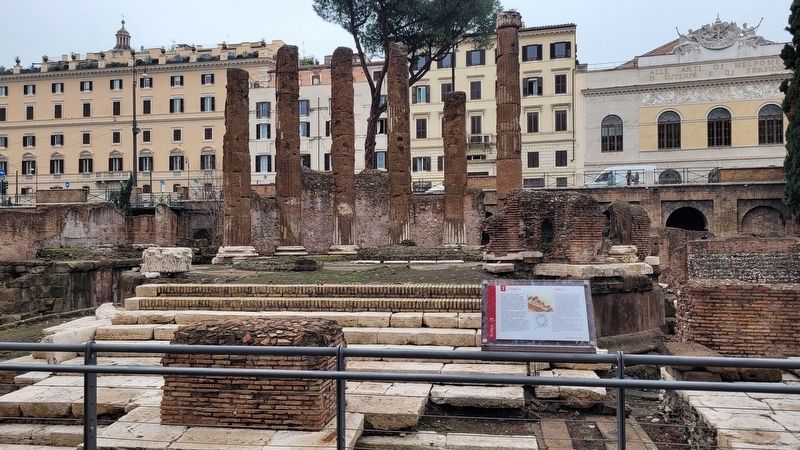
2. Temple B and Marker
At the beginning of the 1st century BC, the temple became pseudoperipteral: the cella was enlarged to incorporate the colonnade, and the podium was enlarged and covered with peperino.
After the disastrous fire in AD 80, Temple B underwent radical restoration works, which transformed it into a sort of tholos, with the spaces between the columns closed by a brick wall, decorated with stucco pilasters. The staircase and a new floor were rebuilt in travertine, on which a brick altar was placed, originally covered with marble slabs.
Erected by City of Rome. (Marker Number 7.)
Topics. This historical marker is listed in this topic list: Anthropology & Archaeology. A significant historical year for this entry is 101 CE.
Location. 41° 53.725′ N, 12° 28.623′ E. Marker is in Roma, Lazio (Latium, Rome), in Città metropolitana di Roma Capitale. It is in Rione IX Pigna. It is at the intersection of Via di S. Nicola de' Cesarini and Largo di Torre Argentina on Via
Photographed by James Hulse, February 26, 2024
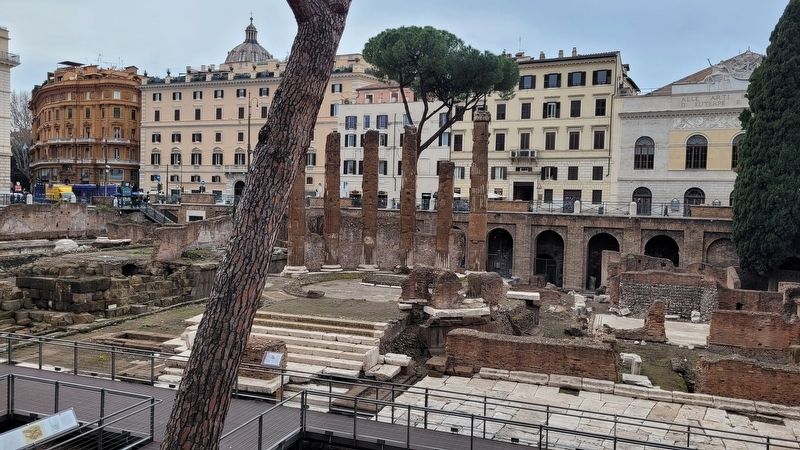
3. The view of Temple B from the street level

Regionally, it is in Europe, the European Union, the Schengen Area, a coastal Mediterranean country, and the Western World. Historically, it finds itself in what was once the Roman Empire.
Other nearby markers. At least 8 other markers are within walking distance of this marker: Il Campo Marzio / Campus Martius (here, next to this marker); Inquadramento Topografico / Topographical Overview (a few steps from this marker); La Curia Di Pompeo / The Curia of Pompey (within shouting distance of this marker); Le Demolizioni e lo Scavo / Demolitions and Excavations (within shouting distance of this marker); Il Tempio A / Temple A (within shouting distance of this marker); La Chiesa Di S. Nicola De' Calcarario Poi De' Cesarini (within shouting distance of this marker); Il Tempio C / Temple C (within shouting distance of this marker); Il Tempio D / Temple D (within shouting distance of this marker). Touch for a list and map
Photographed by James Hulse, February 28, 2024
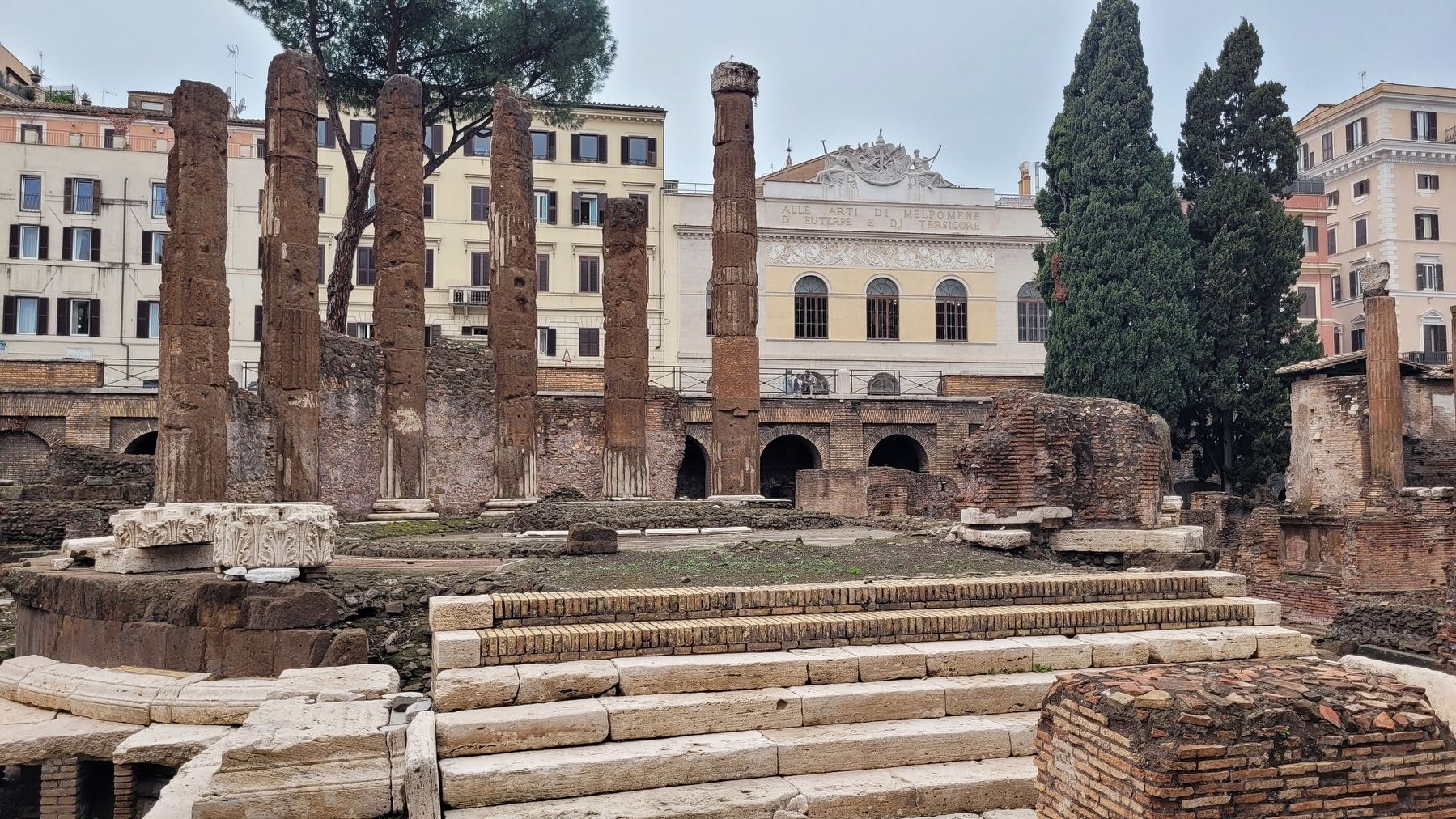
4. Il Tempio B / Temple B Marker
More about this marker. There is a small entry fee to visit the Largo di Torre Argentina archeological site.
Also see . . . Capitoline Superintendency for Cultural Heritage. (Submitted on February 20, 2025, by James Hulse of Medina, Texas.)
Credits. This page was last revised on February 22, 2025. It was originally submitted on February 19, 2025, by James Hulse of Medina, Texas. This page has been viewed 115 times since then and 14 times this year. Photos: 1, 2, 3, 4. submitted on February 22, 2025, by James Hulse of Medina, Texas.
